Introduction
Most drilling problems don't start at the cutting edge. They start at the shank, the part nobody thinks about until it slips, cracks, or chews up an expensive chuck.
Get the shank wrong, and you're looking at broken bits, damaged drive systems, and a rig sitting idle while someone drives to the supply house. That's lost time on a construction site, a mining operation, or an HDD bore that was supposed to wrap up by lunch.
Here's a number worth remembering: just 0.0001 inch of runout can shift tool life by 10%. According to BIG DAISHOWA's tooling data, cutting runout down from 0.0005 to 0.0001 inch can boost tool life by 40%.
Fit matters more than most operators realize.
This guide breaks down the shank types you'll encounter, what actually determines a good fit, and how to pick the right one before it costs you a job.
Key Takeaways
- The shank, not the cutting head, determines how much torque or impact your bit can handle
- Round, hex, SDS-Plus/Max, threaded, Morse taper, and DTH spline shanks each suit different equipment and loads
- Equipment type, torque needs, formation hardness, and duty cycle should drive your shank choice
- Custom-engineered connections beat generic adapters for heavy-duty, continuous-use applications
What is a Drill Bit Shank?
The shank is the end of a drill bit gripped by the chuck, collet, or rig head. It's the part responsible for transmitting rotational force, impact force, or both, from the drive system to the cutting edge.
Get this connection wrong and none of the bit's cutting performance matters. This guide covers the major shank families you'll run into across construction, HDD, mining, and rock drilling:
- Round/straight shanks
- Hex shanks
- SDS-Plus and SDS-Max (keyed/splined)
- Threaded connections (API, proprietary rig threads)
- Morse taper shanks
- DTH spline patterns (DHD, QL, COP, and similar)
Core Components of a Drill Bit Shank
Three functional elements determine whether a shank performs or fails under load.
Shank diameter and size dictates direct compatibility with a specific chuck, collet, or coupling. There's no substitute here, only an adapter, and adapters introduce their own limitations (more on that below).
Shank geometry is the cross-section shape: round, hexagonal, splined, or slotted. This geometry sets the ceiling on how much torque transfers before the bit starts slipping in the holder. A round shank relies purely on friction. A hex or splined shank locks mechanically, which is why it holds up better under sustained torque.
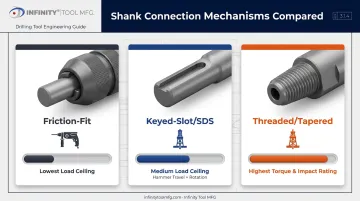
Connection and locking mechanism separates three basic approaches:
- Friction-fit (round shanks clamped by a chuck)
- Keyed-slot systems like SDS, which allow axial hammer travel while still transferring rotation through wedge grooves
- Threaded or tapered connections, which use mated pin-and-box threads or a tapered seat for both retention and load transfer
Each mechanism has a different axial load ceiling. Threaded connections generally handle the highest combined torque and impact loads, which is why you'll find them on rotary blasthole rigs and HDD drill strings rather than on a compact rotary hammer.
Why Correct Shank Selection Matters
These connection mechanisms explain why matching the shank to the equipment isn't a nice-to-have. The choice shows up directly in operating costs:
- Reduces unplanned downtime from slippage or bit ejection
- Extends bit and chuck life by reducing wear from mismatched friction points
- Maintains consistent penetration rates across a shift
- Improves safety during high-torque or impact-loaded operation
- Lowers total cost per hole drilled
Field data backs this up on the heavy-duty end. A 2024 mining industry corrosion-protection study found properly engineered, corrosion-protected shank designs delivering 30% to 100% longer product life than standard shank adapters. That's the kind of gap a properly engineered connection can close.
What to Consider When Choosing the Right Drill Bit Shank Type
Shank selection isn't one-size-fits-all. It shifts based on industry, equipment class, and the formation you're drilling. The five factors below connect technical specs to outcomes procurement teams actually track: uptime, penetration rate, and bit lifespan.
Factor 1: Drilling Method & Equipment Type
Rotary drills, rotary hammers, DTH rigs, and HDD equipment each use a distinct shank or coupling system. You can't mix them without an adapter, and even then, results vary.
- Rotary hammers split into SDS-Plus (10mm shank, lighter-duty) and SDS-Max (18mm shank, heavy-duty concrete work)
- DTH rigs use spline patterns like DHD, QL, or COP that engage a hammer's driver chuck directly
- HDD strings rely on proprietary threaded connections (Firestick, Ultra X3) or API Reg interfaces
This factor influences equipment compatibility and fleet standardization. Mixing shank families across a job site multiplies your spare parts list and your chances of a mismatch.
Factor 2: Torque & Impact Load Requirements
Round shanks slip under sustained torque because they rely on friction alone. High-torque or percussive work needs hex, splined, or threaded connections instead.
SDS-Max adds a third torque-transfer groove compared to SDS-Plus's two, which is exactly why it's rated for heavier hammer classes. Torque transfer efficiency hinges on this choice, along with how fast a bit wears or slips in the holder.
Factor 3: Material & Formation Hardness
Soft soil, concrete, and hard rock all demand different bit designs, and the shank has to match. Boart Longyear's diamond bit lineup, for example, maps directly to Mohs hardness, from Purple bits (1–4.5) up to Red bits (7.5–9).
Formation hardness affects penetration rate directly. It also drives shank fatigue: harder formations with high quartz content accelerate wear at the connection point, not just at the cutting face.
Factor 4: Shank Size & Thread Standard Compatibility
Matching shank size to recognized thread standards, like API rotary-shouldered connections, prevents cross-threading and keeps your fleet interchangeable. API Spec 7-2 lists specific interchangeable pairings, such as NC26 with 2-3/8 IF and NC46 with 4 IF or 4-1/2 XH, giving operators a documented compatibility path.
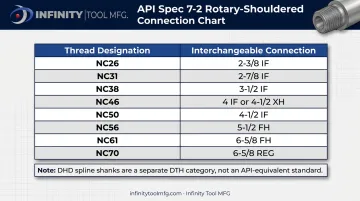
Worth flagging: DHD is a DTH bit-shank family, not an API-equivalent thread standard. Don't treat the two as interchangeable categories when specifying parts.
Inventory costs follow directly from this choice. Standardize on one thread family and your maintenance crew stops hunting for one-off connectors.
Factor 5: Application Duty Cycle & Environment
Continuous operations such as oil & gas and mining run harder on shank connections than intermittent construction work. Corrosive flushing water underground, for instance, drives stress-corrosion cracking and reduced fatigue strength in shank adapters over time.
That's the exact failure mode Sandvik's Golden Shank was built to address. Its field-tested life gains show what happens when a connection is engineered for continuous duty rather than adapted from a general-purpose design. The payoff shows up in mean time between failures and total lifecycle tool cost.
How Infinity Tool MFG Can Help
Standard shank types don't always fit demanding drilling conditions. When a rig spec, formation, or duty cycle falls outside the catalog norm, off-the-shelf parts stop working. Infinity Tool MFG's in-house engineering team steps in to design shank and connection systems matched to the exact equipment on your site.
We've spent over a decade manufacturing PDC bits, DTH bits, and drag bits with connection options built for oil & gas, geothermal, water well, construction, HDD, and mining work. Our Big Flush PDC Bits, for example, ship with multiple connection types specifically so they fit different rig setups without forcing a redesign on your end.
What sets our approach apart:
- In-house engineering and drafting for custom shank and thread designs
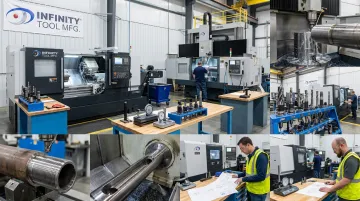
- CNC-cut threads and long-hole boring capability for precision fit
- Product range spanning 1 inch to 48 inch diameters
- American manufacturing facility in Benton, Illinois, equipped for tight tolerances
- Support locations in both the USA and EU
If your drilling program is hitting shank failures on a standard connection, that's usually a signal the application has outgrown an off-the-shelf part. Reach out to our team to talk through a custom-engineered fit.
Conclusion
The right shank match depends on your equipment, your formation, and how hard you're running that equipment day after day, not simply on which option is most common on the shelf.
A mismatched shank rarely fails at the point of purchase. It fails weeks or months later, through downtime, accelerated tool wear, or a safety incident that traces back to a connection nobody double-checked.
Conditions rarely stay static, so review your shank specs whenever they shift rather than just once when you first spec the fleet:
- Shifting into harder or more abrasive drilling conditions
- Upgrading equipment with higher torque or RPM capacity
- Moving from intermittent construction work to continuous production drilling
Frequently Asked Questions
What is bit shank size?
Bit shank size refers to the diameter, and sometimes the length or profile, of the shank end. It must match the chuck, collet, or coupling on your drive system for a secure, slip-free connection.
What are the two common sizes of router bit shanks?
Router bits typically come in 1/4-inch and 1/2-inch straight shanks. The 1/2-inch option has nearly four times the surface area of a 1/4-inch shank, giving it more stability and less risk of breakage with larger cutters.
What's the difference between SDS-Plus and SDS-Max shanks?
SDS-Plus uses a 10mm shank with two wedge torque grooves, suited to lighter rotary hammers. SDS-Max uses an 18mm shank with three wedge grooves for heavier-duty demolition work. They aren't interchangeable without an adapter.
Can adapters be used to switch between different shank types?
Yes, but they're best for occasional or light-duty use. Manufacturers like Makita explicitly warn against using certain adapter configurations under hammering mode, since it can damage the chuck over extended, heavy-duty use.
What shank types are used in rock drilling and DTH applications?
Rock drilling and DTH work typically use threaded connections (top hammer rod strings), splined patterns (DHD, QL, COP for DTH bits), or proprietary systems designed for high torque and repeated impact loads.
How do I determine the correct shank size for my drill or rig?
Check the chuck or coupling specification listed in your equipment's manual, then match it against the bit manufacturer's shank sizing chart. When in doubt, confirm directly with the bit manufacturer before ordering.