Introduction
Sourcing the right drilling bit used to mean calling a local supplier and trusting their word. Now buyers compare manufacturers across three continents, weigh certifications they've never verified, and hope the quoted lead time actually holds. It often doesn't.
Global drilling equipment markets promise more choice and lower prices. In practice, many contractors run into inconsistent bit quality, unpredictable shipping delays, and suppliers who don't understand local ground conditions well enough to recommend the right tool.
The stakes are real. The International Association of Drilling Contractors pegs the administrative cost of managing a single supplier quality incident at $3,000, and that's before counting lost project time.
This guide breaks down the equipment types every buyer should recognize and the criteria that separate reliable global suppliers from risky ones. It also explains why more construction firms are shifting toward American-made drilling tools.
Key Takeaways
- Ground conditions dictate tool choice: PDC, DTH, drag bits, and reamers each solve different formation challenges.
- Manufacturing technology, in-house engineering, and QC processes reveal supplier quality more than price.
- Domestic manufacturing is gaining traction for faster turnaround and stronger engineering support.
- Custom machining capability separates premium suppliers from catalog-only sellers.
Types of Construction Drilling Equipment You Need to Know
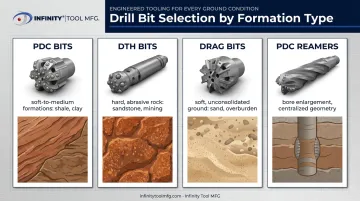
Matching bit type to ground conditions isn't a minor technicality. Get it wrong, and you burn through cutters in soft ground or grind a percussion hammer against rock it was never built to handle. Either mistake costs project time and equipment life.
PDC Bits
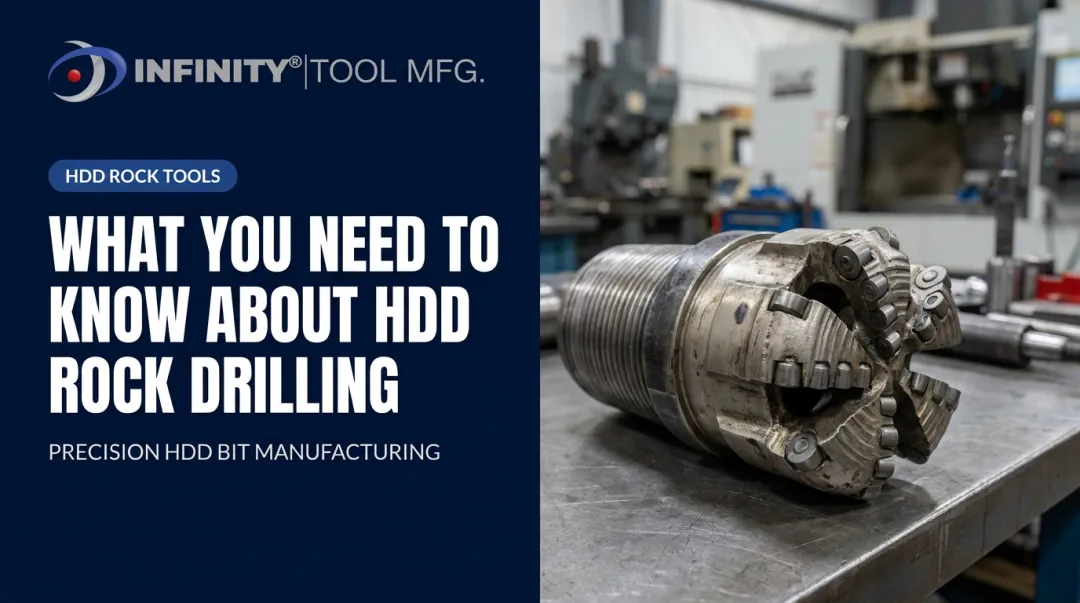
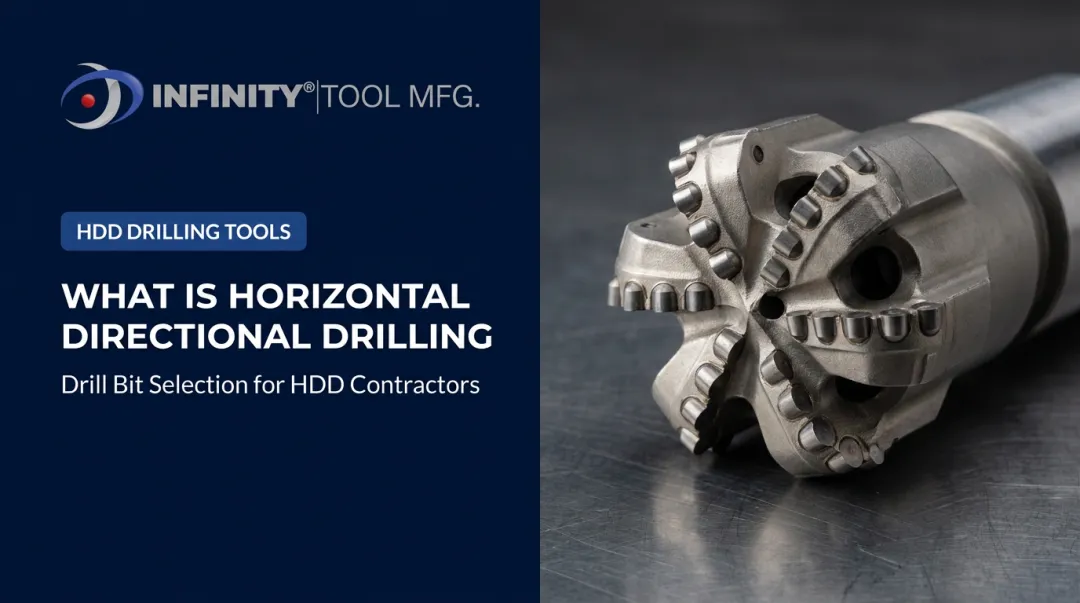
Polycrystalline Diamond Compact (PDC) bits use fixed synthetic-diamond cutters that shear rock rather than crush it. That shearing action allows higher rotational speeds with less mechanical wear, historically making PDC bits the preferred choice for soft-to-medium, nonabrasive formations like shale and clay.
They show up constantly in horizontal directional drilling (HDD), water well construction, and geothermal projects, where medium-hardness rock and long bore runs make cutting efficiency essential.
DTH (Down-The-Hole) Bits
DTH bits work through percussion, not rotation. Compressed air drives a piston that strikes the bit directly, delivering high impact energy with minimal loss through the drill string.
That's why DTH bits are the standard for:
- Mining and quarrying operations
- Heavy construction drilling in fractured rock
- Abrasive formations like sandstone and conglomerate
Where a PDC bit would wear out fast, a DTH hammer keeps working.
Drag Bits
Drag bits use a fixed-cutter, step or chevron blade design that drags through soft, unconsolidated ground: sand, clay, and soft shale. They're simpler than PDC or DTH tools, which keeps upfront cost down. For shallow water well and overburden drilling, where formation competence is low, drag bits remain the cost-efficient choice.
PDC Reamers
Beyond choosing the right bit, enlarging that pilot bore to its finished diameter introduces a different engineering challenge: reamer design, and it matters more than most buyers expect. Poor centralization causes uneven cutter loading, reduces the rate of penetration, and distorts hole geometry, according to drilling contractor INROCK.
Properly centralized reamers with taper and spiral geometry keep the cutting structure balanced through the entire pass. A 2016 equipment spotlight even credited well-designed PDC reamers with drilling 3 to 5 times faster than traditional roller-cone reamers in suitable formations, though that figure comes from manufacturer-reported data rather than an independent study.
Challenges of Sourcing Drilling Equipment from Global Suppliers
Global sourcing isn't inherently risky; it just multiplies the variables buyers need to track.
Quality inconsistency tops the list. Material standards, heat treatment, and cutter-bonding techniques vary widely between manufacturers. With limited on-site oversight, defects often go unnoticed until a bit fails downhole. That's an expensive way to find out a supplier cut corners.
Shipping and customs delays compound the problem. Ocean freight disruptions, like the Red Sea diversions that added roughly 10 days to some shipping lanes in 2024, can stall a project that was already running tight. Add customs clearance variability between countries, and a six-week lead time can quietly stretch to ten.
Communication and customization gaps hit hardest when ground conditions don't match a catalog bit. Suppliers without in-house engineering teams often can't adjust cutter layout, blade count, or hydraulics for site-specific formations. They simply sell what's already on the shelf.
None of this means every overseas supplier is unreliable. It means buyers need documentation, not assumptions. Ask suppliers for:
- Nonconformance records
- Promised-versus-actual delivery data
- A direct engineering contact who returns calls
Domestic manufacturers like Infinity Tool MFG remove much of this uncertainty by keeping engineering and quality control in-house in Illinois.
Essential Criteria for Evaluating Global Drilling Equipment Suppliers
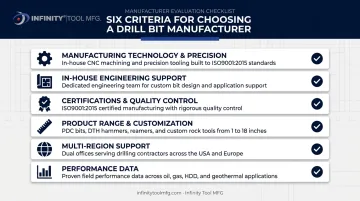
Not every supplier claiming "premium" quality can back it up. Here's what actually separates dependable manufacturers from the rest.
Manufacturing Technology and Precision Engineering
CNC machining alone doesn't guarantee a durable bit. But precision manufacturing does affect dimensional consistency, cutter placement, and balance, all of which influence downhole performance. Ask for dimensional inspection reports and material traceability, not just a claim of advanced equipment.
In-House Engineering and Drafting Support
Ground conditions rarely match a catalog spec exactly. Suppliers with dedicated engineering teams can adjust:
- Cutter layout and blade count for specific formations
- Hydraulic port design for cleaning and cooling needs
- Connection type and gauge to match existing drill strings
Without that capability, you're stuck with whatever's already built, regardless of fit.
Certifications, Product Range, and Ongoing Support
Beyond manufacturing capability and engineering flexibility, evaluate suppliers on four more fronts:
Certifications and quality control: Request ISO 9001:2015 certification scope (does it actually cover the manufacturing site producing your order?), calibration records, and nonconformance tracking. Certification proves a documented quality system exists. It doesn't replace field-performance evidence.
Product range and customization: A supplier's diameter range signals manufacturing depth. Infinity Tool MFG, for example, manufactures PDC bits from 1 inch to 17.5 inches and DTH hammer bits from 2 inches to 18 inches, with custom bit manufacturing available for non-standard sizes. Suppliers who only stock a handful of standard diameters will struggle with unusual bore requirements.
Multi-region support: Suppliers operating across multiple regions can offer more responsive communication than a single overseas factory in one time zone. Infinity Tool MFG runs its manufacturing from Benton, Illinois, with a second office serving European customers directly.
Performance data: Before finalizing an order, request sample bore-completion data or field trial results specific to your formation type. A supplier who can't produce this is asking you to take quality on faith.
Must-Have Features in Modern Drilling Tools & Bits
Not all PDC bits and reamers perform the same, even when they look identical on a spec sheet. These five features separate tools built for the field from tools that just look good in a catalog.
Controlled Drilling Fluid Volume
Flow rate (measured in gallons per minute, or GPM) has to match bit diameter, or you get poor cuttings removal, excess heat, and premature wear. Typical PDC bit operating ranges include:
- 20 GPM for bits up to 5 inches in diameter
- 30 GPM for bits up to 5⅞ inches
- 40 GPM for bits up to 7⅞ inches
Running outside these ranges accelerates cutter wear and reduces cleaning efficiency.
Reduced Chatter and Torque Fluctuation
Stick-slip vibration is a common cause of premature PDC failure. Chatter comes from two distinct sources: friction-induced vibration and cutting-action instability. Controlling depth of cut on each pass helps manage both. Bits engineered with force-balanced blade layouts run smoother and put less cyclical stress on cutters.
Diamond Protection Technology
PDC cutters trade off two properties: abrasion resistance and impact toughness. Backup cutters, positioned to engage rock only when instability increases, add protection exactly when needed without sacrificing cutting speed during normal operation.
Symmetrical Hole-Cutting Design
A bit or reamer with balanced lateral forces cuts a straighter, more consistent bore. Infinity Tool MFG designs its PDC reamers with centralized taper-and-spiral geometry specifically to keep cutting forces distributed evenly from pilot to finished diameter.
Single-Pass Reaming Capability
Reaming from pilot to finish bore in one pass, instead of stepping up through multiple reamer sizes, cuts both time and cost. It's becoming a standard expectation rather than a premium add-on, and it's a design priority behind Infinity Tool MFG's reamer line.
Why American-Made Drilling Tools Are Gaining Preference Over Overseas Suppliers
Reshoring isn't just a manufacturing buzzword. Manufacturers Alliance research identifies industrial equipment as one of the more active categories in the shift toward local-for-local production, driven largely by supply-chain resilience and reduced exposure to trade disruption.
For drilling contractors, that shift shows up in three practical ways:
- Faster delivery, with no ocean transit or customs variability
- Easier communication in the same time zone, without translation gaps on technical specs
- Tighter quality control, thanks to a shorter distance between engineering, manufacturing, and inspection
| Factor | Domestic Sourcing | Overseas Sourcing |
|---|---|---|
| Lead time | Days, no ocean transit | Weeks, subject to port and customs delays |
| Engineering access | Direct line to in-house drafting team | Often routed through distributors |
| Quality response | Faster corrective action | Slower due to distance and time zones |
A Domestic Manufacturer in Practice
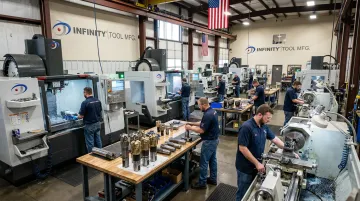
Infinity Tool MFG has spent more than ten years manufacturing PDC bits, DTH bits, and drag bits at its Benton, Illinois facility, with in-house engineering and custom machining built into daily operations. That setup lets the company respond to unusual formation requests without routing designs through a third-party team overseas.
The company's proprietary lines, including the Rock Boss Extreme and Cobble Boss Extreme, were engineered specifically for challenging drilling conditions where standard catalog bits underperform.
Infinity Tool MFG reports completing bores up to 50% faster than traditional methods on qualifying projects. That's a company-stated figure worth validating against your own formation and application before building it into your project timeline.
Country of origin alone doesn't guarantee superior metallurgy or design. It does tend to shorten the distance between identifying a drilling problem and getting a tool built to solve it, and for many construction and HDD contractors, that responsiveness is worth the switch.
Frequently Asked Questions
What is the difference between PDC bits and DTH bits?
PDC bits use fixed diamond cutters that shear through soft-to-medium formations at high rotational speed. DTH bits use compressed-air percussion to hammer through hard, abrasive, or fractured rock.
How do I choose the right drilling equipment supplier for my project?
Evaluate manufacturing capability, in-house engineering support, certification scope, and standard lead times before comparing price. Ask for field performance data specific to your formation type, not just a spec sheet.
What sizes of drilling bits are available for construction projects?
Diameter ranges vary by tool type and manufacturer. Infinity Tool MFG, for example, produces PDC bits from 1 to 17.5 inches and DTH hammer bits from 2 to 18 inches, with custom sizes available on request.
Are American-made drilling tools better than imported ones?
Not automatically, but domestic manufacturers typically offer faster delivery, easier communication, and closer engineering support. Quality still depends on the specific supplier's processes, not just its country of origin.
What industries use PDC reamers and drag bits?
Oil and gas, geothermal, water well, HDD, mining, and general construction all rely on PDC reamers and drag bits, though the specific application depends on ground conditions and bore diameter.
How can custom machining improve drilling performance?
Custom machining lets manufacturers adjust cutter layout, blade count, and hydraulic design for specific soil or rock conditions. That tailored fit typically improves drilling speed and reduces equipment wear compared to a generic catalog tool.