Introduction
Underneath the roads you drive on and the rivers you cross, thousands of miles of pipe and cable get installed every year without a single trench in sight.
That's horizontal directional drilling (HDD) at work, a trenchless method used to place water, gas, sewer, fiber, and power lines underground while leaving the surface almost untouched.
The technology isn't niche anymore. The global HDD market was valued at $10.2 billion in 2023 and is projected to hit $16.4 billion by 2030, growing at a 7.0% CAGR, according to a 2024 ResearchAndMarkets industry report.
This guide skips the surface-level definition. Instead, it breaks down exactly how HDD works stage by stage, the equipment that makes it possible, and where it performs best.
TL;DR
- HDD installs pipe, conduit, or cable underground without open trenching
- The process runs through three stages: pilot hole drilling, reaming, and pipe pullback
- Industries relying on HDD include construction, oil & gas, water/sewer, telecom, and geothermal
- Success hinges on drilling fluid control and purpose-built tooling matched to ground conditions
What Is Horizontal Directional Drilling?
HDD is a trenchless installation method that uses a steerable, surface-launched drilling rig to bore a predetermined underground path. Once that path is drilled, contractors pull pipe or cable through it. No open trench, no torn-up yard, no closed road.
Traditional open-cut trenching does the job, but it tears up pavement, disrupts traffic, and can damage sensitive terrain along the way. HDD was developed specifically to sidestep that disruption while still getting buried infrastructure into the ground.
HDD vs. Oil & Gas Drilling vs. Auger Boring
HDD gets confused with a couple of other drilling methods, but the differences matter:
- Oil & gas directional drilling reaches deep mineral deposits from a vertical well pad. It's a completely different application, scale, and equipment class than utility HDD.
- Auger boring advances a casing from a launch pit using a rotating auger. It's typically non-steerable and reserved for short, on-grade crossings, unlike HDD's steerable pilot-and-ream approach.
Mini, Midi, and Maxi Rigs
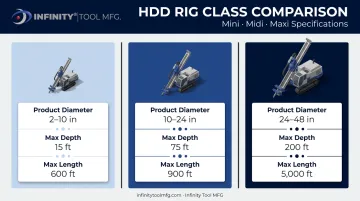
Not all HDD projects call for the same equipment. Rig classifications generally fall into three tiers, based on FHWA guidance:
| Rig Class | Product Diameter | Max Depth | Max Length |
|---|---|---|---|
| Mini | 2–10 in. | 15 ft | 600 ft |
| Midi | 10–24 in. | 75 ft | 900 ft |
| Maxi | 24–48 in. | 200 ft | 5,000 ft |
You'll often hear "directional boring" used for the mini and midi end of that spectrum, and "HDD" reserved for maxi-rig, longer crossings. In practice, the terms overlap, but tooling requirements scale up fast as bore diameter and length increase.
Is HDD Worth the Cost?
Cost depends on the project. A 2012 ASCE case study of a 1,000-meter waterline in Nairobi found HDD ran about 12.5% more expensive than open-cut trenching, tied to local labor conditions.
However, the Distribution Contractors Association points to reduced restoration costs, less traffic disruption, and shorter timelines as the real value drivers. Those savings often outweigh the drilling premium in urban or environmentally sensitive corridors, where restoration costs alone can run high.
How Does Horizontal Directional Drilling Work?
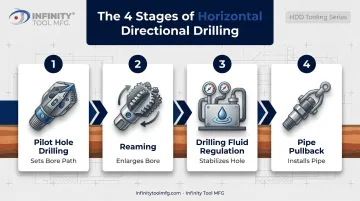
HDD follows a defined sequence of stages: pilot hole, reaming, fluid regulation, and pullback. Each stage demands its own equipment and precision control, and skipping steps or rushing any one of them is where most bore failures start.
Site Prep & Pilot Hole (Initiation)
Before the rig ever turns a drill string, crews handle:
- Utility locating to map existing lines along the planned path
- Entry/exit pit setup at both ends of the bore
- Bore path planning, often using walk-over locators or digital bore-planning software that builds a rod-by-rod plan incorporating entry/exit geometry and known utility crossings
Once the path is set, the rig steers a drill head along that route, guided in real time by surface tracking equipment that reads depth, pitch, and position.
Information, not equipment, is the biggest bottleneck at this stage. Inaccurate utility locating or poor path planning causes utility strikes and off-target bores.
One contractor's 2024 case study on HDD locating reported four utility strikes across more than 100,000 dig tickets in a single year, all tied to unmarked utilities. Their fix: potholing the alignment every 25 feet and at every marked crossing.
Reaming (Core Operation)
Once the pilot hole is complete, a reamer gets pulled back through it to enlarge the bore to the diameter the product pipe needs. This is where most of the real work happens.
During execution:
- Cutting tools break up soil or rock as the reamer advances
- Drilling fluid removes cuttings and stabilizes the hole simultaneously
- Larger diameters often require multiple reaming passes to reach finish bore
Reamer design directly affects how many passes a job takes. Tapered, spiral-cut PDC reamers maintain more consistent torque and cutting speed than standard designs, which matters when you're trying to hit finish bore in fewer runs instead of grinding through pass after pass.
Drilling Fluid Control (Regulation)
Drilling fluid, typically a bentonite-water slurry, gets continuously monitored and adjusted throughout the bore. Its job is straightforward but critical:
- Stabilize the bore wall
- Cool the cutting tools
- Transport spoil to the surface
Volume and viscosity control matter more than most people realize. Too little fluid causes friction and binding. Too much can destabilize the bore or drive up disposal costs.
Vermeer's fluid guidance notes that bentonite raises viscosity and gel strength to carry cuttings and seal the bore wall. That formulation has to change with soil and water chemistry, not stay fixed across a project.
Poor fluid regulation is a leading cause of stuck pipe, hole collapse, and increased torque or chatter on tooling. Far from a background task, fluid control is what keeps every other stage running smoothly.
Pipe Pullback (Output)
In the final stage, the product pipe, usually HDPE, gets attached to the drill string via a swivel and pulled through the enlarged bore from exit point back to entry point.
Once through, the pipe ties into existing infrastructure and the jobsite gets restored to its original condition. HDPE works well here because it's flexible, ductile, and can tolerate the bending and tensile loads pullback puts on it.
Proper reaming and pullback execution reduce pipe damage risk and directly affect how long the whole project takes. A poorly reamed bore means more drag, more torque, and a higher chance of pipe damage during pull.
Where Is Horizontal Directional Drilling Used?
HDD shows up anywhere a utility needs to cross under something without disturbing it: roads, railways, waterways, and longer product pipe runs in oil & gas, water/sewer, and fiber projects.
Ground conditions matter a lot. HDD performs best in:
- Clay (cohesive, holds an open bore well)
- Silt and sand (workable, though fluid properties become critical for stability)
- Moderately consolidated soils overall
Performance drops in cobble, boulders, or highly fractured rock unless you're running specialized tooling, like Infinity Tool's Cobble Boss Extreme bits built for exactly these conditions. Movable cobble, in particular, is often less predictable than competent rock because it deflects tooling and can destabilize the bore.
Industry use varies by scale:
- Construction and municipal crews lean on mini and midi rigs for utility crossings, water lines, and fiber runs under streets
- Oil & gas and geothermal operators rely on maxi rigs for longer, deeper pipeline crossings, sometimes stretching miles under rivers or lakes
- Mining and geotechnical teams use mid-size rigs for exploratory bores and dewatering lines at remote sites
Equipment and Tooling Behind a Successful HDD Bore
A successful bore depends on the rig, but drill bits, reamers, and drill pipe quality carry just as much weight, and operator skill ties it all together.
Key equipment categories include:
- Utility-class vs. pipeline-class HDD rigs (mini/midi vs. maxi)
- Walk-over and in-hole locating tools
- Drilling fluid mixing and reclaiming systems
- Vacuum excavators for pit preparation and potholing
Tooling matters most when ground conditions shift mid-bore. Standard bits and reamers can chip, lose calibration, or slow production the moment a bore transitions from soil into cobble or rock. That's exactly why purpose-engineered tooling exists.
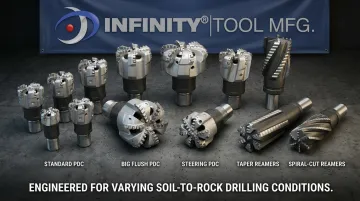
Infinity Tool MFG engineers directly for that shift in ground conditions. The company designs PDC bits and taper/spiral-cut reamers specifically for contractors working through variable soil-to-rock conditions:
- Standard PDC bits handle shifting geology from shale through limestone using a one-piece alloy steel body
- Big Flush PDC bits push higher fluid volumes at lower pressure, suited to softer sand and shale
- Steering PDC bits use a concave head and short skirts to hold centerline alignment and protect diamonds from chipping in harder formations
- HDD PDC Bits (Rock Boss Extreme line) target demanding rock conditions where standard tooling stalls out
The goal across the lineup is the same: reduce chatter and fluctuating torque, protect diamonds from chipping, and ream from pilot to finish bore in fewer passes.
Conclusion
HDD depends on a coordinated sequence of steps: pilot drilling sets the path, reaming enlarges it, fluid regulation keeps the whole system stable, and pullback delivers the pipe. Weaken any one link, and the whole bore slows down or fails outright.
Choosing the right rig, tooling, and drilling fluid strategy for your ground conditions determines whether you get a clean bore or a jobsite full of costly rework. Infinity Tool MFG manufactures the PDC bits and reamers built for each stage of that process.
Frequently Asked Questions
How expensive is directional drilling?
Cost depends on bore length, diameter, soil or rock conditions, and rig size. HDD can cost more upfront than trenching, but it often saves money overall through reduced restoration and traffic disruption.
What is a directional drill used for?
Directional drills install underground utilities such as water, sewer, gas, electrical conduit, and fiber optic lines without open trenching, especially under roads, waterways, and sensitive terrain.
What is the difference between horizontal directional drilling and directional boring?
Professionals often use these terms interchangeably. "Directional boring" typically refers to smaller mini or midi rigs and shorter utility crossings, while "HDD" usually describes larger maxi rigs and longer crossings.
How deep or far can horizontal directional drilling reach?
Utility-scale crossings generally span hundreds to a few thousand feet. Pipeline-class maxi rigs can reach significantly farther and deeper, depending on geology and equipment capacity.
Can horizontal directional drilling go through rock?
Yes, with the right tooling. PDC cutters generally handle soft-to-medium rock in the 2,000–19,000 psi range, but fractured, abrasive, or mixed formations often need roller-cone or hammer systems instead.
How long does a typical HDD project take to complete?
Timelines vary based on bore length, ground conditions, and pipe diameter. Short utility bores can wrap up in a single day, while long pipeline-class crossings through difficult ground can take several weeks.