That failure pattern is exactly what pushed drillers toward simultaneous drill-and-case systems like ODEX. Yet plenty of contractors run ODEX rigs without fully grasping the mechanics behind them, which leads to the wrong bit or reamer choice, tools wearing out early, or slow progress in ground the system was never meant to handle.
This guide breaks down what ODEX drilling actually is, how each stage of the process works, and where it delivers the most value on a job site.
Key Takeaways
- ODEX (Overburden Drilling Eccentric) drills and cases a borehole in one continuous pass
- A DTH-driven eccentric reamer and pilot bit cut a hole slightly larger than the casing
- The process runs through initiation, reaming, casing advancement, and retrieval
- It performs best in overburden, sand, gravel, cobbles, and moderately fractured rock
- Bit and reamer quality directly affects penetration speed, hole straightness, and tool life
What Is ODEX Drilling?
ODEX stands for Overburden Drilling Eccentric (sometimes written "Excentric" depending on the manufacturer). It's a percussive drilling method that installs casing at the same time the hole is drilled, using a pilot bit paired with a swing-out eccentric reamer.
The gap it solves is straightforward. Drilling loose sediments, fractured rock, or boulder-laden overburden with a standard rotary setup often causes circulation loss, hole collapse, and stuck tools before casing can be inserted.
According to TerraRoc's ODEX documentation, unconsolidated soil, clay, sand, and boulders can cave in behind the bit and disrupt flushing before casing arrives. ODEX prevents that by never leaving an open, unsupported hole behind the bit.
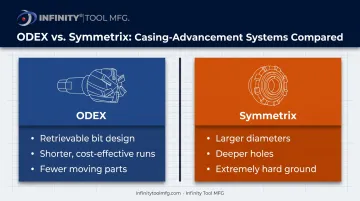
ODEX isn't the only casing-advancement system out there. Symmetrix, its main alternative, uses a concentric ring bit rather than an eccentric reamer.
Symmetrix generally suits larger diameters, deeper holes, and extremely hard ground. ODEX fits shorter, more cost-effective, retrievable applications where the bit assembly needs to come back out intact.
Why ODEX Still Holds Up
Despite newer casing systems on the market, ODEX remains a go-to choice for several reasons:
- Retrievable bit design that comes back out intact after each run
- Fewer moving parts than multi-component alternatives
- Lower long-term maintenance costs
Atlas Copco and Sandvik originally developed the system in the early 1970s for boulder clay in Scandinavia. It's been in regular use across UK construction and US drilling for decades, according to a geotechnical drilling methods review.
Sizing scales up predictably. According to a TerraRoc equipment brochure, the current documented range runs from ODEX 90 to ODEX 240:
| ODEX Size | Pilot/Reamed Diameter | Recommended Casing OD |
|---|---|---|
| 90 | 90 / 123 mm | 114.3 mm |
| 115 | 115 / 152 mm | 139.7 mm |
| 140 | 140 / 181 mm | 168.3 mm |
| 165 | 165 / 209 mm | 193.7 mm |
| 190 | 190 / 237 mm | 219.1 mm |
| 240 | 240 / 306.5 mm | 273 mm |
The working principle stays identical across every size. Only bit diameter, casing OD, and required torque change as the system scales up.
How Does ODEX Drilling Work?
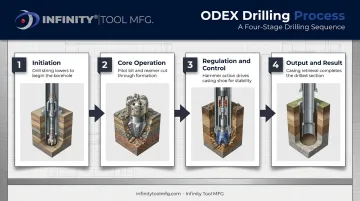
ODEX operates through a defined sequence: initiation, reaming with casing advancement, regulation, and output. Each stage affects hole quality and how fast the job moves.
Initiation
The process starts when the drill string, fitted with the pilot bit and eccentric reamer, is lowered inside the outer casing tube. The DTH hammer engages forward rotation, and impact energy kicks in.
Initiation is purely mechanical. The reamer wing only swings outward once forward rotation and hammer impact are both applied; there's no automated trigger involved.
That mechanical dependency is where avoidable problems often start. If the reamer or locking kit is worn or misaligned, it won't fully extend, and the resulting hole comes out too tight for smooth casing advancement.
Core Operation
Once initiation is complete, the pilot bit cuts ahead while the eccentric reamer enlarges the hole just enough for the casing to slide down directly behind the bit assembly. Nothing gets left exposed.
During execution:
- Percussive impact from the DTH hammer breaks up the formation
- High-pressure air flushing clears cuttings through internal galleries
- The bit face stays clean, which keeps penetration consistent
This stage governs penetration rate and hole straightness more than any other. TerraRoc's brochure specifies a maximum operating air pressure of 14 bar for effective flushing across the ODEX range, which matters directly for keeping the bit face debris-free in tight, cobble-heavy ground.
Regulation and Control
Keeping the bit face clean is only part of the equation; managing how that energy reaches the casing is the other. A shoulder on the guide device transfers part of the DTH hammer's impact energy to the casing shoe, driving it down in sync with the advancing bit rather than as a separate operation tacked on afterward.
Rotation and torque requirements scale with system size. Per the TerraRoc specifications, smaller ODEX 90 setups run at roughly 20-30 rpm with minimum torque around 900 Nm, while larger ODEX 190 and 240 configurations drop to 10-15 rpm but require torque exceeding 5,500 Nm.
Without properly balanced energy transfer at this stage, operators risk casing misalignment, faster wear on the hammer and drill string, or costly hole deviation. Bit and reamer condition matter as much here as at initiation.
Output and Result
Once the target depth is reached, rotation reverses. The reamer wing folds inward, and the drill string withdraws back through the installed casing. The casing itself either stays in place or gets pulled later, depending on how the project is designed.
The result: a fully cased, debris-free borehole ready for reinforcement cage placement and grouting, with no separate casing pass required after drilling wraps up.
Where Is ODEX Drilling Used?
ODEX shows up at several distinct project stages:
- Foundation and micropiling work — pre-drilling through overburden before pile installation
- Water well casing installation — advancing casing through silt, clay, sand, and gravel
- Geotechnical investigation — penetrating overburden ahead of sampling work
One documented example: a 2014 micropile project in Salcombe, UK used ODEX 115 through 240 configurations to install piles 5 to 13 meters long on a steep, restricted-access site with clayey angular gravel over weathered mica schist.
Ground conditions where ODEX performs best:
- Loose overburden and glacial till
- Sand, gravel, and cobbles
- Moderately fractured rock where an open, uncased hole would collapse
These ground conditions explain why usage patterns differ by industry. Construction and piling contractors favor ODEX for its retrievable, cost-effective bit design, while water well drillers value the clean, contamination-free holes it produces through unstable strata.
ODEX isn't universal, though. One dam-engineering source cautions against using it inside embankment dams, since percussive action and high-pressure air can damage the structure. Sampling work in that context tends to run harder and costlier than with hollow-stem augers.
Benefits and Tooling Considerations for ODEX Drilling
Combining drilling and casing into a single pass cuts out a separate operational step. Fewer steps mean shorter timelines and lower overall costs, since there's less need for tool swaps or remedial work after a hole collapses.
But the system only performs as well as the tooling running through it. Bit and reamer durability determines how consistently ODEX holds up in boulder-laden or abrasive ground:
- Worn cutters reduce penetration rate
- Reduced penetration rate increases downtime
- Downtime drives up per-meter drilling cost
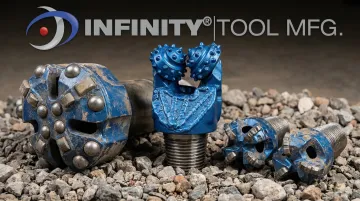
Tool selection becomes a real business decision at this point. Infinity Tool MFG manufactures DTH hammer bits, drag bits, and boulder-rated designs, including the Cobble Boss Extreme, engineered specifically for the cobble and boulder conditions ODEX systems are built to push through.
Steadier cutting structures and durable bit bodies deliver:
- Longer tool life in abrasive, boulder-laden ground
- Fewer mid-project stoppages
- Lower per-meter drilling costs over time
On sites where every hour of downtime adds up, that reliability separates a dependable tool from a costly one.
Conclusion
ODEX drilling follows a coordinated sequence. Eccentric reaming enlarges the hole, casing advances in step behind the bit, and controlled retrieval leaves a stable, cased bore in place. Understanding each stage (initiation, core operation, regulation, and output) explains why worn tooling or an incorrect bit selection creates problems before a rig reaches target depth.
Getting the right ODEX size, bit design, and casing thickness matched to ground conditions determines whether a run goes smoothly or gets stuck. Precision-built tooling, like Infinity Tool MFG's PDC and DTH bits, keeps that fit consistent and improves long-term costs.
Frequently Asked Questions
What does ODEX stand for in drilling?
ODEX stands for "Overburden Drilling Eccentric," describing its eccentric bit-and-reamer design used for simultaneous drilling and casing installation.
How does ODEX differ from Symmetrix drilling?
ODEX uses an eccentric reamer suited to shorter, cost-effective retrievable applications. Symmetrix uses a concentric ring bit better suited to deeper, larger-diameter, harder ground.
What ground conditions is ODEX drilling best suited for?
ODEX performs best in loose overburden, sand, gravel, cobbles, and moderately fractured rock, where an open hole would otherwise risk collapse before casing goes in.
What sizes are ODEX casing systems available in?
Documented ODEX systems range from ODEX 90 through ODEX 240, with casing diameter scaling to match pilot bit size and project requirements.
Is ODEX drilling cost-effective compared to conventional methods?
Combining drilling and casing into one pass cuts labor and rework, making ODEX more economical in unstable ground. It's less cost-effective for sampling-heavy work like certain dam investigations.
Can the ODEX drill bit be reused after retrieval?
Yes. Reversing rotation retracts the reamer wing, allowing the bit assembly to pull back through the installed casing intact and get reused on the next borehole.