Introduction
Every successful bore, whether it's a geothermal test hole or a 2,000-foot HDD pipeline crossing, depends on two distinct processes: drilling and reaming.
Confuse the two, or skip one when the project calls for it, and you're looking at pipe that won't fit, casing that binds, or a pullback that stalls halfway through.
The stakes are real. Utilities that own and operate HDD equipment grew 6% year-over-year, according to Underground Infrastructure's 2024 annual HDD survey. More contractors are now competing for hard-rock and cobble-heavy jobs, where tooling mistakes get expensive fast.
This article breaks down exactly what separates drilling from reaming, where each process fits in your bore sequence, and how to choose the right approach for your formation and project stage.
Key Takeaways
- Drilling creates the initial borehole; reaming refines it to precise tolerances
- Reaming holds thousandths-of-an-inch tolerances, while drilling removes material fast
- Pilot holes and exploratory bores rely on drilling; pullback prep and casing rely on reaming
- Formation hardness and bore tolerance determine which process, or both, your project needs
Drilling vs Reaming: Quick Comparison
Here's how drilling and reaming compare side by side:
| Factor | Drilling | Reaming |
|---|---|---|
| Purpose | Creates a new hole through bulk material removal | Enlarges, trues, and smooths an existing hole |
| Material removal | High removal rate, moderate tolerances | Minimal removal (thousandths of an inch), tight tolerances |
| Tooling | Drag bits, PDC bits, DTH bits built for penetration | Multi-blade reamers built for centering and smoothing |
| Project stage | First step in the bore sequence | Secondary or finishing step before casing/pipe install |
Notice the pattern: drilling is about getting through the ground, and reaming is about getting the hole right. Neither replaces the other. They're sequential steps that serve different jobs.
What Is Drilling?
Drilling is the process of creating an initial borehole using rotational force, axial load, or percussive impact to break through rock or soil. It's the foundational step in oil & gas, geothermal, waterwell, HDD, and mining operations, and it's the point where the bore's trajectory gets set.
What drilling delivers operationally:
- Delivers fast penetration through bulk formation removal
- Sets the trajectory every follow-on operation depends on
- Removes bulk material efficiently without requiring tight sizing
Method varies by formation. Rotary drilling with drag bits works well in softer shale and sandstone.
DTH (down-the-hole) drilling uses percussive hammer action for hard rock. The U.S. Geological Survey notes that down-the-hole percussion drilling can penetrate hard formations faster than a comparable roller-type bit.
PDC drag bits, meanwhile, shine in moderately hard, non-abrasive rock where continuous cutting action outpaces mechanical crushing.
Use Cases of Drilling
Drilling is the pilot hole or production hole stage, meaning it precedes reaming, casing, or completion work. You'll find it as the dominant operation in:
- Exploratory oil & gas wells
- Geothermal test holes
- Waterwell pilot bores
- HDD pilot paths ahead of pullback
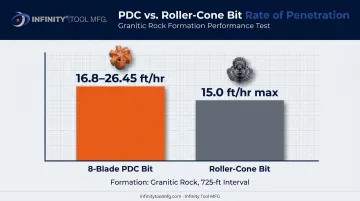
Bit selection has a measurable impact here. In a 2011 Sandia National Laboratories field trial through granitic rock in California's Chocolate Mountains, an 8-blade PDC bit averaged 26.45 ft/hr across a 725-foot interval.
That bit's minimum ROP of 16.8 ft/hr still beat the roller-cone bit's maximum recorded rate of 15.0 ft/hr on the same well (Sandia/GRC, 2012).
That's a formation-specific result, not a universal ratio, but it shows why matching bit design to rock type matters more than defaulting to whatever's on the truck.
What Is Reaming?
Reaming is a precision process that enlarges, trues, and smooths a pre-drilled hole to an exact final diameter. Where drilling is about progress, reaming is about accuracy, which is why it's essential in HDD, geothermal, and mining projects that need tight-tolerance bores.
Why it matters operationally:
- Reduces chatter and fluctuating torque during the pass
- Cuts symmetrically around a centralized axis, keeping the bore true
- Protects diamond cutting elements from chipping or breaking under load
Reamer Types and Design
Reamers come in a few flavors depending on the job. Single-stage reamers handle one enlargement pass, while multi-stage reamers step the hole up gradually, useful when you're going from a small pilot to a much larger final diameter without overloading the tool.
PDC reamers with a taper-and-spiral design are engineered specifically to distribute cutting load evenly, which is what keeps torque steady and diamonds intact.
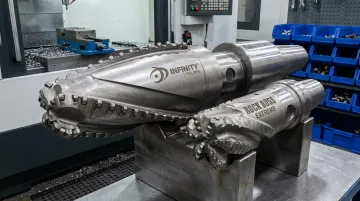
Infinity Tool MFG builds its PDC reamers around this geometry, pairing them with purpose-built pilot tools like the Rock Boss Extreme and Cobble Boss Extreme for hard rock and heavy cobble ground. This keeps the pilot hole clean before the reaming pass even starts.
Use Cases of Reaming
Reaming is the finishing stage, preparing a bore for pipe pullback, casing, or component installation. It dominates in:
- HDD pipeline installation
- Geothermal well completion
- Mining shaft and borehole enlargement
- Waterwell casing preparation
Proper reaming pays off in real terms. On the Verdigris River crossing, a 48-in. full-face hole opener enlarged a 12.25-in. pilot hole to full diameter in a single reaming pass over 1,757 feet of shale and limestone.
This replaced the conventional three- to four-stage expansion sequence, according to Trenchless Technology's 2016 case study. Cutters showed minimal wear after 197 operating hours, and pullback completed without complications at forces below 675,000 lb.
Drilling vs Reaming: Which Is Right for Your Project?
Most projects need both, just not always in equal measure. The decision comes down to four factors:
- Formation hardness – Harder rock demands more purpose-built tooling at every stage, not just at the pilot.
- Required bore tolerance – Exploratory holes can tolerate rough walls; pipeline pullback can't.
- Project stage – Drilling always comes first; reaming only makes sense once a pilot exists.
- Time and cost constraints – Skipping reaming saves a pass, but risks pullback failures that cost far more.
When to drill alone: Exploratory or non-critical holes where exact diameter isn't essential. Think early-stage geothermal test bores or geotechnical sampling.
When to add reaming: Any application needing precise sizing, smooth walls, or reduced pullback friction, such as HDD pipeline installation or casing prep for waterwell completion.
Real-World Example
A Missouri-based HDD contractor, Eastern Missouri Industries, ran 300- to 400-foot shots through hard limestone with 30-40 feet of cobble at entry and exit. Their existing setup, a low-flow mud motor paired with a conventional reamer, managed only 20-30 feet per day (Trenchless Technology, 2014).
The fix wasn't just a better reamer. The contractor switched to a DTH hammer for a 5.25-in. pilot hole and a dedicated pull reamer for 12-in. and 16-in. reaming passes. The results:
- Pilot drilling: 15-20 minutes per 10-ft rod
- Pull reaming: 25-30 minutes per 10-ft rod
- Full 300-400 ft bores completed in six days or less
- HDPE pullbacks succeeded without incident
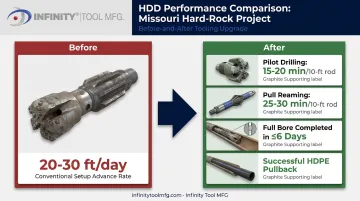
Matching the right pilot bit and reamer to hard, cobble-laden formations turns a stalled project into a predictable one.
If your crew is fighting similar ground, Infinity Tool MFG's custom PDC bit and reamer lineup is built for exactly this kind of formation-matching work — reach out to talk through your specific conditions.
Conclusion
Drilling and reaming aren't competitors fighting for the same job. Drilling opens the path; reaming makes that path usable for the pipe, casing, or equipment that follows. Trying to make one process do the other's job is how you end up with oversized bit wear, failed pullbacks, or bores that need re-drilling entirely.
The practical move is matching tool selection to formation type and project stage, not defaulting to whatever's already on the rig. Get that match right, and you'll see it in bore precision, reduced downtime, and installations that go smoothly the first time.
Frequently Asked Questions
What is the difference between drilling and reaming?
Drilling creates the initial hole through bulk material removal, establishing the bore's path. Reaming refines that existing hole to a precise diameter and smooth finish, typically before pipe or casing installation.
Why use a reamer instead of a drill bit?
Reamers produce a smooth, accurately sized bore that a drill bit alone can't achieve. This matters most when pipe pullback fit or casing tolerance is critical to the project's success.
What is the formula for reaming drill size?
There's no universal formula across all industries. In HDD, the rule of thumb sizes the final bore at 1.2 to 1.5 times the product pipe's outside diameter. Always check project-specific tooling specs.
Can you ream without drilling a pilot hole first?
No. Reaming always requires a pre-existing hole to work through. Reaming refines an existing hole rather than creating one, so a pilot bore must exist before reaming can begin.
How much material does a reamer typically remove?
Reamers remove a minimal amount of material, often just thousandths of an inch to a few millimeters, in a single controlled pass. This is what keeps tolerances tight and cutters protected.
Is reaming necessary for every HDD or well drilling project?
Not always. Reaming is essential when precise bore diameter, smooth walls, or reduced pullback friction matter, but exploratory or non-critical holes can often skip it entirely.