Introduction
Every extra day on location costs money, and drilling programs are under more pressure than ever to shrink that number.
Advanced offshore rigs averaged $420,000 per day in the first half of 2023, with roughly 90% of available units working or under contract, according to World Oil's rig market analysis.
In geothermal work, the stakes are even steeper: drilling can eat up 50% of capital cost on a standard 50-MW plant and more than 75% on an enhanced geothermal system, per NREL's 2022 GETEM update.
PDC cutters get discussed a lot as an engineering breakthrough. That's fine, but engineers don't sign the invoices. What matters on the rig floor is simpler: trips avoided, days saved, failures that never happened.
This article breaks down the specific cost mechanisms (ROP, bit life, and downhole reliability) through which PDC cutters actually move the needle on cost per foot.
TL;DR
- PDC cutters cut costs through faster ROP, longer bit life, and fewer torque failures
- These translate into fewer trips, less billed rig time, and more predictable budgets
- Cutter size, geometry, and grit selection determine how much of those savings you capture
- Infinity Tool MFG's custom-engineered bits and reamers help match cutter design to your formation and cost goals
What Is a PDC Cutter
A PDC (Polycrystalline Diamond Compact) cutter is a synthetic diamond layer bonded to a tungsten carbide substrate, fixed onto a drill bit or reamer body. It shears rock instead of crushing or gouging it the way roller-cone or carbide-insert bits do.
You'll find PDC cutters on tools across:
- Oil & gas and geothermal drilling
- Water well construction
- HDD and construction boring
- Mining and geotechnical work
Diameters and configurations vary widely by application, from small-diameter directional tools to large-diameter reamers.
None of this matters for novelty's sake. Shearing rock takes less time and energy per foot than crushing it, and that difference is what shows up on the final well-cost report.
Key Advantages of PDC Cutters (Cost Drivers)
The advantages below aren't abstract engineering claims. Each one maps to a KPI operators already track on daily drilling reports (ROP, cost per foot, NPT hours, bit runs), making the cost impact easy to benchmark against your own data.
Higher Rate of Penetration Cuts Rig Time Costs
A PDC cutter shears continuously across the rock face. A roller-cone or TCI bit crushes and gouges, which wastes energy and slows progress in consistent formations like shale, sandstone, and limestone.
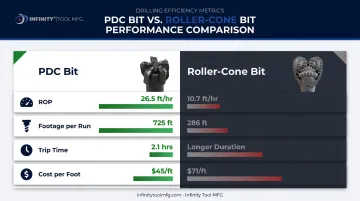
The performance gap can be substantial. In a Sandia field trial through a metamorphosed volcanic interval, two PDC bits averaged 26.5 ft/hr and 20.4 ft/hr, compared to just 10.7 ft/hr for the roller-cone baseline drilled in the same project, according to DOE/Sandia geothermal drilling data. That's more than double the footage per hour, in the same rock, on the same rig.
Faster ROP shortens time-to-depth directly. Since rig time bills daily regardless of formation, every hour shaved off translates straight into dollars saved. Operators use this ROP data to justify bit selection and forecast well budgets before spud.
KPIs impacted:
- ROP (ft/hr)
- Cost per foot
- Total days to TD
- Cumulative rig-day spend
Long horizontal or lateral sections, high day-rate rigs, and deep or offshore wells see the biggest return here, since every hour of rig time carries real weight on the invoice.
Extended Cutter and Bit Life Reduces Trip and Replacement Costs
The diamond-carbide compact resists abrasive wear far longer than traditional carbide inserts. Cutting edges stay sharp across more footage before a bit change is needed.
Fewer bit changes mean fewer trips. A trip means pulling the entire drill string out of the hole and running it back in, foot by foot, in both directions.
The Sandia trial illustrates the gap well. The PDC bits ran 725 ft and 573 ft on a single bit before pulling out, versus 286 ft for the roller-cone baseline in the same project.
Trip time for the PDC runs measured 2.1 and 2.6 hours respectively. The study also calculated a project cost of $45/ft for the better-performing PDC bit against a projected $71/ft for the roller-cone comparison (Sandia/OpenEI).
Tripping is one of the largest hidden cost drivers in a drilling program precisely because it consumes rig time without adding depth. Fewer trips also mean less exposure to wellbore instability, which can trigger its own expensive remediation work.
KPIs impacted:
- Footage per bit run
- Number of trips per well
- NPT hours
- Total cost per well
Impact peaks in long horizontal runs, remote or offshore rigs where trip costs stack up fast, and hard abrasive formations that chew through conventional cutters.
Reduced Chatter and Torque Fluctuation Improve Predictability
Cutter and reamer geometry (tapered profiles, spiral flighting, centralized designs like those used in Infinity Tool MFG's PDC reamers) controls the vibration and torque swings that otherwise wear down tools prematurely.
Symmetrical cutter loading protects the diamond table from chipping and breaking. In practice, this can allow a single pass from pilot to finish bore rather than multiple reaming runs, cutting both time and tool wear.
Predictable torque matters because unplanned NPT events, like stuck pipe or twist-offs, are expensive emergency operations. An SPE case study from one Niger Delta field estimated NPT at roughly 31% of total annual drilling cost per well in that study area, according to SPE's Niger Delta basin analysis.
That's a field-specific figure, not a universal average, but it shows how much room NPT can eat into a budget when torque behavior goes unmanaged.
KPIs impacted:
- Torque variability
- NPT hours
- Tool failure/chipping rate
- Bore diameter accuracy
Reaming operations, HDD, directional or complex wells, and tight-tolerance bores in construction or water well projects benefit most, where precise torque control prevents costly rework.
What Happens When the Wrong PDC Cutter Is Selected
Premium diamond technology doesn't guarantee savings. Match the cutter poorly to the formation and you get the opposite result:
- Inconsistent ROP: footage per run becomes unpredictable, making budgeting a guessing game
- Premature diamond chipping: torque fluctuation and impact damage wear cutters out early
- More trips and NPT: driving up cost per foot despite paying a premium for the technology
- Broken benchmarking: costs stop scaling consistently across a multi-well program, so lessons from one well don't transfer to the next
This is the gap between owning PDC technology and actually capturing its cost benefits.
How to Get the Most Cost Savings from PDC Cutters
Savings depend on matching cutter size, geometry, and grit to the specific formation. There's no one-size-fits-all bit. Working with a manufacturer that has in-house engineering support, such as Infinity Tool MFG's custom drafting and design team, helps avoid guessing your way into an expensive mismatch.
A few practices that make a real difference:
- Review performance data run-over-run: ROP trends, wear patterns, and torque logs tell you whether the current design fits the formation or needs adjustment
- Treat cutter selection as ongoing, not final: the first bit you buy for a formation shouldn't be the last design you ever try
- Feed field results back into future designs: each run's data should sharpen the next bit or reamer spec, not just get filed away
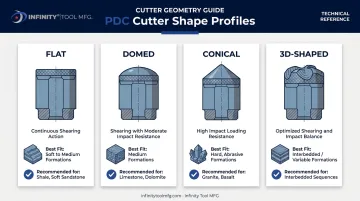
Selection practices are only half the equation; cutter geometry matters just as much. Flat, domed, conical, and 3D-shaped cutters each shift how a bit handles impact loading versus continuous shearing. The right shape depends on rock strength, abrasiveness, and interbedding in your specific target zone, which is exactly why formation-specific offset data matters more than generic spec sheets.
Conclusion
The cost benefits of PDC cutters compound across a drilling program. Faster ROP shortens rig time. Longer bit life cuts trip frequency. Steadier torque prevents the expensive failures that blow up a well budget without warning. Together, these three levers lower cost per foot across the life of a well or a fleet.
The real value depends on matching cutter design to the formation you're actually drilling, not on adopting PDC technology in general terms. A generic bit in the wrong rock can underperform a well-matched design by a wide margin.
Partnering with Infinity Tool MFG for custom PDC bit and reamer design, backed by an in-house engineering team that reviews field performance and refines specs accordingly, helps make sure those savings show up consistently, run after run.
Frequently Asked Questions
What is a PDC cutter?
A PDC (Polycrystalline Diamond Compact) cutter is a synthetic diamond layer bonded to a tungsten carbide base. It's fixed onto drill bits and reamers to shear rock efficiently instead of crushing it.
What type of cutters do PDC bits have?
Common cutter shapes include flat, domed, conical, and 3D-profiled designs. Shape and size selection depends on formation hardness and the ROP you're targeting.
What does PDC stand for in drilling?
PDC stands for Polycrystalline Diamond Compact. The term applies to both the diamond cutting material itself and the bits or reamers built around it.
How much can PDC cutters reduce overall drilling costs?
Savings come primarily from higher ROP, fewer trips, and reduced NPT. Actual percentage savings vary by formation and should be benchmarked against offset-well or supplier field data rather than a flat industry figure.
How long do PDC cutters typically last before replacement?
Lifespan depends on formation abrasiveness, cutter grit and size, and operating parameters. In comparable conditions, PDC cutters generally outlast traditional carbide-insert cutters by a wide margin.
Are PDC cutters more expensive than traditional drill bit cutters?
Upfront cost runs higher than traditional carbide-insert cutters. However, factor in fewer trips, longer runs, and reduced failures, and total cost per foot typically comes out lower.