
That precision matters most in tight-tolerance industries. Aerospace fastener holes, automotive bushing bores, medical device components, and precision tooling all depend on repeatable, accurate holes. A worn dowel pin fit or a rough bearing seat can mean a failed assembly.
This guide breaks down the main reamer types, the materials they're made from, and how to pick the right one for your job.
Key Takeaways
- Reamers finish holes to tight tolerances; they don't drill new ones or fix drill drift
- Chucking, hand, shell, taper pin, expansion, and spiral-fluted reamers each match a specific shank, hole, or volume need
- HSS suits general-purpose and hand reaming; carbide holds size longer in abrasive materials
- The right choice depends on hole size, material, tolerance, and production volume
What Is a Reamer and Why Does It Matter in Machining?
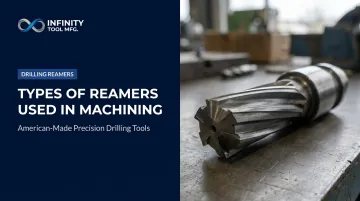
A reamer is a rotary cutting tool that enlarges and finishes a pre-drilled or bored hole to a precise diameter and smooth surface. It doesn't cut a hole from solid stock. It follows a hole that already exists.
That's the key difference from drilling. Drills remove bulk material and are prone to wander, taper, and rough walls. Reamers take a much lighter pass, correcting size and finish without correcting a poorly located hole.
Why this precision matters:
- Dowel pins, bushings, and bearing seats need consistent, repeatable fits
- Aerospace, automotive, and medical device work often calls for tolerances measured in microns
- Guhring's HR 500 reamers hit IT7 tolerance grades, as tight as 15 to 21 micrometers for 6mm-30mm holes, per ISO 286-2 standards
Skip the reaming step, or do it poorly, and the consequences show up fast. Expect oversized or rough bores, parts that won't seat correctly, premature wear on mating components, and assembly failures down the line.
Getting the Pilot Hole Allowance Right
Reaming only works if the pilot hole leaves the correct amount of stock. Too little, and the reamer rubs instead of cutting, which dulls edges and degrades finish. Too much, and you risk chip packing or tool breakage.
Kennametal's general guidance for stock allowance is a useful starting point:
- 0.010 in for holes below 1/4 in diameter
- 0.015 in for holes from 1/4 in to 1/2 in
- 0.025 in for holes from 1/2 in to 1-1/2 in
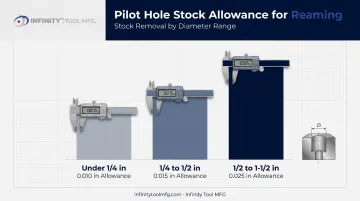
These figures come from Kennametal's reaming tool guide and serve as a baseline. Actual allowance still depends on material, finish requirements, and reamer type.
Types of Reamers Used in Machining
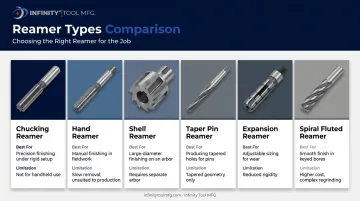
Reamer selection comes down to four factors: how the tool mounts (shank type), the shape of the hole, the workpiece material, and whether the job is manual or machine-driven.
These types didn't develop by accident. Each solves a specific problem, whether that's one-off field repairs, high-volume CNC production, tapered pin fits, or blind holes with interruptions like keyways.
Chucking (Machine) Reamers
Chucking reamers are the workhorse of the category. They mount in a drill press, lathe, or mill via a straight or Morse taper shank, and they come with straight or helical flutes.
Best for: high-precision, repeatable production reaming where a machine controls speed and feed consistently.
Limitation: they need machine setup, ruling them out for a quick field fix or manual repair job.
Hand Reamers
Hand reamers have a square-drive shank that fits a tap wrench, plus a slightly tapered lead-in that helps the tool self-align as it starts cutting.
Best for: one-off jobs, field repairs, and low-volume work where no machine is available.
Limitation: precision depends on the operator's steadiness and feel. That human variable makes hand reamers a poor fit for tight-tolerance production runs.
Shell Reamers
A shell reamer is a hollow, sleeve-style cutting head that slides onto a separate arbor. Most catalogs list a minimum diameter of roughly 0.75 inch, though this varies by manufacturer.
Best for: large-diameter, high-volume reaming. Since only the cutting head wears out, shops replace the head instead of the entire tool, cutting long-term tooling costs.
Taper Pin / Tapered Reamers
These conical-shaped reamers cut a tapered hole that matches a standard taper pin or Morse taper fitting. Many follow a 1:48 diameter taper, roughly 1/4 inch per foot.
Best for: locating pins, aircraft assembly, and tooling alignment where a tapered fit locks components in place.
Limitation: this is a specialized geometry. It has no application on standard cylindrical holes.
Expansion / Adjustable Reamers
Expansion reamers use a screw mechanism that radially adjusts the cutting blades, letting a machinist compensate for wear or fine-tune diameter without swapping tools.
Best for: maintenance work and moderate-precision jobs where slight size adjustments come in handy.
Limitation: the adjustable design sacrifices rigidity. Expect less material removal capacity and shorter tool life than a solid reamer.
Spiral (Helical) Fluted Reamers
Helically twisted flutes distribute cutting forces more evenly and push chips out of the hole as the tool cuts.
Best for: blind holes, holes with keyways or slots, and tougher or work-hardening materials such as stainless steel. The spiral geometry bridges interruptions that would chatter a straight-fluted tool.
Limitation: on softer materials, the aggressive flute geometry can score or mar the bore wall.
Infinity Tool MFG applies these same taper and spiral principles when engineering PDC reamers for rock drilling, protecting diamond cutters while reaming from pilot to finish bore in HDD, oil & gas, and mining applications.
Reamer Materials: HSS vs. Carbide
Once you've settled on a reamer type, material choice determines how it performs over time.
High-speed steel (HSS) reamers are the cost-effective, tough option. They handle general-purpose reaming of softer metals well and remain the standard choice for hand reaming, where impact resistance matters more than raw wear life.
Carbide reamers, by contrast, bring greater hardness and wear resistance to the table. That translates to longer size retention and a smoother finish over more holes, particularly in hardened or abrasive materials.
The tradeoff: carbide is brittle. It demands a rigid, vibration-free setup. Run a carbide reamer in a loose chuck or an unstable fixture, and you risk chipping the cutting edges before you see any wear-life benefit.
A quick comparison:
| Factor | HSS | Carbide |
|---|---|---|
| Cost | Lower | Higher |
| Toughness | Higher | Lower (brittle) |
| Wear resistance | Moderate | High |
| Best for | Hand reaming, general steel/aluminum | High-volume, hardened, or abrasive materials |
| Setup requirement | Flexible | Rigid, low-runout |
According to Hannibal Carbide's reamer selection guide, carbide's wear resistance helps it maintain accurate hole size and finish quality longer than HSS in production settings. The exact gain in holes-per-tool varies by steel grade, hardness, coolant, and coating, so treat any specific multiplier you hear from a supplier as setup-dependent rather than universal.
How to Choose the Right Reamer for Your Application
The right reamer isn't the one you're most familiar with. It's the one that matches your hole size, material, tolerance, and volume.
Factors to weigh:
- Hole diameter and depth : shell reamers for large bores, chucking reamers for standard production sizes
- Workpiece material and hardness : carbide for hardened or abrasive stock, HSS for general-purpose work
- Required tolerance and surface finish : tighter callouts point toward machine reaming over hand reaming
- Production volume : one-off jobs favor hand or adjustable reamers; batch runs favor chucking or shell reamers
- Manual vs. machine operation : availability of CNC or lathe setup narrows the field quickly
Common mistakes to avoid:
- Choosing an expensive carbide reamer for a simple, low-volume softer-metal job
- Ignoring flute type on holes with keyways or slots, where straight flutes chatter
- Skipping pilot-hole allowance guidelines and ending up with a rubbing or overloaded tool
- Defaulting to whatever reamer is already in the drawer instead of matching the tool to the job
Standard catalog reamers cover most shop-floor needs. But specialized or large-diameter applications, such as oil & gas, HDD, or mining drilling, often fall outside what a catalog part can handle. This is where in-house engineering makes a difference.
Infinity Tool MFG, based in Benton, Illinois, designs and manufactures custom reamers for exactly these conditions.
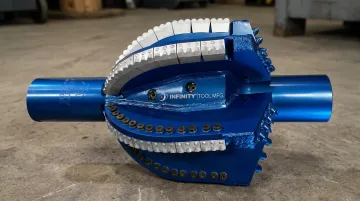
Its PDC reamer line uses a taper-and-spiral geometry built to cut symmetrical bores, reduce chatter and fluctuating torque, and protect diamond cutters from chipping during aggressive drilling. For contractors reaming from pilot to finish bore in demanding formations, that kind of purpose-built design often outperforms an off-the-shelf tool.
Conclusion
Reamers do one job well: turning a rough, oversized pre-drilled hole into a precise, smooth-walled bore. Chucking, hand, shell, taper pin, expansion, and spiral-fluted types each address a different shank, hole shape, or production scenario. HSS versus carbide comes down to balancing cost, toughness, and wear resistance against your material and setup.
Understanding these distinctions saves money and downtime. Pick a reamer based on hole geometry, material hardness, and tolerance requirements, not habit. You'll get consistent results whether you're finishing a single field repair or running a batch of aerospace components.
Frequently Asked Questions
Which is better: carbide or HSS reamers?
Carbide holds size and finish longer on hard or abrasive materials, making it the choice for high-volume or demanding jobs. HSS costs less and handles impact better, making it the practical pick for general-purpose or hand reaming.
What are the different types of reamers?
The main categories are chucking (machine), hand, shell, taper pin, expansion, and spiral-fluted reamers. Selection depends on shank type, hole shape, and whether the job is manual or machine-driven.
What is the difference between H7 and H8 reamers?
Both are ISO 286 hole-basis tolerance grades, where "H" means zero lower deviation. H7 has a tighter tolerance band: for a 10-18mm hole, it's 0 to +18 micrometers versus 0 to +27 for H8.
What is a 7-degree reamer?
This refers to a nominal 7-degree included-angle taper reamer, commonly used in automotive work to finish tapered holes for ball joints, tie-rod ends, and steering arms. Always confirm the exact angle against a dated OEM drawing before machining a critical fit.
How do I determine the correct pilot hole size before reaming?
Pilot hole allowance depends on final diameter and material; Kennametal's baseline guidance is 0.010 in for holes under 1/4 in, 0.015 in for 1/4-1/2 in, and 0.025 in for 1/2-1.5 in. Check your reamer manufacturer's chart for material-specific values.
Can reamers be used on materials other than metal?
Reamers are primarily built for metals, but certain spiral-fluted designs work on plastics when paired with sharp geometry, rigid support, and good chip evacuation. Thermal expansion and residual stress in plastics still require extra care to hold dimensional accuracy.