The federal government is betting big on making this process faster and cheaper. In December 2022, the Department of Energy awarded more than $15 million to two drilling technology projects, each targeting at least a 25% improvement in drilling rates.
Here's the catch: many people lump geothermal drilling in with standard water wells or oil and gas rigs. That's a mistake. The heat, pressure, and rock conditions are different, and using the wrong tooling can mean stuck bits, blown budgets, or a well that never performs as designed.
This guide breaks down what geothermal drilling actually is, how it works stage by stage, and where it gets applied in the field.
TL;DR
- Boreholes tap Earth's heat for power generation, direct heating, or heat pump systems
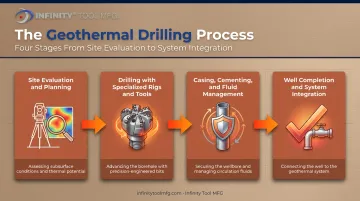
- The process follows four stages: site evaluation, drilling, casing/cementing, and completion
- Wells face higher heat, harder rock, and longer service demands than typical water wells
- Depths range from a few hundred feet for heat pumps to over 10,000 feet for power generation
- PDC and DTH bits are central to controlling penetration rate, hole quality, and tool life
What Is Geothermal Drilling?
Geothermal drilling is the engineered process of boring into the Earth's crust to reach naturally occurring heat that can be converted into usable energy. Unlike oil and gas extraction, there's no finite reservoir being depleted here, just a stable heat source being tapped for long-term use.
The reason this process exists comes down to physics. You can't harness subsurface heat for electricity, direct-use heating, or ground-source heat pumps without first building a stable, precisely engineered pathway connecting the surface to that heat. That pathway is the well itself.
Geothermal drilling also differs from two adjacent fields: oil & gas drilling, which targets finite hydrocarbon reservoirs rather than renewable heat, and standard water well drilling, which typically doesn't contend with extreme temperatures or abrasive, fractured rock.
Tools and rigs sometimes overlap across these industries, but the engineering demands diverge sharply once you're targeting formations that exceed 150°C, according to C2ES's analysis of geothermal well specifications.
Solar and wind depend on weather and time of day. Geothermal doesn't. It's a continuous, baseload heat source, which is exactly why drilling into it remains essential even as surface renewables scale up.
There are two broad categories worth knowing:
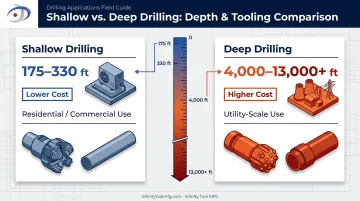
- Shallow drilling for ground-source heat pumps, typically 175-330 feet based on NYSERDA field data
- Deep drilling for power generation or direct-use heat, ranging from 4,000 to over 13,000 feet in NREL's modeled cost curves
Depth changes everything — bit selection, casing design, and cost all scale up dramatically between the two.
How Does Geothermal Drilling Work?
Geothermal drilling follows a defined, multi-stage sequence. Each stage builds toward a well that can perform reliably for decades, not just get the job done today.
Initiation: Site Evaluation and Planning
Before any rig mobilizes, geologists and engineers run surveys to assess rock type, heat gradients, groundwater presence, and fault lines. This stage is entirely human-directed, with no automation involved.
NREL's exploration workflow combines geological, geochemical, and geophysical evidence into a working model, then confirms it with temperature-gradient holes and core sampling. At one Nevada site, gradient holes revealed 124°C at just 152 meters deep.
The output of this stage determines target depth, drilling method, and equipment needs. Get it wrong, and you're looking at costly redrilling or tool failure down the line.
Core Operation: Drilling With Specialized Rigs and Tools
This is where the borehole actually takes shape. A rig rotates a drill string fitted with a bit that cuts, crushes, or grinds through rock, advancing in stages as depth increases.
During execution, drilling fluid or air circulates continuously to:
- Cool the bit under extreme temperatures
- Clear rock cuttings out of the hole
- Stabilize the borehole walls
Conductor, surface, and intermediate casing get installed progressively as the well deepens. Standard tooling wears out fast in this environment, so drillers rely on high-torque rotary systems, heavy-duty drill rods, and bits engineered specifically for hard, hot, abrasive rock.
Bit selection is where drilling efficiency lives or dies. NREL's 2025 cost modeling puts drilling at 30% to 57% of total geothermal plant capital cost, meaning bit life and rate of penetration directly move the needle on project economics.
This is where purpose-built tooling matters. Infinity Tool MFG manufactures PDC and DTH bits designed for the abrasive, high-heat conditions geothermal formations throw at standard equipment.
Their DTH hammer bits, built with carbide-impregnated cutting surfaces, are engineered for rock exceeding 30,000 psi compressive strength, a threshold common in granite and basalt formations found at geothermal sites.
Production drilling into the hot reservoir itself is the toughest phase. Diamond-enhanced or heat-resistant tooling helps avoid chipping and premature breakage when bits are grinding through crystalline rock at depth.
Regulation and Control: Casing, Cementing, and Fluid Management
As the well deepens, drillers monitor temperature, pressure, and hole stability continuously to prevent collapse or fluid loss into fractured zones.
Casing and cement get installed at each depth interval for specific reasons:
- Isolate unstable zones that could otherwise collapse the borehole
- Protect groundwater from contamination
- Maintain wellbore integrity against heat and pressure over the well's lifespan
Washington State's drilling code requires conductor casing cemented from shoe to surface, and production casing that uses high-temperature-resistant cement admixtures. Skip these steps, and drillers risk stuck tools, lost circulation, or aquifer contamination, all expensive problems that stall projects.
Output: Well Completion and System Integration
The final product is a cased, tested borehole capable of safely circulating hot fluid, steam, or heat-exchange loops to the surface. From there, it connects downstream to production piping, heat exchangers, or turbines depending on the project.
Construction quality here determines operational reliability. A 2025 Stanford Geothermal Workshop case study documented a well in western Anatolia where poor cementing led to casing collapse, dropping flow to just 20% of the original rate. A workover recovered 80% of pre-collapse performance, but only after significant downtime and cost.
That downtime, and the lost revenue behind it, is the real cost of cutting corners at this final stage.
Where Is Geothermal Drilling Used?
Geothermal drilling supports a wider range of projects than most people realize:
| Application | Typical Depth/Scale | Common Operators |
|---|---|---|
| Residential/commercial heat pumps | 175-400 ft | HVAC and water well contractors |
| District heating networks | 0.5-50 MWth loads | Municipal/utility teams |
| Industrial process heat | Site-specific | Direct-use operators |
| Utility-scale power plants | 4,000-13,000+ ft | Oil & gas-adjacent operators |
It performs best under specific conditions: stable rock formations with predictable heat gradients, adequate site access for rig mobilization, and geology suited to vertical or directional well design.
Usage patterns vary by depth and industry:
- HVAC and water well contractors typically handle shallower systems, closer in scope to conventional water well work
- Municipal and direct-use operators run mid-scale district heating and industrial process systems between these extremes
- Oil & gas-adjacent operators manage the deep, high-temperature production wells that demand heavier rigs and hardened tooling
The core mechanics stay similar across these segments; the differences come down to scale, temperature exposure, and tooling.
Conclusion
Geothermal drilling follows a staged, engineering-driven process:
- Evaluate the site
- Drill with purpose-built tools
- Case and cement for integrity
- Complete the system for decades of service
This approach prioritizes longevity over quick extraction.
Getting the tooling right at the drilling stage has outsized influence on everything downstream: it speeds penetration rates, extends tool life, and controls total project costs. Infinity Tool MFG manufactures PDC and DTH bits engineered for the hard rock and high heat that define geothermal formations, giving drillers application-specific options rather than generic tooling stretched beyond its limits.
Frequently Asked Questions
How much does it cost to drill a geothermal well?
Costs range widely by depth and application — from a few thousand dollars for shallow residential heat pump wells to $3 million to $13 million or more for deep utility-scale wells. Drilling often represents 30% to 57% of total plant capital cost.
How long does geothermal drilling take?
Shallow heat pump wells can take days. Deep production wells for power generation typically take 30-75 days depending on depth, rock hardness, and casing requirements, though some projects have completed in as few as 16 days.
What is the most commonly used drilling fluid in geothermal drilling?
Water-based muds and air are common for hole stabilization and cuttings removal. Deeper, hotter wells often require specialized high-temperature-resistant fluids or aerated systems to manage lost circulation.
How deep do geothermal wells typically need to be drilled?
Shallow heat pump systems typically run 175-400 feet. Deep power-generation wells can extend from 4,000 feet to over 13,000 feet depending on the heat resource and project design.
What type of drill bit is best for geothermal drilling?
PDC bits work efficiently in softer-to-medium rock, while DTH and diamond-enhanced bits handle extremely hard, abrasive, high-temperature formations better. Bit choice should match the specific rock conditions at target depth.
Is geothermal drilling environmentally safe?
Regulated practices like proper casing, cementing, and fluid monitoring minimize groundwater impact. Geothermal energy also carries a life-cycle emissions median of 37 g CO2e/kWh, well below fossil fuel sources.