Introduction
Somewhere in the world right now, a rig is turning a bit into the ground. Borehole drilling supports water supply, oil and gas extraction, mining exploration, geothermal energy, and construction projects on every continent.
Groundwater alone supplies almost half of the world's drinking water and about 43% of irrigation withdrawals, according to the World Bank. Meeting that demand depends on engineered access to underground water, not guesswork.
Most people picture drilling as simply "boring a hole." In reality, it's a sequenced process involving casing, fluid control, and bit selection, each chosen for the geology at hand. This guide breaks down exactly what borehole drilling is and how the process actually works, stage by stage.
Key Takeaways
- Borehole drilling creates a narrow shaft to access water, minerals, energy, or subsurface data
- The process moves through site assessment, drilling, casing, and completion
- Rotary, DTH, auger, sonic, or cable-tool methods suit different formations and goals
- Bit selection drives penetration speed, hole quality, and total project cost
What Is Borehole Drilling?
Borehole drilling is the process of creating a narrow, cylindrical hole in the earth using a rig and specialized cutting tools to reach subsurface resources, formations, or data. The hole itself, before anything is installed inside it, is the borehole.
This method solves a specific problem: reaching something far below ground without moving the mass of earth above it. Open-pit mining and tunneling remove large volumes of material. A borehole doesn't. It advances a narrow shaft, which makes it faster, cheaper, and far less disruptive to the surrounding land.
Borehole drilling is also distinct from hand-dug wells, which are wide, shallow excavations dug by hand and rarely exceed a few dozen feet. Mechanized borehole rigs reach depths and precision that hand-digging simply can't match.
Why this still matters: A 2024 study published in Nature analyzed roughly 170,000 monitoring wells across 1,693 aquifer systems worldwide. Groundwater levels are dropping faster than 0.1 meters per year in 36% of those systems, and faster than 0.5 meters per year in 12%.
As shallow water sources decline, drilling deeper becomes less of an option and more of a necessity.
Types of Borehole Drilling
The right method depends entirely on ground conditions and project goals. The main types include:
- Rotary drilling – A rotating bit cuts the formation while circulating air or fluid carries cuttings back to the surface. Works across soil and rock.
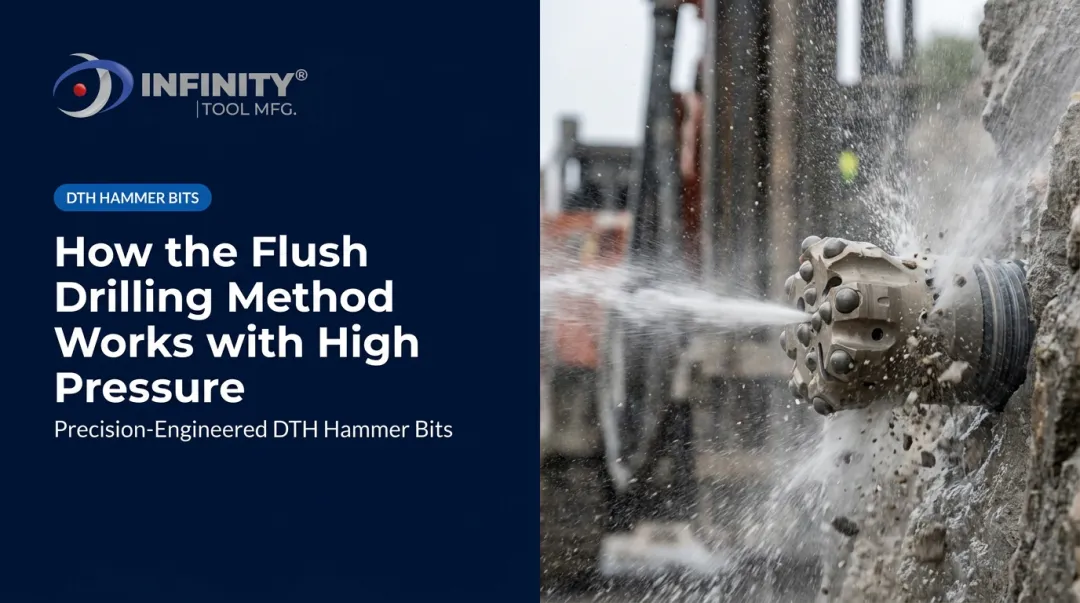
- DTH (down-the-hole) hammer drilling – A compressed-air-powered hammer sits directly behind the bit, delivering rapid percussive blows. Suited to hard rock and coarse boulder formations.
- Cable-tool (percussion) drilling – A heavy tool string repeatedly rises and drops, crushing material that's then removed from the hole. Slower, but effective in mixed formations.
- Auger drilling – Rotating helical flights convey cuttings upward mechanically. Typically limited to shallower depths, around 150 feet, and works best in soil and weathered rock.
- Sonic drilling – High-frequency vibration advances casing and a sampler, delivering strong core recovery in soil, cobbles, and softer rock.
- Reverse circulation drilling – Fluid or air travels down the outer pipe while cuttings return through an inner tube, keeping returns separate from the borehole wall for fast, clean recovery.
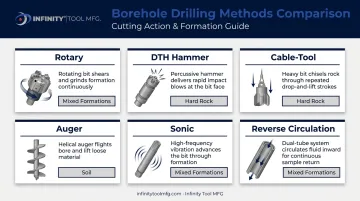
Rotary and DTH methods rely on circulating fluid or air to clear the hole. Auger and cable-tool bring material up mechanically or through repeated impact, no circulation fluid required.
How Does Borehole Drilling Work?
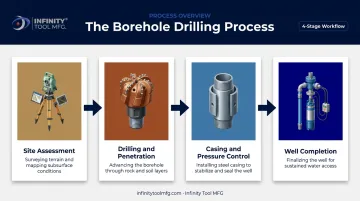
Borehole drilling follows a defined operational sequence. Skipping or rushing any stage is usually where projects run into trouble, whether that's a collapsed hole, a contaminated sample, or a stuck bit.
Initiation: Site Assessment and Setup
Before a single foot of hole is drilled, the site gets evaluated. This includes soil type, topography, target depth, and access for rig equipment.
This stage is largely planning-based:
- Review surveys and geological data
- Complete permitting and regulatory checks
- Finalize rig placement and setup
Modern rigs increasingly use sensor-guided planning tools, but the core work here is still manual judgment. The most common bottleneck? Poor site assessment. Choosing the wrong method for the geology, or setting up on unstable ground, causes delays and rework that cost far more than the assessment would have.
Core Operation: Drilling and Penetration
Here's the working principle in plain terms: a rotating or percussive bit advances through soil and rock while a fluid or air system clears cuttings out of the way continuously.
In practice, drillers usually start with a smaller pilot hole to set the trajectory. A larger bit then widens and deepens the bore, with speed and pressure adjusted as the geology changes layer by layer.
Bit selection matters more here than almost anywhere else in the process. PDC bits shear through formations, tricone bits gouge and crush, and DTH hammers deliver repeated impact for hard rock. According to the International Association of Drilling Contractors, formation transitions can generate vibration that limits how reliably a PDC bit performs across mixed intervals.
This is exactly why bit engineering matters. Premium PDC bits designed for abrasive rock, and DTH hammers built for hard, fractured formations, reduce chatter and keep penetration rates consistent instead of stalling out at every formation change. Manufacturers like Infinity Tool MFG engineer bit ranges specifically around this problem, building tools that hold performance steady as ground conditions shift.
Regulation and Output: Casing, Pressure, and Well Completion
Once the bore advances, it needs stabilizing. Casing, PVC or steel depending on geology, gets installed to keep the hole open and prevent collapse.
For contaminant-sensitive work, the EPA recommends stainless steel casing (304/316) for many organic-contaminant monitoring programs, and rigid PVC meeting NSF Standard 14 for many inorganic or corrosive settings.
Drilling fluid density and circulation get monitored throughout. Fluid does three jobs at once:
- Cools and lubricates the bit
- Carries cuttings out of the hole
- Maintains pressure against the borehole wall
Skip this control and the risks escalate fast: hole collapse, fluid contamination, or in oil and gas work, a blowout. That's why the industry standard for pressure-sensitive wells includes a blowout preventer, a casing-head device built to seal the well and confine fluids if pressure spikes unexpectedly.
With casing set and pressure under control, the process reaches its final stage, producing either a functional well or a set of geological samples.
For water and resource wells, completion means installing screens, filters, and pump systems so the well delivers a consistent, usable yield.
**For exploration and geotechnical projects**, the output is core samples or cuttings sent to a lab for analysis, informing decisions about resource viability or ground stability.
Either way, output quality traces directly back to how well the earlier stages were executed. A properly completed borehole delivers reliable yield or accurate subsurface data. A poorly executed one risks contamination, structural failure, or data that simply can't be trusted.
Where Is Borehole Drilling Used?
Borehole drilling supports several distinct workflows, each with different priorities:
- Resource exploration – Mining and mineral programs prioritize core sample integrity, often combining reverse circulation cuttings with continuous diamond core for a fuller geological picture.
- Water supply development – Waterwell drilling prioritizes casing integrity and long-term yield over speed.
- Geotechnical investigation – Auger and sonic methods dominate here, favoring minimal disturbance and representative sampling over depth.
- Oil and gas drilling – Demands stricter pressure control and well-integrity verification throughout the bore.
- Horizontal directional drilling (HDD) – Relies on a steerable pilot bore followed by reaming passes to reach final diameter.
Method choice tracks closely with formation type. Rotary and DTH handle deep, hard rock efficiently. Auger and sonic suit shallow, minimal-disturbance sampling where preserving sample condition matters more than speed.
Choosing the Right Drilling Tools and Bits
The drill bit is the the single biggest factor in drilling speed, hole quality, and total project cost. Get the bit wrong for the formation, and everything downstream—timeline, equipment wear, sample quality—suffers.
Here's how the main bit categories break down:
| Bit Type | Best Suited For | Cutting Action |
|---|---|---|
| PDC (fixed cutter) | Soft-to-hard abrasive formations | Shears rock rather than crushing it |
| Drag bits | Soft clay and sand | Scrapes through low-abrasion ground |
| DTH hammer | Hard rock, coarse boulders | Repeated percussive impact |
| Tricone/roller cone | Soft-to-hard formations | Gouges and scrapes soft rock; chips and crushes hard rock |
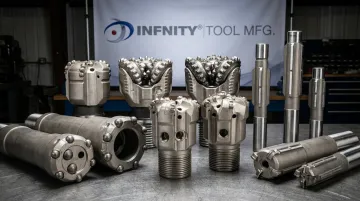
Infinity Tool MFG, based in Benton, Illinois, manufactures across this full range. Its product line includes:
- PDC bits engineered for controlled fluid volume
- DTH hammer bits built for percussive drilling
- Tricones and drag bits for varied formations
- Reamers designed for symmetrical hole cutting
The company's Rock Boss Extreme HDD PDC bits use a concave head design and short skirt geometry to keep the bit centered on the drill string. This reduces side pressure and protects diamond cutters from chipping during directional work.
For operators running oil and gas, waterwell, geothermal, or HDD projects, that kind of formation-specific engineering is what separates a smooth bore from one plagued by chatter and slow penetration.
Conclusion
Borehole drilling is a controlled, multi-stage process. Site assessment, bit selection, casing, and fluid management each protect stability, safety, and output quality across the job.
Matching the right method and bit to the geology in front of you cuts downtime and keeps cost and risk in check, whether you're drilling for water, minerals, energy, or geotechnical data. Infinity Tool MFG builds its PDC and DTH bits around exactly that matching problem, engineering each one for the ground it's cutting through.
Frequently Asked Questions
How much does it cost to drill a borehole?
Costs vary widely based on depth, diameter, geology, and casing type, ranging from a few thousand to tens of thousands of dollars. Get a site-specific quote from a drilling contractor for an accurate estimate.
How long does water from a borehole last?
A well-constructed borehole can supply water for decades with proper maintenance. Actual yield depends on aquifer recharge rate and how heavily the pump is used over time.
How deep does a borehole need to be?
Depth depends entirely on purpose. Domestic water wells in the US have a median depth of around 142 feet, according to USGS groundwater depth data, while oil, gas, and mineral boreholes can extend thousands of feet.
What is the difference between a borehole and a well?
A borehole is the drilled shaft itself, nothing more. A well is the completed structure once casing, screens, and pump systems have been installed inside that shaft.
How long does it take to drill a borehole?
Timelines range from a single day for shallow water wells to several weeks for deep or geologically complex projects. It depends heavily on drilling method and rig power.
What type of drill bit is best for hard rock drilling?
DTH hammer bits and PDC bits both perform well in hard, abrasive rock, though the right choice depends on fracturing and abrasiveness. Infinity Tool MFG manufactures both bit types for hard-rock and specialty drilling applications.