Introduction
Walk onto almost any drilling rig today, whether it's punching through Permian Basin shale or boring a utility crossing under a highway, and you'll find a PDC bit doing the cutting.
By 2015, polycrystalline diamond compact bits accounted for more than 90% of worldwide footage drilled, a staggering jump from less than 5% back in 1988.
That dominance creates a problem of its own. With PDC, PCD, tricone, and hybrid bits all competing for attention, many operators end up grabbing the wrong tool for the formation. The result: burned-up cutters, stalled rigs, and budgets blown on non-productive time.
This guide breaks down what a PDC bit actually is, how it's built, why it outperforms older designs in the right conditions, and how to pick one that matches your formation.
Key Takeaways
- PDC bits shear rock with diamond cutters instead of crushing it like roller cones
- Shearing delivers faster rates of penetration and longer bit life than roller cone designs
- Steel body designs repair easily; matrix body designs resist abrasive formations better
- Soft-to-medium formations favor PDC; harder, abrasive rock may need tricone or hybrid bits
- Infinity Tool MFG engineers custom bit designs matched to specific formation conditions
What Is a PDC Drill Bit?
A PDC (Polycrystalline Diamond Compact) bit is a fixed-cutter drilling tool with zero moving parts. Unlike roller cone bits, which rely on rotating cones with bearings to crush rock, a PDC bit's entire cutting structure is fixed to the bit body. There's nothing to seize, nothing to wear out mechanically.
The technology traces back to 1971, when General Electric developed the first carbide-supported polycrystalline diamond cutter. Hughes Tool Company introduced it commercially the following year, and GE's Stratapax cutter line hit the market in 1976.
Adoption was slow at first: under 5% of worldwide footage in 1988, climbing to 24% by 2000, and finally crossing 90% by 2015, according to Drilling Contractor's historical review.
Here's how the cutter itself is made:
- Technicians place synthetic diamond powder against a tungsten carbide disc
- The disc and powder then endure extreme pressure (often exceeding 800,000 psi) and temperature around 1,400°C
- A cobalt-based catalyst binds the diamond particles into a solid, sintered layer
- The diamond layer fuses permanently to the carbide substrate
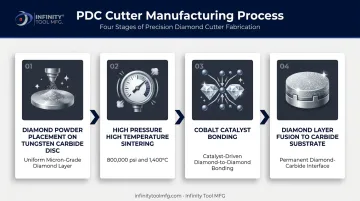
This layered design isn't arbitrary. The diamond table brings extreme hardness and wear resistance, while the tungsten carbide underneath absorbs shock and adds toughness. Diamond alone would crack under impact; carbide alone wouldn't survive abrasion. Together, they cover each other's weaknesses.
What Is the Difference Between PDC and PCD?
This trips up a lot of people, and honestly, the terms get used interchangeably even in industry literature. Here's the clean distinction:
- PCD (Polycrystalline Diamond) refers to the diamond material itself, the sintered diamond layer
- PDC (Polycrystalline Diamond Compact) refers to the finished cutting element, meaning the PCD layer bonded to its carbide substrate
So every PDC cutter contains PCD, but PCD by itself isn't a usable drilling component until it's fused to carbide.
Anatomy of a PDC Drill Bit: Key Components
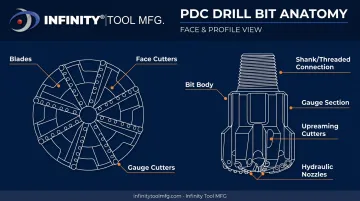
A PDC bit looks simple from a distance, but every part earns its place. Break it down and you've got four structural pieces working together.
- Bit body: The core structure, made of steel or a tungsten carbide matrix, that houses everything else
- Blades: Raised sections radiating from the bit face that carry the cutters and channel cuttings away
- Shank/threaded connection: Transmits torque and weight from the drill string into the bit
- Gauge section: Maintains consistent hole diameter as the bit rotates and advances
The cutters themselves fall into three functional categories:
- Face cutters handle most of the rock removal on the bottom of the hole
- Gauge cutters sit along the bit's outer diameter, holding the borehole to size
- Upreaming cutters face backward slightly, helping the bit clear its own path if it needs to be pulled back through tight sections
Placement matters just as much as cutter type. A well-engineered layout spreads cutting forces evenly across the bit face, so no single cutter takes disproportionate wear.
Nozzles and hydraulic channels round out the design. These direct drilling fluid across the bit face to cool the cutters, clear cuttings, and prevent bit balling, a common issue in sticky clay or shale formations where debris can cake onto the bit and choke performance.
Steel Body vs. Matrix Body PDC Bits
Bit body material changes how the tool performs and how it's serviced.
| Feature | Steel Body | Matrix Body |
|---|---|---|
| Manufacturing speed | Faster | Slower |
| Field repairability | Easier, cutters can be replaced | Limited |
| Abrasion resistance | Moderate | Superior |
| Best fit | Softer, less abrasive formations | Hard, abrasive formations |
Matrix bodies are built from a tungsten carbide matrix infiltrated with a binding alloy, which is why they hold up so well against abrasive rock. Steel bodies trade some of that abrasion resistance for toughness and faster turnaround. Infinity Tool MFG's in-house engineering team chooses between the two constructions based on what the drilling program actually calls for, rather than defaulting to one body type across every job.
Gauge protection is another detail worth watching. Diamond-enhanced inserts and thermally stable polycrystalline elements along the gauge section help the bit hold its diameter over the full run. That consistency matters more than people expect, especially once a bit starts wearing near the end of its life.
How PDC Drill Bits Work and Why They Outperform Older Bit Designs
The core difference between PDC and roller cone bits comes down to motion. PDC cutters shear rock, dragging across the formation in a continuous scraping action, similar to a lathe cutting metal. Roller cone bits crush and grind, using rotating teeth to indent and fracture rock through repeated impact.
Shearing takes less energy than crushing. That translates into:
- Lower required weight-on-bit to achieve the same cutting depth
- Less heat generation at the cutting face
- Higher rates of penetration in suitable formations
- No bearings to fail, since there are no moving parts
Real-world numbers back this up. In one oil-sand lateral benchmark, a contiguous-PCD fixed-cutter design achieved a rate of penetration 117% higher than the average of 29 offset runs, with 30% longer run length before the bit needed pulling. Results like these are formation-specific, but they show what's possible when the cutter design matches the rock.
These performance gains trace back to the cutting material itself. Is diamond really the strongest cutting material available? It's certainly one of the hardest, and according to SLB's oilfield review, diamond is roughly 10 times harder than steel and twice as hard as tungsten carbide.
But hardness isn't the whole story. Diamond cutters are hard yet comparatively brittle, meaning they can chip on impact even though they resist abrasion beautifully. Real-world durability depends on formation type, vibration, and thermal stability just as much as raw hardness.
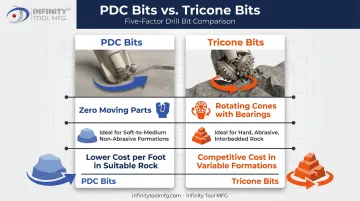
PDC vs. Tricone Bits: Key Differences
| Factor | PDC Bits | Tricone Bits |
|---|---|---|
| Cutting action | Shear/scrape | Crush/grind |
| Ideal formation | Soft to medium, non-abrasive | Hard, abrasive, interbedded |
| Moving parts | None | Rotating cones with bearings |
| Common failure mode | Cutter abrasion, impact chipping | Bearing wear or failure |
| Typical cost per foot | Lower in suitable rock | Competitive in hard, variable formations |
Neither bit type wins everywhere. PDC dominates footage totals because so much of the world's drilling happens in soft-to-medium formations, but tricone bits still earn their keep in hard, interbedded, or highly abrasive rock where shearing cutters wear out fast.
Choosing the Right PDC Bit for Your Drilling Application
PDC bits show up across a wider range of industries than most people realize:
- Oil & gas: Shale, sandstone, and mudstone in vertical and horizontal wells
- Geothermal and waterwell: Often harder, hotter formations requiring abrasion-resistant designs
- Mining: Exploration and production holes through varied rock strata
- Construction and geotechnical: Site investigation and foundation drilling
- Horizontal directional drilling (HDD): Consolidated rock crossings for utility installation
Picking the right bit means evaluating a handful of factors before you ever put steel in the ground:
- Formation hardness: Soft shale and mudstone need different cutter geometry than harder limestone
- Required bit diameter: Match the bit to your bore plan, not the other way around
- Blade and cutter count: More blades add cutting surface but can reduce fluid clearance in sticky formations
- Hydraulic design: Nozzle placement needs to match the cuttings volume you expect to clear
Infinity Tool MFG's in-house engineering and drafting team designs custom PDC bits and reamers, including a taper-and-spiral reamer built for centralization and smoother reaming from pilot hole to finished bore. Diameters range from 1 inch to 17.5 inches, engineered around actual formation data instead of a generic catalog spec.
Not sure which body style or blade count fits your job? That's exactly what a custom design consultation is for.
Frequently Asked Questions
What is polycrystalline diamond compact?
It's a composite material made from a synthetic diamond layer sintered under extreme heat and pressure, then bonded to a tungsten carbide substrate. This composite forms the cutting element used in PDC drill bits.
What is the difference between PDC and PCD?
PCD refers to the diamond material itself. PDC refers to the complete cutting compact, meaning the PCD layer combined with its carbide backing, ready to be mounted on a bit.
Are diamond drill bits the strongest?
Polycrystalline diamond ranks among the hardest synthetic cutting materials available, roughly 10 times harder than steel. Overall bit durability still depends on formation type, impact resistance, and drilling conditions.
How long does a PDC drill bit last?
Lifespan varies widely based on formation abrasiveness, drilling parameters, and bit design quality. A well-matched bit run in the right formation can outlast a poorly selected one by a wide margin under identical conditions.
What is the difference between PDC and tricone drill bits?
PDC bits shear rock with fixed cutters and no moving parts; tricone bits crush rock using rotating cones on bearings. PDC generally suits softer, less abrasive formations, while tricone handles harder, more variable rock.
Can a PDC drill bit be repaired or refurbished?
Steel body PDC bits are generally easier to refurbish since worn cutters can be replaced. Matrix body bits offer superior abrasion resistance but are more limited when it comes to field repair.