This happens on rigs across the world because roller cone bits are not interchangeable parts. Manufacturers build tooth structures differently from one another, which is exactly why the drilling industry adopted a shared classification standard: a system that lets buyers compare bits from different makers using the same reference points instead of guesswork.
This guide breaks down what a tooth bit actually is, how the IADC classification code works, the two major tooth bit families, and how to match the right one to your formation before you ever pick up the phone to order.
Key Takeaways
- IADC three-digit codes decode tooth type, formation hardness, and bearing structure in seconds.
- Milled tooth bits (series 1-3) suit soft-to-medium formations.
- Insert/TCI bits (series 4-8) handle hard, abrasive rock.
- Matching bearing seals to weight-on-bit, RPM, and hole temperature prevents premature bit failure.
- Custom-engineered bits solve mixed or unusually hard formations that off-the-shelf codes can't fully address.
What Is a Tooth Bit? (Definition, Anatomy, and Appearance)
A tooth bit, more formally a roller cone or rock bit, uses cutting elements mounted on independently rotating cones. As the bit turns on bottom, those cones spin and their teeth gouge and crush the rock beneath them, according to SLB's technical overview of bit engineering.
This sets tooth bits apart from fixed-cutter bits, where the cutting surface never moves relative to the bit body.
Recognizing the Structure
If you're inspecting a tooth bit on the rig floor, look for:
- Three cones, each mounted on sealed or unsealed bearings
- Visible tooth or insert patterns cut or pressed into each cone
- A threaded pin connection (commonly API Regular) linking the bit to the drill string
- Nozzles positioned to direct drilling fluid across the cones for cooling and cleaning
Every tooth bit falls into one of two families. Milled tooth bits have steel teeth machined, cast, or forged directly into the cone. Insert bits, often called TCI (tungsten carbide insert) bits, use separately manufactured carbide buttons pressed into holes drilled in the cone.
Why They're Called "Milled Tooth" Bits
The name comes straight from the manufacturing process. Early cutter teeth were machined out of the cone's steel body using a milling process, and the term stuck even as hardfacing and improved metallurgy were added over the decades.
Compare that to a PDC or drag bit, where fixed diamond cutters shear rock in a continuous transverse motion as the whole bit rotates. Tooth bits, by contrast, rely on the rolling, gouging, and crushing action of three independent cones. Neither mechanism is universally faster; it depends entirely on the formation.
Classification of Tooth Bits: The IADC Coding System
The International Association of Drilling Contractors built a unified three-digit code so a buyer could compare a bit from one manufacturer against a competitor's without reading two different spec sheets. The standard traces back to IADC/SPE 23937, the formal roller-bit classification paper that's still incorporated into the IADC Drilling Manual today.
First Digit: Tooth Type and General Formation Range
- Series 1-3: Steel/milled tooth bits, running from softest (1) to hardest (3) formations
- Series 4-8: Insert (TCI) bits, running from softest (4) to hardest and most abrasive (8)
Second Digit: Formation Hardness Subdivision
Each series above splits into four finer grades, from softest (1) to hardest (4). A quick reference:
| First Digit | Bit Type | Second Digit Range | Meaning |
|---|---|---|---|
| 1-3 | Milled tooth | 1-4 | Soft to hard within that series |
| 4-8 | TCI (insert) | 1-4 | Soft to extremely hard/abrasive within that series |
Third Digit: Bearing and Structural Features
This digit tells you what's happening mechanically inside the bit:
| Code | Feature |
|---|---|
| 1 | Standard open (unsealed) roller bearing |
| 2 | Air-cooled open bearing |
| 3 | Open bearing with gauge protection |
| 4 | Sealed roller bearing |
| 5 | Sealed roller bearing with gauge protection |
| 6 | Journal sealed bearing |
| 7 | Journal sealed bearing with gauge protection |
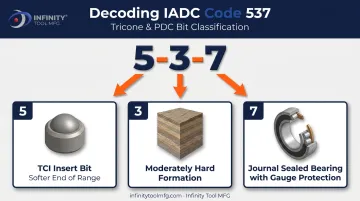
Decoding a Real Code: IADC 537
Take a bit marked 537:
- 5 = a TCI insert bit, on the softer end of the insert range
- 3 = the third hardness subdivision within that series (moderately hard)
- 7 = journal sealed bearing with gauge protection
That single number tells you tooth type, formation range, and bearing design before you even open a spec sheet. Still, the IADC code doesn't capture everything: insert geometry, carbide grade, and hydraulics vary by manufacturer. Verify formation-specific performance data with Infinity Tool MFG's engineering team before finalizing a purchase order.
Types of Tooth Bits: Milled Tooth vs Insert (TCI) Bits
Both bit families exist to solve the same problem, breaking rock efficiently, but they're built for opposite ends of the hardness spectrum.
Milled Tooth Construction and Best-Fit Formations
Milled tooth bits use integral steel teeth machined from the cone, sometimes reinforced with hardfacing for extra wear resistance. They perform best in soft-to-medium formations such as clay, shale, and soft limestone.
Infinity Tool Manufacturing's mill tooth tricones, for instance, are rated for formations up to roughly 6,000 PSI compressive strength. They typically run at 40 to 60 RPM, with maximum weight-on-bit specs of 21,000 lbs on a 5-1/2" bit and 24,000 lbs on a 6-1/2" bit.
TCI Construction and Best-Fit Formations
TCI bits press tungsten carbide buttons or chisel-shaped inserts into the cone body. That construction covers a much wider hardness range, extending into hard, abrasive rock where milled teeth wear out fast. Industry TCI ranges commonly span from around 5,000 PSI up through 50,000+ PSI, covering everything from harder sandstone through basalt.
| Factor | Milled Tooth | TCI (Insert) |
|---|---|---|
| Construction | Steel teeth machined into cone, may be hardfaced | Carbide inserts pressed into drilled cone holes |
| Formation suitability | Soft to medium | Medium to extremely hard/abrasive |
| Durability in abrasive rock | Lower | Higher |
| Rock-breaking mechanism | Gouging and scraping (long, offset teeth) | Crushing and indentation (shorter, denser insert layout) |
| Relative upfront cost | Lower | Higher |
The Cost and Lifecycle Trade-Off
TCI bits generally cost more upfront, but that premium buys longer bit life in abrasive formations, fewer trips, and less rig downtime.
Independent, formation-matched cost-per-foot comparisons between milled and TCI bits are hard to find publicly, so treat any blanket percentage claim with skepticism. What matters in practice is matching the insert grade and bearing seal to your specific formation, not chasing a generic ratio from a brochure.
That formation-specific matching gets more complicated when the rock itself won't stay consistent. For interbedded formations, where hardness swings sharply across a single bore, hybrid or mixed-insert roller cone configurations combine cone rows with different insert geometries on one bit. That avoids swapping bits mid-run when the rock changes underneath you.
How to Select the Right Tooth Bit for Your Drilling Application
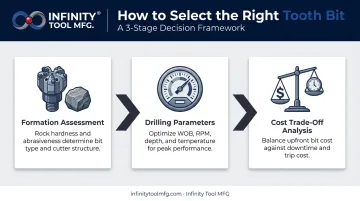
Formation assessment comes first, always. Before anything else, determine hardness and abrasiveness, since that decision alone tells you whether you need an IADC 1-3 milled tooth bit or a 4-8 series insert bit.
From there, layer in your drilling parameters:
- Weight-on-bit and RPM – higher WOB and faster RPM push toward sealed or journal bearings (third digit 4-7) rather than open bearings.
- Expected penetration rate – slower expected ROP in hard rock often justifies the extra cost of gauge-protected inserts.
- Hole depth and temperature – deeper, hotter holes put more stress on seals, favoring journal sealed bearing designs.
Finally, weigh upfront tool cost against total trip and downtime cost. A cheaper bit that fails early and forces an unplanned trip almost always costs more than the pricier option that finishes the interval. Consulting Infinity Tool MFG's in-house engineering team, rather than relying on the IADC code alone, reduces the risk of premature bit failure.
Advantages and Limitations of Tooth (Roller Cone) Bits
Core advantages:
- Combined gouging-and-crushing rock-breaking action works across a wide range of formations
- Properly designed nozzles actively clean cones and cutters while cooling the bit
- Sealed designs deliver measurable rig-cost savings in application-specific cases
- One Green Canyon directional drilling case reported $150,000 to $300,000 in savings over an established PDC application, with some bits logging over 1 million revolutions without seal failure
Key limitations:
- Moving cones and bearings are mechanically vulnerable, especially under high-speed or high-heat conditions
- Penetration rates can lag behind fixed-cutter bits in homogenous, non-abrasive formations
- High rotational speeds (well above the typical 50-150 RPM range) generate heat that fatigues bearing seals faster
When a formation is largely uniform and non-abrasive, and consistent, high-speed penetration matters more than impact resistance, a tooth bit may not be the optimal choice.
When to Consider PDC or Custom-Engineered Bits Instead
PDC (polycrystalline diamond compact) bits use fixed diamond cutters that shear rock continuously as the bit rotates, rather than crushing it in a rolling motion. In many formations, that delivers faster, more consistent penetration than a rotating tooth bit can match.
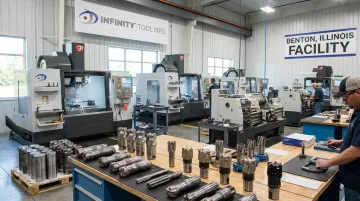
This is where working with a manufacturer that engineers both bit types pays off. Infinity Tool Manufacturing designs and machines custom PDC bits, drag bits, and reamers in-house at its Benton, Illinois facility, for oil & gas, geothermal, water well, HDD, construction, and mining applications.
That in-house CNC capability means a formation that doesn't fit neatly into an off-the-shelf IADC code can still get a purpose-built solution, with diameters spanning 1 inch to 48 inches across the product line.
Mixed, unusually hard, or highly abrasive formations call for a conversation with an engineering team before defaulting to whatever bit type worked on the last well. Consider custom design when facing:
- Mixed formations with alternating hard and soft layers
- Unusually hard rock that shortens tricone bit life
- Highly abrasive formations that accelerate tooth wear
Custom design support, backed by over a decade of hands-on tricone and PDC manufacturing experience, often optimizes total drilling cost more effectively than classification charts alone.
Frequently Asked Questions
What is a tooth bit?
A tooth bit is a roller cone drill bit that uses rotating cones fitted with steel or tungsten carbide teeth to crush and gouge rock. It contrasts with fixed-cutter bits, which have no moving parts.
What are the different types of tooth bits?
The two primary categories are milled tooth bits (IADC series 1-3, best for soft-to-medium formations) and insert or TCI bits (IADC series 4-8, built for hard, abrasive rock).
What does a tooth bit look like?
It has three cones mounted on bearings, each showing visible teeth or carbide inserts, connected to the drill string through a threaded pin connection at the top.
What is the difference between a tooth bit and a PDC bit?
A tooth bit crushes and gouges rock through rotating cones, while a PDC bit uses fixed diamond cutters that shear rock continuously as the bit turns. Formation hardness and abrasiveness usually determine which performs better.
What does the IADC code on a tooth bit mean?
The three digits represent tooth type and general formation range, a finer hardness grade within that series, and the bearing or structural design, such as sealed or gauge-protected bearings.
How do I choose the right tooth bit for my formation?
Start by assessing formation hardness and abrasiveness, match that to the correct IADC series, then confirm bearing type against your WOB, RPM, and hole conditions. Consulting Infinity Tool MFG's in-house engineering team helps avoid costly guesswork.