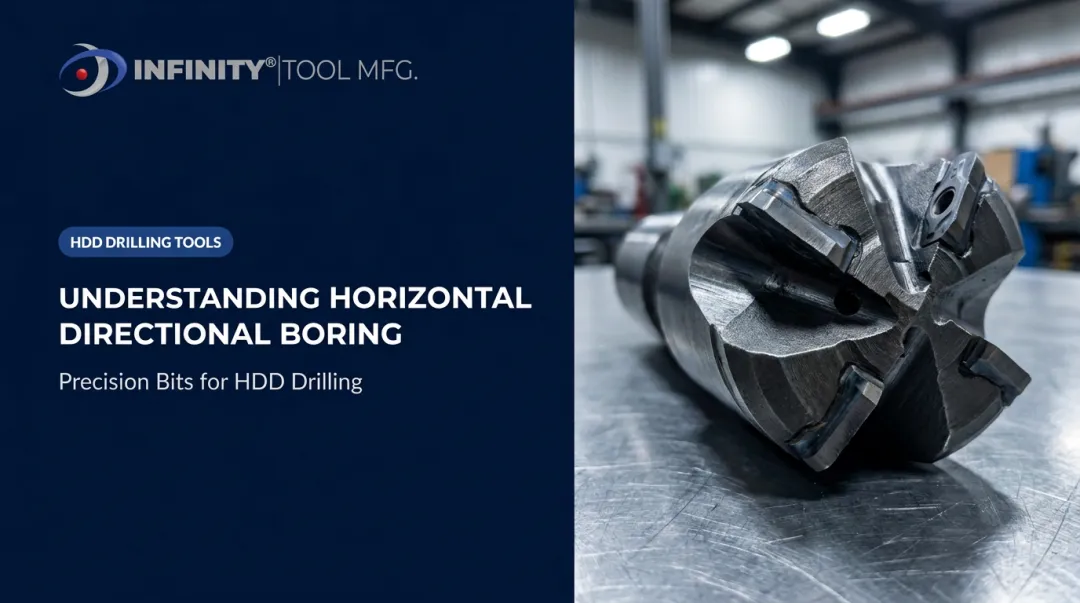
Most HDD guides cover pilot bores, reaming, and pullback in general terms. Few explain what changes once you're grinding through granite instead of gliding through sand. This guide fills that gap: what defines HDD rock drilling, how rock hardness dictates tool choice, the essential tools you need, the challenges that trip up experienced crews, and best practices drawn from Infinity Tool MFG's decade of manufacturing rock drilling tools.
Key Takeaways
- Compressive strength (psi/MPa) determines the right bit: PDC, tricone, or DTH hammer
- Rock drilling demands slower footage and a different steering mindset than soil boring
- Purpose-built tooling cuts downhole failures and total job costs more than budget alternatives
- Tapered, spiral reamer designs speed up hole enlargement while protecting diamond cutters from chipping
What Is HDD Rock Drilling?
HDD rock drilling is horizontal directional drilling conducted through rock formations rather than soil, clay, or sand. It requires specialized bits, hammers, and steering approaches that soft-ground tooling simply can't handle.
The mechanical difference matters. Soil boring relies mostly on hydraulic excavation, meaning fluid pressure does the work of displacing material. Rock drilling flips that: mechanical crushing or shearing from the tool itself does the heavy lifting, with drilling fluid playing a supporting role for cooling and cuttings removal.
The Three-Phase Process in Rock
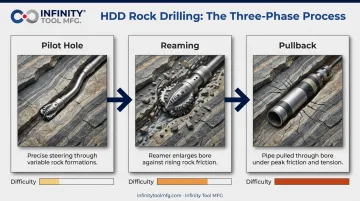
HDD still follows the same three-phase sequence in rock as in soil, but every phase gets harder:
- Pilot hole: A steerable drill string cuts a narrow guide path along the design profile, with steering precision far more critical in fractured or hard rock
- Reaming: Rock reamers enlarge the pilot hole in one or multiple passes, often replacing standard soil openers for added durability
- Pullback: Crews pull the product pipe through the enlarged bore, with rock-created friction and hole stability playing a bigger role than in clay or sand
Can HDD drill through rock? Yes. With the correct tooling and technique, contractors regularly bore through granite, basalt, and limestone. What changes is productivity and risk: footage rates drop, tooling wear accelerates, and steering tolerances tighten considerably.
Rock drilling has become enough of a specialty that many general HDD contractors sub out the rock-heavy stretches of a bore to specialists with the right equipment and experience. This shows up across several industries:
- Oil & gas pipeline installations crossing rock ridges or riverbeds
- Geothermal & water well drilling through bedrock formations
- Construction projects requiring utility routing beneath rock-laden sites
- Utility crossings for telecom, fiber, water, and sewer lines beneath rock obstacles
Understanding Rock Hardness and Formation Types
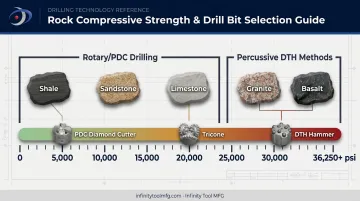
Rock hardness isn't a guess. It's measured through unconfined compressive strength (UCS), typically expressed in psi or MPa, and it's the single biggest input into tool selection.
Industry-standard rock strength classifications, based on established rock mechanics research, break down like this:
| Strength Class | UCS (psi) | Typical Rock Types |
|---|---|---|
| Weak | 725 - 3,625 | Shale, mudstone |
| Medium Strong | 3,625 - 7,250 | Sandstone, soft limestone |
| Strong | 7,250 - 14,500 | Dense limestone |
| Very Strong | 14,500 - 36,250 | Granite, basalt |
These figures line up with real-world lab results, where granite specimens have tested between 19,000 and 34,000 psi and basalt has averaged around 24,700 psi (Rocscience, "Intact Rock Strength").
As a practical rule for HDD tooling decisions, formations up to roughly 25,000 psi (sand, shale, mudstone, sandstone, softer limestone) suit rotary/PDC drilling, while formations above roughly 30,000 psi (granite, basalt, hard limestone) call for percussive DTH methods.
Beyond Raw Hardness
Compressive strength alone doesn't tell the whole story. Three other variables shape tool wear and bit selection:
- Abrasivity: how much the rock grinds down cutting surfaces over footage drilled
- Fracture state: whether the formation is solid, broken, or heavily fractured
- Rock density: impacts penetration rate and torque requirements
Skipping ground investigation is where budgets get blown. Before bidding, pull rock samples and send them for lab testing, specifically compressive strength and abrasivity tests. That data point is what separates an accurate tooling quote from an expensive guess.
If your crew hits unexpected rock mid-bore:
- Stop and gather soil or rock samples from cuttings if possible
- Document current tooling condition and wear patterns
- Consult with your tooling manufacturer before continuing. Pushing forward with the wrong bit often causes more damage than the delay of pausing to check.
Essential Tools for HDD Rock Drilling
Tool selection is the single most important decision for HDD rock drilling economics. Get it wrong, and you're looking at lost footage, stuck strings, or a bit that simply won't cut the formation in front of it.
PDC (Polycrystalline Diamond Compact) Bits
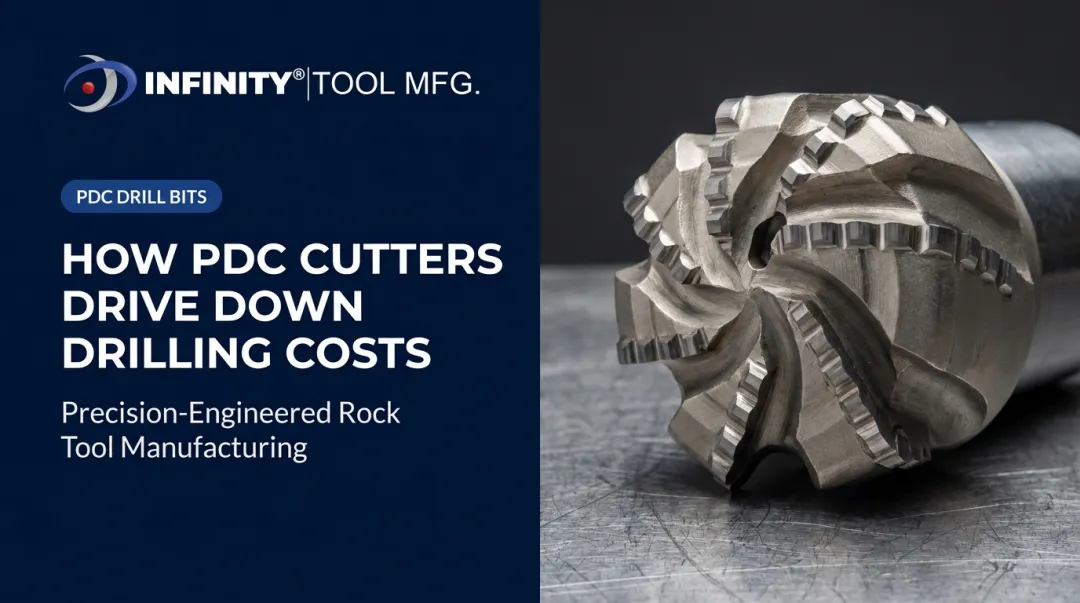
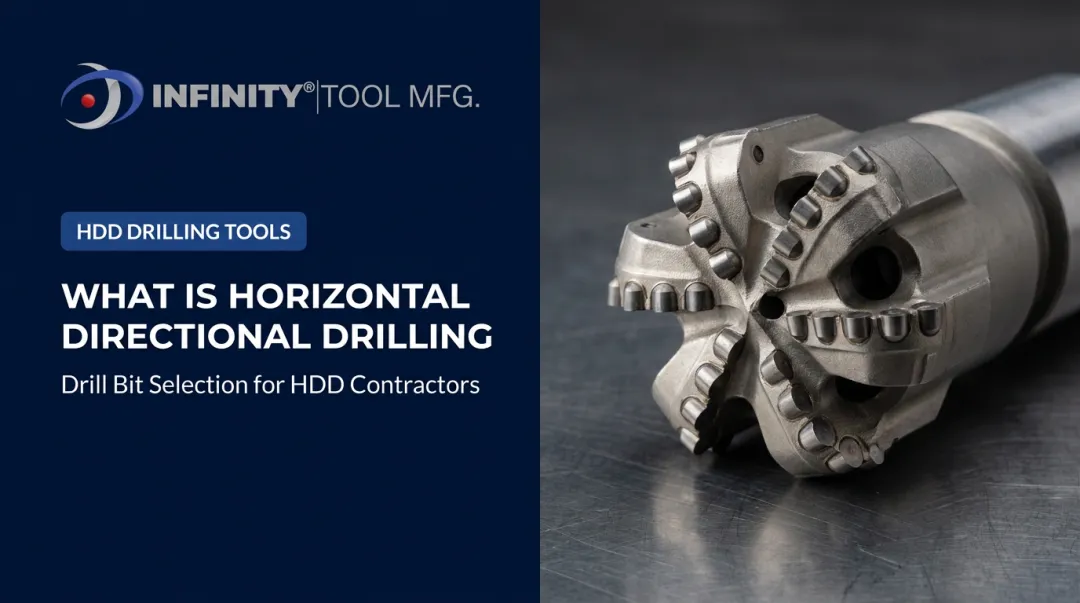
PDC bits use synthetic diamond cutters to shear rock rather than crush it. They're best suited to low-to-medium hardness formations and offer several advantages:
- Higher penetration rates than percussive alternatives in suitable rock
- Lower torque requirements, easing strain on the drill string
- Less vibration, which protects steering accuracy
- Clean, consistent hole geometry
Diamond compact tables are durable, testing around 20 times stronger in compression than granite (SLB, "Defining Series: Bits"). That durability is exactly why PDC dominates the softer end of the rock spectrum, but it's not a universal fix for every formation.
Roller Cone (Tricone) Bits
Tricone bits use rotating cones fitted with mill tooth or tungsten carbide inserts (TCI) to crush rock under applied pressure rather than shear it. This makes them versatile across a wide hardness range, particularly in fractured or mixed formations where a PDC cutter might chip.
Their strength is impact resistance. When a bore transitions through broken rock with unpredictable voids, tricones tend to hold up better than diamond cutters, which perform best against solid, homogeneous formations.
DTH (Down-the-Hole) Hammers
For very hard rock like granite and basalt, DTH hammers change the mechanism entirely. Instead of relying on rotation alone, a pneumatic percussive hammer delivers rapid impact behind a carbide bit, fracturing rock through repeated blows.
Why it matters in abrasive formations:
- Faster penetration rates than rotary methods in hard rock
- Lower relative wear compared to PDC in highly abrasive conditions
- Better performance where compressive strength exceeds roughly 30,000 psi
Reamers and Hole Openers
Once the pilot hole is set, PDC reamers and hole openers progressively enlarge it through rock. Design matters here. Tapered and spiral centralized profiles protect diamond cutters from chipping while keeping the hole symmetrical, which reduces drag during pullback.
Infinity Tool MFG builds this into two specialized product lines: the Rock Boss Extreme and Cobble Boss Extreme, engineered specifically for challenging rock and cobble conditions to help crews complete bores up to 50% faster than traditional reaming methods allow.
Common Challenges in HDD Rock Drilling
Rock drilling narrows the margin for error in a specific way: high torque combined with steering demands creates a more volatile environment than anything soft ground throws at you.
That volatility shows up fast on the jobsite, often as one of these warning signs of tooling mismatch:
- Lost tooling downhole, often from a bit that couldn't handle the formation
- Aggressive wear on sub savers or drive chucks
- Poor locator signal strength, sometimes caused by excessive vibration
- Unusual fuel consumption or pressure readings on the rig
Behind most of these warning signs sit three recurring mistakes:
- Over-steering: Rock doesn't forgive aggressive corrections the way clay does, and forcing a correction can snap or bind the string
- Inadequate drilling fluid volume: Even in rock, fluid still cools the bit and clears cuttings; skimping on volume accelerates wear
- Choosing cheaper tooling: A bit that fails at 40% of expected footage doesn't save money. It drives up total project cost through downtime, retrieval, and replacement
Best Practices for Successful HDD Rock Drilling
Getting through rock cleanly comes down to preparation and discipline, not luck.
- Investigate before you bid. Pull core samples, run compressive strength and abrasivity tests, and confirm bit type with your tooling manufacturer for that specific rock.
- Reset your footage expectations. Rock isn't soil. Patient, methodical steering prevents costly downhole errors from rushing an unfamiliar bore.
- Invest in purpose-built tooling. Infinity Tool MFG engineers PDC bits, DTH bits, tricones, and reamers specifically for rock, with in-house engineering support that cuts downhole failures.
Frequently Asked Questions
Can HDD drill through rock?
Yes. With correct tooling like PDC bits, tricones, or DTH hammers, HDD crews regularly bore through rock formations. Productivity and steering precision are more demanding than in soil, though.
What is HDD in drilling?
HDD (horizontal directional drilling) is a trenchless method for installing underground pipe, conduit, or cable. It works through a pilot hole, reaming, and pullback sequence, all without open trenching.
What is the difference between HDD and tunneling?
HDD uses a steerable drill string and drilling fluid to bore a relatively small-diameter path with no personnel entering the excavation. Tunneling excavates a larger passage, often involving personnel or machinery working inside it.
What type of drill bit is best for hard rock in HDD?
DTH hammers generally work best for very hard, abrasive rock above roughly 30,000 psi. PDC bits suit softer-to-medium rock, while tricones offer versatility across fractured formations.
How do you determine rock hardness before drilling?
Send rock samples to a qualified lab for compressive strength (psi) and abrasivity testing. Finalize tooling selection only after that data comes back, not before.
What is the difference between a PDC bit and a DTH hammer?
PDC bits rotate and shear rock with diamond cutters, ideal for softer formations. DTH hammers use percussive pneumatic impact behind the bit, better suited for very hard, abrasive rock like granite.