](https://file-host.link/website/infinitytoolmfg-qpmg1k/assets/blog-images/2a6e9d4e-b2b6-4d60-9263-8f6ee311621e/1784647508089388_11db1b2e81eb42b88d790f54485039d0/360.webp)
Miss one link in that chain, and the whole operation slows down. Bit wear accelerates. Pipe gets stuck. Costs climb.
Understanding how these tool categories work together isn't just technical trivia. It's what separates a drilling program that hits target depth on schedule from one that bleeds money on non-productive time. This guide breaks down the major tool categories, what each one does, and how to match them to your project.
Key Takeaways
- Drilling tools fall into four categories: cutting tools, drill string components, circulation/solids control, and well control equipment
- Mismatched tools increase bit wear, cause stuck pipe, and raise cost per foot
- Choose tools based on formation hardness, drilling method, and depth, not habit or price
- Custom-engineered bits and reamers often outperform generic tools in tough formations
What Are Oil and Gas Drilling Tools?
Oil and gas drilling tools are the mechanical, hydraulic, and safety equipment used to create, stabilize, and control a wellbore from the first spud to final completion.
These tools don't operate in isolation. They function as a coordinated system:
- The bit cuts through rock at the bottom of the hole
- The drill string transmits rotation and weight down to that bit
- The fluid system carries cuttings back to surface and cools the bit
- The safety tools contain pressure and prevent uncontrolled releases
Think of it less like a toolbox and more like a relay team. Each piece has to hand off cleanly to the next, or the whole run breaks down.
That's why tool selection comes down to formation and depth, not generic specs pulled off a shelf. A bit that performs beautifully in soft shale can chip apart in abrasive limestone, so the right choice always depends on what's actually downhole.
Why Are Drilling Tools Important in Oil & Gas Operations?
The right tool combination directly affects penetration rate, wellbore stability, and total project cost. Get it wrong, and the financial impact shows up fast.
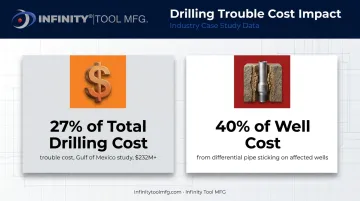
The numbers back this up. In a Gulf of Mexico drilling analysis covering 1999 through 2004, Anadarko found that 27% of total drilling cost from spud through evaluation came from "trouble cost". These problems tie directly to equipment and process failures. That's over $232 million in one case study alone.
Differential pipe sticking is one specific culprit. According to an SPE deep-rig case study, sticking problems alone can account for as much as 40% of total well cost on affected wells.
What actually goes wrong when tool selection misses the mark:
- Excessive bit wear from using a cutter structure not suited to formation hardness
- Hole washout from poorly designed reamers that can't hold gauge
- Stuck pipe from inadequate stabilization or the wrong BHA configuration
- Safety incidents tied to pressure control failures on the rig floor
That reality pushes more operators toward manufacturers with real engineering capability, not just a catalog. Infinity Tool MFG's in-house engineering and drafting team at its Benton, Illinois facility designs custom PDC and DTH bit configurations when a formation doesn't match anything off the shelf — and that capability matters more than chasing the lowest quote.
Common Types of Oil and Gas Drilling Tools
"Drilling tools" is really an umbrella term. It covers several functional categories, each addressing a different stage or challenge in the process. Understanding how they fit together helps you build a complete drilling system rather than obsessing over a single component while ignoring the rest.
Drill Bits (Cutting Tools)
The drill bit sits at the bottom of the drill string and does the actual work of breaking rock to create the borehole. Everything else in the system exists to support this one component.
Four bit types dominate the market:
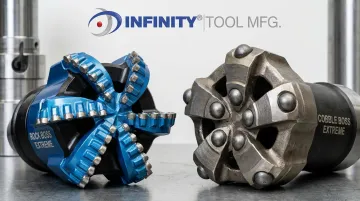
- PDC (polycrystalline diamond compact) bits shear through rock using fixed synthetic-diamond cutters, with no moving parts. They dominate soft-to-medium formations, having drilled more than 90% of worldwide footage as of 2015.
- Tricone/rotary bits use three rotating cones with teeth or carbide inserts to crush and gouge rock, well-suited to mixed or interbedded formations.
- DTH (down-the-hole) hammer bits deliver repeated piston impacts straight to the bit face, making them the go-to choice for hard rock, mining, and geothermal work.
- Drag bits plow and scrape with fixed blades, best for shallow, soft-formation drilling where speed matters more than durability.
Infinity Tool MFG engineers PDC, DTH, and drag bits in-house at its Benton, Illinois facility, including proprietary designs like the Rock Boss Extreme and Cobble Boss Extreme, built specifically for demanding drilling conditions where standard catalog bits fall short.
Where each type shines:
| Bit Type | Best For | Limitation |
|---|---|---|
| PDC | Soft-to-medium, efficiency-focused formations | Cutters can chip in highly abrasive rock |
| Tricone | Mixed or interbedded formations | Slower penetration than PDC in soft ground |
| DTH | Hard rock, mining, geothermal | Less efficient in soft formations |
| Drag | Shallow, soft-formation work | Wears quickly in deep, hard rock |
Reamers & Hole-Opening Tools
A reamer enlarges a pilot hole to its final bore diameter. Its job is straightforward on paper: create a consistent, symmetrical wellbore. In practice, poor reamer design is one of the fastest ways to lose a hole.
A centralized, tapered, and spiraled reamer design solves several problems at once. It:
- Controls drilling fluid volume more precisely
- Reduces chatter and torque fluctuation during the ream pass
- Enables reaming from pilot to finish bore in a single pass on most holes
Infinity Tool MFG's PDC reamer line applies this approach, using taper and spiral geometry to centralize the tool in the pilot hole and protect the diamond cutters from chipping.
Reamers earn their keep on horizontal directional drilling (HDD), geothermal, and water well projects where a true-to-gauge bore isn't optional. The tradeoff: reamers add cost and complexity compared to a simple bit pass. They're worth it when bore accuracy actually matters to the project outcome, not as a default addition to every run.
Drill String & Downhole Components
Drill pipe, drill collars, stabilizers, and downhole motors make up the connective tissue between the surface and the bit. Drill pipe transmits axial and torsional loads and carries fluid down to the cutting structure.
Drill collars add concentrated weight, keeping the thinner drill pipe in tension rather than compression. Stabilizers and downhole motors then take over the directional side of the job, centralizing the assembly and controlling trajectory.
This becomes especially critical in directional drilling programs, where a bent-housing motor can steer the well without rotating the entire string.
This category is where structural integrity and directional accuracy live. Get the bottomhole assembly wrong, and you'll see it in vibration, wear, and off-target wells.
Circulation & Solids Control Tools
Mud pumps, shale shakers, degassers, and mud cleaners manage the drilling fluid that keeps everything else running. This fluid cools the bit, removes cuttings, and helps control downhole pressure.
- Mud pumps drive fluid down the string, through the bit, and back up the annulus
- Shale shakers vibrate cuttings out of returning fluid before it recirculates
- Degassers strip entrained gas, including methane and H2S, from the mud
- Mud cleaners combine hydrocyclones with a shaker for finer solids removal
This system matters most in continuous operations, where consistent fluid quality directly affects rig uptime. Degraded mud means slower penetration and higher risk of a hazardous gas buildup on surface.
Well Control & Handling Tools
Blowout preventers (BOPs), stabbing guides, safety clamps, and elevators protect personnel and prevent uncontrolled releases. These tools don't drill anything, but they're what keeps a high-pressure well from becoming an incident.
- BOPs shut in the wellbore to stop underground fluids from escaping when a kick occurs
- Stabbing guides align pipe connections and protect threads from impact damage
- Safety clamps guard against dropped tubulars during handling
- Elevators grip and lift drill pipe, casing, or collars during trips
These tools are non-negotiable on high-pressure wells and on any rig where repeatable, precise pipe handling is part of the daily routine.
How to Choose the Right Drilling Tools for Your Project
Formation characteristics and project goals should drive tool selection, not whatever the crew used last time or whatever costs least upfront. Before specifying a bit or reamer, run through the variables that actually affect performance downhole.
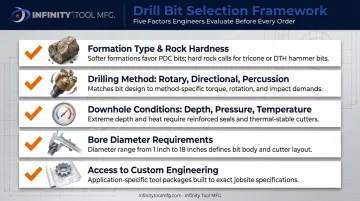
Factors to Consider
- Formation type and rock hardness: soft, medium, hard, or abrasive changes everything about bit and reamer choice
- Drilling method: rotary, directional, or percussion (DTH) each demand different tool geometry
- Downhole conditions: depth, pressure, and temperature affect material selection and tool durability
- Bore diameter requirements: determines whether reaming or hole-opening is necessary
- Access to custom engineering: matters most when conditions don't fit a standard catalog product
Get these factors wrong, and even a well-made bit will underperform or fail early, which is exactly where the following mistakes creep in.
Common Mistakes to Avoid
- Choosing a generic bit or reamer without matching it to actual formation hardness data
- Ignoring reamer design details like taper, spiral, and centralization, which risks hole washout or cutter damage
- Chasing the lowest upfront price instead of evaluating total cost per foot drilled
- Working with suppliers who can't engineer custom solutions when conditions fall outside standard offerings
A tool that costs less per unit but wears out twice as fast isn't actually cheaper. Total cost per foot is the number that matters.
Conclusion
Drilling depends on a system, not a single hero component. Bits cut, string components transmit force, circulation equipment manages fluid, and safety tools contain pressure. When each piece functions correctly, the whole operation runs smoothly.
Matching tool type to formation and project conditions is what separates efficient drilling programs from ones eaten up by delays and rework. When standard catalog tools don't fit the geology in front of you, custom engineering becomes essential. Manufacturers like Infinity Tool MFG, which offer both proven designs and in-house custom capabilities, help ensure the right tool shows up on location.
Frequently Asked Questions
What is petroleum drilling?
Petroleum drilling is the process of boring a wellbore into the earth to access oil and gas reservoirs. It uses a rotating bit and drill string, with drilling fluid circulated throughout to remove cuttings and control pressure.
What tools do oil rig workers use?
The main categories include drill bits, drill pipe and collars, mud pumps, blowout preventers (BOPs), and handling tools like stabbing guides and elevators. Each serves a distinct role in cutting, transmitting force, or maintaining safety.
What is the most commonly used drill bit in oil and gas drilling?
PDC bits are the most widely used today, thanks to their efficiency across a broad range of soft-to-medium formations. DTH and tricone bits remain the preferred choice for harder or mixed formations.
What is the difference between a PDC bit and a tricone bit?
A PDC bit shears rock using fixed synthetic-diamond cutters with no moving parts. A tricone bit uses three rotating cones with teeth or inserts to crush and grind rock. This design suits harder or interbedded formations better.
What is a reamer used for in drilling?
A reamer enlarges a pilot hole to its final bore diameter, ensuring a symmetrical, accurately sized wellbore. It is especially critical in HDD, geothermal, and water well projects where bore accuracy matters.
What safety tools are essential on a drilling rig?
Blowout preventers, stabbing guides, and safety clamps are core safety equipment. They prevent uncontrolled fluid releases and reduce the risk of pipe-handling accidents on the rig floor.