
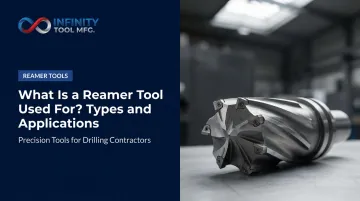
That's where a reamer comes in. It's a precision cutting tool built specifically to enlarge and finish a hole that's already been drilled, taking it from "close enough" to exact.
Reamers show up everywhere from CNC machine shops building aerospace components to oil & gas rigs stabilizing boreholes thousands of feet underground. This article breaks down what a reamer actually is, why the reaming step matters, the main types you'll encounter, and how to pick the right one for your application.
TL;DR
- Reamers finish pre-drilled holes to exact diameter, roundness, and surface quality that drilling alone can't achieve.
- Applications span automotive, aerospace, construction, and rock drilling/HDD, covering burr removal, sizing, and hole stability.
- Main types include hand, machine/chucking, shell, and specialty PDC reamers for rock drilling.
- The right choice depends on hole size, material hardness, volume, and tolerance requirements.
What Is a Reamer Tool?
A reamer is a multi-fluted rotary cutting tool designed to enlarge and finish an existing hole to a precise diameter and surface finish. It doesn't create holes from scratch. That's a drill bit's job. Kennametal describes reaming as a finishing operation that removes only a small, controlled amount of material from a hole already close to the target size (Kennametal, 2025).
Basic Construction
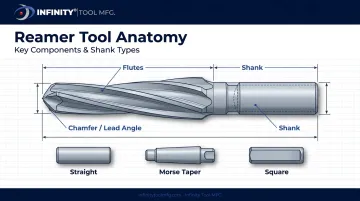
Most reamers share a common anatomy:
- Flutes: straight or spiral channels that carry cutting edges and evacuate chips
- Chamfer/lead angle: the tapered entry that guides the tool into the hole
- Shank: straight, Morse taper, or square, depending on how the tool mounts
As the reamer rotates and advances into the hole, it shaves away a thin layer of material along its cutting edges, correcting size and roundness rather than removing bulk stock.
Reamer vs. Drill Bit: What's the Difference?
This is one of the most common questions in the shop. A drill bit bores through solid material to create a hole. A reamer refines a hole that already exists.
- Drill bit: Cuts fast, removes bulk material, leaves rough walls and imprecise diameter
- Reamer: Cuts slowly and precisely, corrects roundness, size, and surface finish
Reamers turn up across a surprisingly wide set of industries: automotive and aerospace assembly, oil & gas, geothermal, and general construction drilling. In nearly every case, reaming is the second stage of a two-step process: drill first, then ream.
Why Is Reaming Important in Machining and Drilling?
Reaming matters because it delivers dimensional accuracy and surface finish that drilling simply can't. In precision assembly work, holes for dowel pins or bearing fits often require tolerances tighter than a drill bit can hold on its own.
Guhring's HR 500 reamer line, for example, documents application results reaching IT5 to IT8 tolerance grades and surface finishes as fine as Ra 0.8 on cast-iron components Guhring's 2018 HR 500 catalog data.
Those are product-specific benchmarks, not guarantees for every job, but they illustrate the precision reaming is capable of.
What Happens Without Proper Reaming
Skip the reaming step (or do it poorly) and problems compound fast:
- Oversized or rough hole walls that won't hold a precision fit
- Poor part alignment during assembly
- Accelerated wear on mating components
- Costly rework or scrapped parts
These issues often surface only after assembly, when the cost of correction is highest.
Reaming in Heavy-Duty Drilling
The same principle scales up dramatically in rock drilling. In horizontal directional drilling (HDD), reaming opens the pilot hole to slightly larger than the carrier pipe diameter, and larger pipe often requires multiple passes to reach final bore size a 2019 Trenchless Technology industry interview.
In these long-bore applications, maintaining consistent diameter across the entire run is critical. Infinity Tool MFG designs its PDC reamers with this in mind. The tool geometry reduces chatter and torque fluctuation across varying ground conditions, keeping the bore consistent from start to finish.
Types of Reamers
Reamers aren't one-size-fits-all. They vary by drive method, flute design, and intended application, whether that's a hand tool in a maintenance shop or a heavy-duty rig chewing through rock. Choosing correctly comes down to hole size, material hardness, production volume, and whether the job is manual or machine-driven.
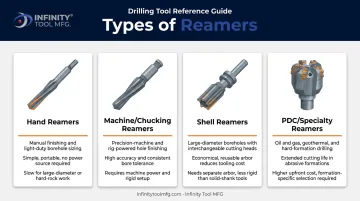
Hand Reamers
Hand reamers are turned manually, typically with a tap wrench. They feature a long tapered lead that helps the tool self-guide into the hole without machine alignment.
- Best suited for: Low-volume finishing, maintenance work, field or shop jobs without CNC access
- Key strengths: Simple, portable, inexpensive for occasional precision work
- Limitations: Slower and less consistent than machine-driven options; not built for high-volume production
Machine (Chucking) Reamers
These reamers mount in drill presses, lathes, and CNC machines via straight or Morse taper shanks. Because the machine itself provides alignment, chucking reamers use a much shorter lead-in taper than hand reamers.
- Best suited for: Repetitive, high-accuracy production runs
- Key strengths: High repeatability, fast cycle times, available in HSS or carbide for different materials
- Limitations: Require a rigid machine setup and a pre-drilled hole within tolerance to work correctly
Shell Reamers
Shell reamers have no integral shank. Instead, they mount on a separate arbor and are fluted along nearly their entire length. Manufacturer catalogs commonly place these tools starting around 3/4 inch and up, though some lines start slightly smaller.
| Feature | Detail |
|---|---|
| Typical diameter range | ~3/4 in and above (varies by manufacturer) |
| Mounting | Separate arbor with lug-driven engagement |
| Best for | Large bores, bearing housings |
- Key strengths: Cost-effective for big-diameter work; one arbor swaps between multiple reamer sizes
- Limitations: Added setup complexity; not practical for small-diameter holes
Specialty and Rock Drilling Reamers (Including PDC Reamers)
This category covers purpose-built tools: tapered reamers, adjustable reamers, and heavy-duty PDC (polycrystalline diamond compact) reamers used in oil & gas, geothermal, water well, and HDD drilling. Rather than finishing a shop-machined hole, these tools widen and stabilize a borehole under load.
PDC underreamers are a documented technology in oil & gas borehole enlargement, used for deepwater and other applications requiring hole widening beyond the pilot diameter, according to a 2011 SPE technical paper. Geothermal drilling uses similar reamer technology to restore hole diameter when gauge wear shrinks the bore.
Infinity Tool MFG's PDC reamer line (including Pull Reamers, Push Reamers, and Maxi Rig Shark Reamers) is engineered with a tapered, spiral cutter layout for centralized, symmetrical cutting. The intent behind this geometry is to let the tool ream from pilot to finish bore in a single pass on most jobs, while helping shield the diamond cutters from chipping.
- Key strengths: Built for tough ground conditions; designed to move faster than repeated conventional reaming passes
- Limitations: Higher upfront cost; often application-specific rather than off-the-shelf
How to Choose the Right Reamer for the Job
Choosing the right reamer means matching the tool to the hole's specific demands, not simply grabbing the most advanced option on the shelf.
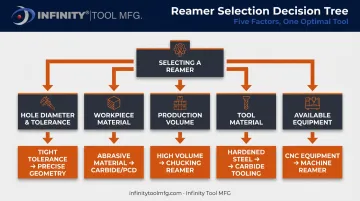
Consider these factors before you buy:
- Hole diameter, depth, and tolerance: tighter tolerances demand more precise tool geometry and stock removal control
- Workpiece material: soft metals, hardened steel, composites, and rock formations all behave differently under a cutting edge
- Production volume: a one-off job favors a hand reamer; repetitive CNC runs favor chucking reamers
- Tool material: HSS works fine for softer metals; carbide or PCD handles abrasive or hardened conditions
- Available equipment: hand tools, drill press, lathe, or a drilling rig all dictate which reamer type is even feasible
As a starting reference, Kennametal recommends leaving the pre-reamed hole roughly 3% undersized (Kennametal, 2025). Specific inch allowances scale by diameter, for example 0.010 in under 1/4 in or 0.015 in for 1/4–1/2 in. Always defer to the specific tool manufacturer's allowance table when one is available.
In demanding drilling environments, such as abrasive ground, deep boreholes, or unusual formation conditions, working with a manufacturer that offers custom-engineered designs matters. Infinity Tool MFG's in-house engineering team works directly with drilling contractors to match reamer geometry to specific ground and material conditions, ensuring each tool fits its intended job precisely.
Conclusion
Reamers make holes precise, smooth, and consistently sized, whether that's a dowel-pin fit in a machine shop or a stabilized borehole hundreds of feet underground. Which specific reamer works best depends on the application:
- Hand reamers for quick field fixes
- Chucking reamers for repeatable CNC production
- Shell reamers for large-diameter bores
- Heavy-duty PDC reamers for rock drilling under real load
Choosing the right type cuts rework, extends tool life, and keeps production moving. Infinity Tool MFG manufactures reamers across this full range, including PDC pull, push, and Maxi Rig Shark Reamers built for demanding drilling conditions.
Frequently Asked Questions
What do you use a reamer for?
Reamers enlarge, finish, and smooth pre-drilled holes to precise diameters. They remove burrs and prepare holes for tight-tolerance fits like dowel pins or bearings.
Why use a reamer instead of a drill bit?
Drills create holes but leave rough or slightly inaccurate diameters. Reamers refine those holes afterward for roundness, size accuracy, and a smooth surface finish.
What materials can you use a reamer on?
Reamers work across metals like aluminum, steel, cast iron, and stainless steel, plus plastics. Specialty PDC designs extend this to rock formations in drilling applications.
What is the difference between reaming and drilling?
Drilling creates a hole from solid material. Reaming is a secondary finishing operation that enlarges an existing hole by a small, controlled amount for precision.
How do you determine the right pre-drill size for a reamer?
A common rule of thumb is leaving roughly 3% of the reamer's diameter as stock, though the exact allowance varies by material hardness and tool manufacturer specs.
What is a PDC reamer and where is it used?
PDC reamers use polycrystalline diamond cutters in a tapered, spiral design to widen and stabilize boreholes. They're common in oil & gas, geothermal, and HDD drilling operations.