What changes is everything else. Use the wrong bit for the material and you get chipped edges, overheated tips, snapped shanks, or a drilling rig burning expensive hours on a hole that should've taken minutes.
This guide breaks down the major drill bit categories, from hardware-store staples to the purpose-engineered rock bits used in oil & gas, geothermal, and mining. You'll learn what each bit does best, what materials and coatings affect performance, and how to pick the right one instead of just grabbing what's closest.
Key Takeaways
- Wood, metal, masonry, and rock each need different bit types; none are interchangeable
- Twist drills suit general-purpose work; masonry, spade/auger, step, and specialty bits target specific jobs
- Bit material (HSS, cobalt, carbide) and coatings determine tool life and speed
- Hard-rock and large-scale jobs need purpose-built PDC, DTH, or drag bits
- Matching bit to formation and rig avoids wasted time, broken tools, and injuries
What Is a Drill Bit and Why Does the Right Choice Matter?
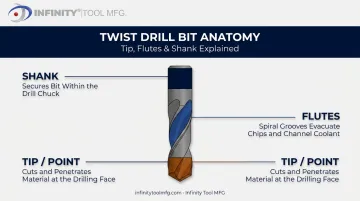
A drill bit is an interchangeable cutting tool that mounts into a drill, drill press, or drilling rig and rotates (sometimes with added hammering force) to bore a hole into a material. Three parts define how it performs:
- The tip/point: does the actual cutting or shearing
- The flutes: helical grooves that carry debris and cuttings away from the hole
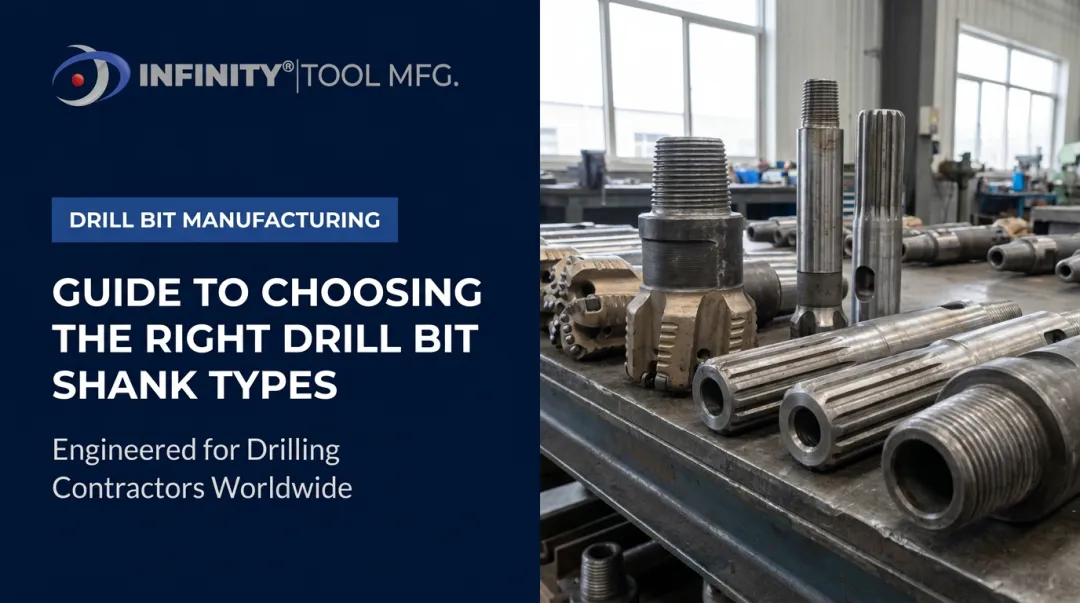
- The shank: the end that locks into the chuck or drive system
Manufacturers engineer these parts around a specific material. A wood bit's tip cuts fibers cleanly but can't grind through aggregate. A masonry bit's carbide tip withstands hammering impact, not fine metalwork. Swap them and one of two things happens: the bit dulls almost instantly, or it breaks.
This shows up beyond the workshop, too. A CPWR study on concrete drilling found that worn carbide-tipped bits caused a large and statistically significant drop in drilling productivity, along with longer worker exposure to vibration. On a job site, a worn or mismatched bit adds real cost and safety risk, not just wasted time.
Types of Drill Bits and Their Uses
Drill bits are grouped by the material and application they're built for. No single bit performs well across wood, metal, masonry, and rock, which is why dozens of distinct types exist. Below, we move from common handheld bits to the heavy-duty tools used in construction, horizontal directional drilling (HDD), and rock drilling.
Twist Drill Bits
The twist drill is the general-purpose workhorse of the bit world. Its helical flutes lift chips away from the cutting edge as it bores through wood, metal, or plastic.
Point angle matters more than most people realize:
- 118°: the standard general-purpose angle, self-centering for hand-drilled holes
- 135°: flatter, often used on harder materials and some stainless applications
- Manufacturers also produce 140° and other specialized geometries for particular jobs
There's no single "harder material, lower angle" rule: point geometry is application-specific and varies by manufacturer, not a fixed formula. Twist bits come in the widest range of sizes and materials, including HSS, cobalt, and carbide, making them the default choice for everyday drilling.
Masonry Drill Bits
Masonry bits pair a tungsten carbide tip with a steel body, designed to work with hammer drills that combine rotation with a hammering action. That hammering is what separates them from twist bits: masonry material doesn't cut cleanly and needs to be pulverized and cleared.
These bits handle:
- Brick and block
- Standard concrete
- Natural stone and limestone
The limitation: standard masonry bits wear quickly in reinforced concrete or dense rock. Full-carbide heads and rebar-rated designs exist for tougher jobs, but once you're consistently hitting rebar or hard aggregate, you're pushing past what a masonry bit was designed for.
Spade and Auger Bits (Wood)
Both bore holes in wood, but they solve different problems.
- Spade bits: flat-tipped, fast, built for rough holes. Ideal for running electrical cable or plumbing lines where finish doesn't matter.
- Auger bits: spiral-fluted with a screw tip that self-feeds into the wood, producing deeper, cleaner holes with less wandering.
The trade-off is straightforward: spade bits prioritize speed and will splinter the exit hole; augers prioritize precision and take a bit longer to set up. If you're drilling for a doorknob and don't care about the back side, grab a spade bit. If you're boring deep, structural, or visible holes, use an auger.
Step Drill Bits
Step bits look like a cone-shaped staircase, and that's exactly how they work: a single bit drills multiple hole diameters as you push it deeper. One tool replaces a whole set of twist bits for certain jobs.
- Best for: sheet metal and thin materials, along with general wood and metal accessory work
- Coating advantage: titanium-nitride coating reduces friction and heat buildup as the bit spins through progressively larger steps
Step bits aren't limited strictly to sheet metal and plastic; some manufacturers rate them for wood and metal drilling accessories too. What they aren't built for is thick or hardened material; the staggered design depends on relatively thin stock to work cleanly.
Glass, Tile, and Hole Saw Bits
These are specialty tools for specific hole types, each demanding its own technique.
- Glass and tile bits use a carbide spear-point tip that cuts clean, round holes with minimal chipping. They need slow rotary-only speed and often a wet start to prevent cracking. Plowing in at full speed shatters brittle material fast.
- Hole saw bits are serrated circular blades that cut large-diameter holes in wood, metal, or plastic while leaving the core intact, useful for door locksets, plumbing penetrations, or electrical box cutouts.
Both require patience: angled or slow starts, steady pressure, and (for metal hole saws) cutting oil to manage heat. Neither is a high-speed, general-purpose tool.
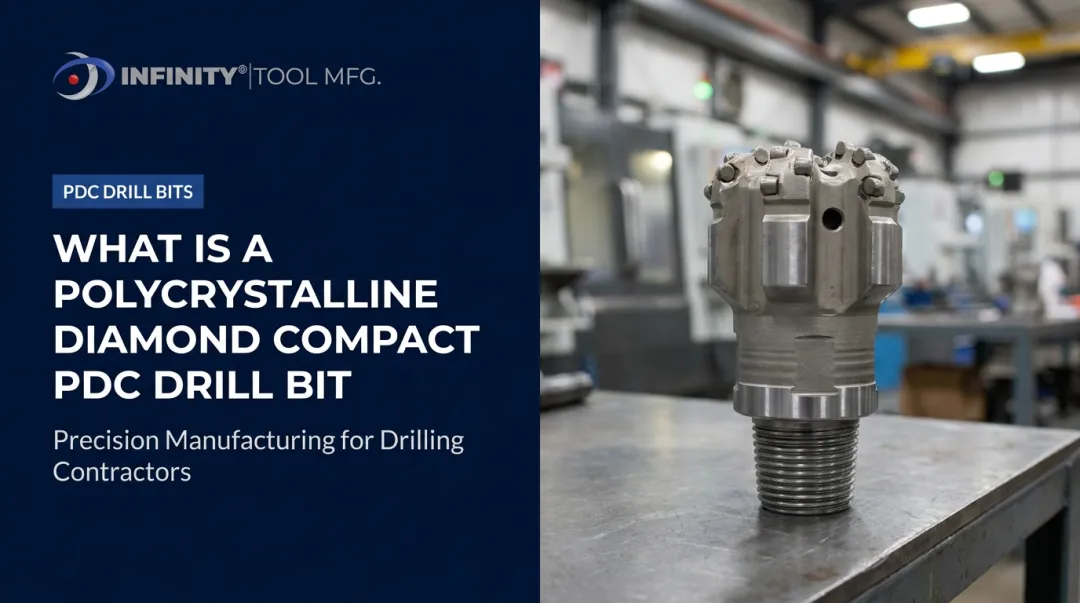
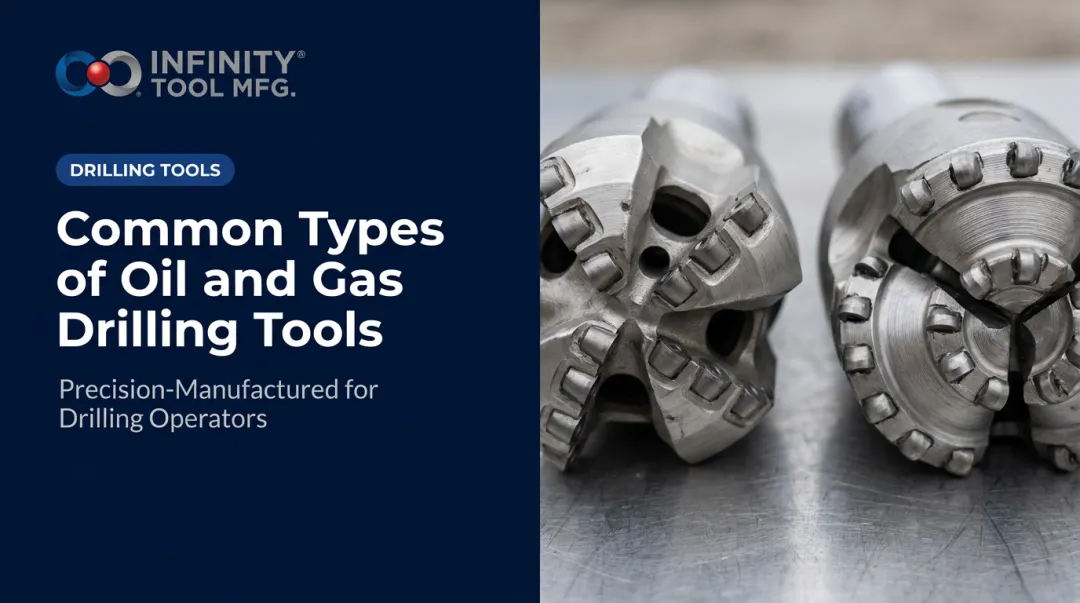
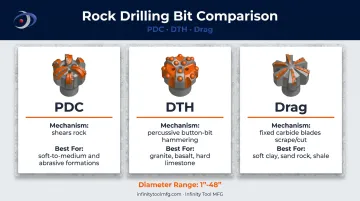
Industrial and Rock Drilling Bits (PDC, DTH, and Drag Bits)
Once you're past household and light construction work, standard twist and masonry bits stop being relevant. Oil & gas, geothermal, water well, HDD, and mining operations rely on purpose-engineered rock tools instead.
| Bit Type | Mechanism | Best For |
|---|---|---|
| PDC | Diamond cutters shear rock | Soft-to-medium and increasingly harder/abrasive formations |
| DTH | Percussive button-bit hammering | Granite, basalt, hard limestone, shale |
| Drag | Fixed carbide-insert blades scrape/cut | Soft-to-medium clay, sand rock, shale |
Diameters in this category scale dramatically depending on the application: some catalogs range from roughly 1 inch up to 48 inches. In this world, bit selection carries real financial weight. According to SPE's Journal of Petroleum Technology, with some rig rates exceeding $1 million per day, saving even a few drilling minutes through proper bit selection can save tens of thousands of dollars.
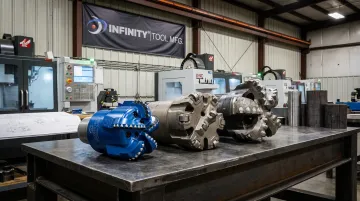
Infinity Tool Manufacturing builds this category in-house at its ISO 9001:2015-certified Benton, Illinois facility, including PDC bits, DTH hammer bits, tricone bits, directional hammer bits, drag bits, and cable tool bits. Beyond standard catalog sizes, the company also develops proprietary designs like the Rock Boss Extreme and Cobble Boss Extreme, engineered specifically for drilling conditions that wear out generic bits fast.
Drill Bit Materials, Coatings, and Sizing
Bit material determines how hard, how hot, and how long a bit can cut before it dulls. In order of hardness and cost:
- Carbon steel — basic, low-cost, limited to soft materials
- High-speed steel (HSS) — tough and forgiving, the standard for general-purpose bits
- Cobalt steel — HSS with added cobalt (often 5-8%), improving heat resistance and edge life for metal work
- Carbide-tipped — a carbide cutting head joined to a steel body, common in masonry bits
- Solid carbide / PCD — maximum hardness and wear resistance for the most demanding jobs, though more brittle and less forgiving of unstable setups
Coatings extend bit life without changing the base material:
- Black oxide — improves abrasion resistance on the substrate
- Titanium nitride (TiN) — reduces abrasive and adhesive wear, cutting friction
- Titanium aluminum nitride (TiAlN) — handles higher cutting temperatures, useful in demanding production work
Sizing conventions differ by category. Handheld and shop bits use fractional-inch, wire gauge, letter, or metric sizing systems (ISO 235:2016 governs standard parallel-shank drills).
Industrial and rock drilling bits skip that system entirely. They're specified by diameter in inches to match the rig's drive system and the borehole requirement — whether that's a 6-inch water well bit or a 14-inch PDC bit for a geothermal project.
How to Choose the Right Drill Bit
The right bit depends on three factors working together, not just whatever's already in the case.
- Material hardness and type. Wood, metal, masonry, and rock each demand a different bit category and tip material. This is the first filter; get it wrong and nothing else matters.
- Hole size, depth, and finish requirements. A rough utility hole calls for a spade bit; a deep, clean bore calls for an auger; a thin sheet metal panel calls for a step bit.
- Equipment compatibility. A handheld drill, a drill press, and a rig each have different shank requirements and size limits. A bit that fits a hammer drill won't necessarily fit a rig's drive system.
For large-scale or rock drilling work, there's a fourth factor: who's making the bit. Generic, off-the-shelf options often can't handle mixed or abrasive formations.
Working with a manufacturer that offers in-house engineering, like Infinity Tool Manufacturing's custom PDC, DTH, and drag bit programs, solves this problem. Matching bit design precisely to formation conditions and rig specs, rather than settling for the closest catalog size, is what keeps a drilling program on schedule.
Conclusion
Drill bits are foundational tools across construction, manufacturing, and drilling operations of every scale, from a water well installation to an oil & gas exploration rig. Dozens of distinct types exist for one simple reason: no single bit performs well across every material and condition.
Understanding those differences, and choosing purpose-built tools for demanding applications, is what separates a fast, safe, cost-effective drilling job from one that burns time and money on avoidable tool failure.
Frequently Asked Questions
What are the categories of drill bits?
Drill bits fall into five broad categories: twist drills, masonry bits, wood bits (spade/auger), specialty bits (glass, tile, step, hole saw), and industrial/rock drilling bits (PDC, DTH, drag bits). Each is built for a specific material and use case.
What is the most common type of drill bit?
The twist drill bit is the most widely used. Its general-purpose design and helical flutes let it work across wood, metal, and plastic, making it the default choice for most jobs.
What drill bit is best for drilling metal?
HSS bits handle general metal drilling well. Cobalt bits are preferred for stainless steel and harder alloys, since the added cobalt improves heat and abrasion resistance.
How do I know what size drill bit to use?
Match the bit diameter to the fastener size or hole specification using a standard drill bit size chart. Chart options include fractional inch, wire gauge, letter, or metric, depending on your region and tool type.
What's the difference between HSS and carbide drill bits?
HSS is more affordable and forgiving for general-purpose use. Carbide holds an edge far longer and handles harder, more abrasive materials, but it's more brittle and less tolerant of unstable setups.
What type of drill bit is used for drilling into rock or concrete?
Masonry bits handle brick and standard concrete for construction work. Harder rock formations in mining, geothermal, or HDD applications require specialized PDC, DTH, or drag bits engineered for those specific conditions.