
Choosing the right drilling type isn't just a technical preference. It affects penetration rate, hole quality, cost per meter, and how long your bits actually last. With more than 2,300 active critical-mineral projects representing $431.9 billion in potential investment as of January 2025, according to E&MJ's 2025 Global Mining Project Spending Outlook, the pressure on drilling capacity and productivity has never been higher.
This article breaks down the major drilling methods used in mining today, how they differ mechanically, and how operators match them to geology, depth, and project stage.
Key Takeaways
- Mining drilling supports four stages: exploration, development, production, and blasting.
- Five methods dominate mining: rotary (drag/PDC), top hammer, DTH, diamond core, and blast hole drilling.
- Rock hardness, hole depth, and diameter determine which method works, not convenience.
- Application-matched bits improve penetration rate, hole straightness, and cost per meter.
What Is Drilling in Mining?
Mining drilling is the process of creating boreholes in rock or soil. These holes support exploration sampling, blast-hole charging, ground support installation, or dewatering, depending on the project phase.
Drills accomplish this through three basic mechanisms:
- Rotation: a bit spins and shears rock through torque and downward pressure
- Percussion: a hammer delivers repeated impact to fracture rock
- Hybrid systems: combining rotation with impact for harder formations
Cuttings get cleared from the hole using air, water, or occasionally foam flushing, depending on whether the operation is above or below ground.
Drilling is the operational starting point of the mining cycle. Whatever happens at the borehole, whether it's straight or crooked, on-target or off, ripples through every stage that follows: blasting, fragmentation, loading, and hauling.
Why Drilling Matters to Mining Operations
Hole placement and depth determine the difference between a clean blast and a costly mess.
When drilling is done right, you get better fragmentation, less secondary breaking, and controlled cost per meter. When it's done poorly, the list of problems grows fast:
- Uneven fragmentation that requires secondary blasting
- Excessive dust, vibration, or airblast
- Premature bit wear from mismatched tooling
- Missed ore zones from inaccurate placement
- Unstable ground conditions post-blast
According to Epiroc's SED Reference Book, hole deviation alone can trigger uncontrolled fragmentation, intersecting-hole misfires, secondary breaking, and wasted explosives.
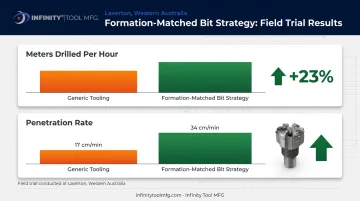
In one field trial in Western Australia's Laverton district, a formation-matched bit strategy delivered 23% more meters drilled per hour, doubling penetration to 34 cm/min. That's the kind of gain that comes from matching tooling to rock, not from a faster rig.
Types of Drilling in Mining
Mining drilling isn't one-size-fits-all. The right method depends on rock hardness, hole depth and diameter, whether you're exploring or producing, and whether you're working on the surface or underground.
Each type below solves a different problem: sample quality, penetration speed, hole straightness, or cost efficiency. Rarely does one method do all four well.
Rotary Drilling (Drag & PDC Bit Drilling)
Rotary drilling uses a continuously rotating bit combined with downward pressure to shear through rock. Drag bits and PDC-style cutters are the most common tooling here.
How it differs: Unlike percussive methods, rotary drilling relies on torque and weight-on-bit rather than repeated impact. It's a grinding, shearing action rather than a hammering one.
Best suited for:
- Softer sedimentary rock like salt, silt, and soft limestone
- Large-diameter blast holes (Epiroc lists 200-440 mm as typical rotary diameters)
- Exploration drilling in unconsolidated ground
Key strengths: Rotary drilling produces smooth, low-vibration boreholes with minimal noise compared to percussive methods. Infinity Tool's PDC and drag bit designs are built around a one-piece high-grade alloy steel body, with concave head geometry and back-out cutters that reduce side pressure and protect diamond cutters from chipping in these softer conditions.
Limitations: Performance drops off fast in hard, abrasive rock. Epiroc notes drag cutting is strictly limited by abrasiveness and becomes impractical in quartz-bearing formations, where cutter wear accelerates and torque demand climbs.
Top Hammer (Percussive) Drilling
In top hammer drilling, the hammer mechanism sits at the top of the drill string. Impact energy travels down the rods to the bit, while rotation clears cuttings from the hole.
How it differs: Energy is delivered from a distance, transmitted through rod strings rather than generated at the bit face.
Best suited for: Medium-hard rock and holes up to roughly 30 meters. Epiroc places conventional top-hammer quarry drilling at 51-165 mm diameters within that depth range.
Key strengths: Speed and fuel economy. In favorable rock conditions, top hammer rigs typically run cheaper per meter than DTH alternatives.
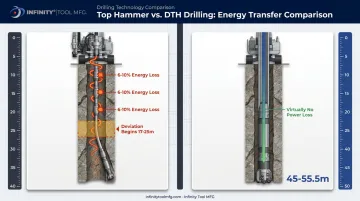
Limitations: Energy attenuates as rod strings lengthen. Epiroc's data shows the stress wave loses 6-10% of its energy at every additional coupling, and hole strings typically begin deviating between 17 and 25 meters. Past that point, straightness and efficiency both suffer.
DTH (Down-The-Hole) Drilling
DTH drilling places the hammer directly behind the bit, at the bottom of the hole. Impact energy transfers straight to the rock face with almost no loss along the way.
How it differs: Where top hammer systems lose energy over distance, DTH delivers impact at the point of contact. Epiroc describes this as "virtually no power loss," regardless of hole depth.
Best suited for: Deep, hard, abrasive formations that demand straight, consistent boreholes. Optimum tool diameter runs 90-254 mm, and specific rig configurations reach depths of 45 to 55.5 meters.
Key strengths: Straighter holes and consistent penetration rates, even as depth increases. Infinity Tool's DTH bit range covers 2 to 18 inches in diameter, with configurable face shapes (concave, convex, flat, double gauge) and button profiles built for sustained high-impact contact in hard rock.
Limitations: DTH systems demand serious compressor capacity. Field examples show requirements as high as 23-25 m³/min at 24 bar, or up to 870 cfm at 28 bar for larger hammers. That's a real equipment and fuel cost to weigh against the depth and straightness gains.
Diamond Core Drilling (Exploration)
Diamond core drilling uses a diamond-impregnated bit mounted on hollow rods to cut and retrieve a continuous cylindrical rock core.
How it differs: This method prioritizes sample recovery over rock-removal speed, retrieving an intact geological sample for analysis.
Best suited for: Exploration and geotechnical programs that need precise data on rock composition, structure, and mineral content.
Key strengths: No other method recovers geological samples with the same completeness and low contamination risk. That precision matters when a resource estimate or geotechnical model depends on it.
Limitations: It's slow and expensive. According to Boart Longyear, reverse circulation drilling typically runs three times faster and half the cost per meter compared to diamond core drilling. Diamond core isn't built for production-scale rock removal, and trying to use it that way burns budget fast.
Blast Hole Drilling
Blast hole drilling patterns holes into rock benches that get charged with explosives to fragment large volumes of material.
How it differs: Blast hole drilling is classified by purpose rather than mechanism, since rigs running rotary or DTH systems typically execute it.
Best suited for: Open-pit production and underground development where large-scale fragmentation drives the operation forward.
Key strengths: Done well, it enables controlled, high-volume rock breakage ahead of loading and hauling. Epiroc's rule-of-thumb ratios put spacing at 1.25 times burden, with subdrilling around 0.3 times burden.
Limitations: Precision matters here more than almost anywhere else. Poor hole spacing or depth planning risks:
- Uneven fragmentation
- Flyrock and airblast
- Wasted explosive charge
- Secondary breaking downstream
A 2025 basalt-quarry study using UAV-supported blast design reduced flyrock range by an average of 42%, simply by tightening burden accuracy before charging.
How to Choose the Right Type of Drilling
The right method depends on your geology, your project stage, and what you're trying to achieve, not what's newest or what your crew already knows how to run.
Factors to Consider
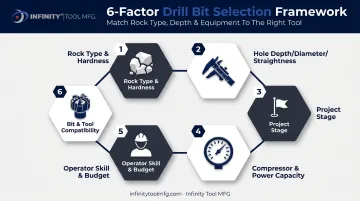
Work through these before committing to a method:
- Rock type and hardness: Soft sedimentary ground favors rotary; hard abrasive formations push you toward DTH.
- Hole depth, diameter, and required straightness: Top hammer works fine to about 30 meters; beyond that, DTH's consistent energy delivery starts to pay off.
- Project stage: Exploration calls for diamond core or RC; production calls for blast hole patterns executed with rotary or DTH rigs.
- Compressor and power capacity: DTH's air demand can outstrip what a smaller site is equipped to supply.
- Operator skill and equipment budget: Some methods require more specialized handling than others.
- Bit and tool compatibility: Match tooling to formation type and rig specs instead of forcing a generic bit to do a job it wasn't built for. Manufacturers like Infinity Tool Mfg offer custom-engineered PDC, drag, and DTH bits for exactly this purpose.
What to Check Before Finalizing a Drilling Method
A few final checks tend to save operations real money down the line:
- Don't over-engineer it. Choosing DTH or diamond core when a simpler top hammer or rotary method would meet the need just adds cost without added benefit.
- Respect known limitations. Energy loss in top hammer rigs at depth and high air demand in DTH systems aren't minor footnotes. Plan around them.
- Factor in bit wear, not just rig cost. A cheaper rig with fast-wearing bits can cost more over a project's life than a pricier setup with durable tooling.
- Assess actual rock conditions. Defaulting to whatever equipment is already on site, rather than what the geology demands, is one of the most common (and expensive) mistakes in drilling program planning.
Conclusion
Drilling is the foundation of every mining operation. It shapes blasting outcomes, worksite safety, and cost efficiency long before the first load hits the truck.
Each method covered here (rotary, top hammer, DTH, diamond core, and blast hole drilling) solves a different problem, and none of them is universally "best." The operator who matches technique to ground, and pairs it with well-engineered bits, runs safer and faster programs.
Infinity Tool MFG designs PDC, DTH, and tricone bits for these mining applications, engineered to withstand the demands each method creates.
Frequently Asked Questions
What is a mining drill?
A mining drill is heavy-duty equipment used to bore holes in rock for blasting, exploration, or ground support. It works through rotary force, percussive impact, or a combination of both.
What drills are used for mining?
The primary types are rotary, top hammer, DTH, diamond core, and blast hole drilling. Each is used across surface and underground operations depending on rock conditions and project goals.
How effective is a mining drill?
Performance comes down to matching rig type and bit quality to the rock you're drilling. Well-matched setups consistently achieve faster penetration rates and lower cost per foot than generic tooling.
What is the difference between top hammer and DTH drilling?
Top hammer drilling places the hammer at the top of the drill string, transmitting impact through the rods. DTH drilling places the hammer at the bit itself, delivering impact directly and maintaining straighter holes at greater depths.
Which type of drilling is best for hard rock formations?
DTH drilling is generally preferred for hard, abrasive rock. Its direct impact delivery loses minimal energy regardless of hole depth, unlike top hammer systems.
How deep can mining drilling rigs drill?
Top hammer rigs typically reach around 100 feet before deviation becomes a problem. DTH rigs commonly reach 150 to 180 feet or more, though exact capability varies by rig specification and rock conditions.