The wrong bit doesn't just slow you down. It multiplies trips, adds downtime, and drives cost-per-foot through the roof. In one documented case, standard PDC bits in abrasive, high-strength formations needed 4-8 runs before an optimized design cut that down and saved roughly $2 million in trip time.
This guide breaks down the top drill bit types for hard rock, how they compare, and the factors that actually determine which one belongs on your rig.
Key Takeaways
- PDC and DTH hammer bits generally outperform other options in hard, abrasive rock
- Match bit choice to rock hardness (UCS), hole diameter, and rig specs, not price alone
- Cost-per-foot economics matter more than upfront bit cost
- Custom-engineered bits often outlast generic options in extreme drilling conditions
Overview of Drill Bits in the Rock Drilling Industry
A rock drill bit is the cutting tool at the business end of a drill string. It's responsible for breaking rock, whether through shearing, crushing, or percussive impact. The bit you choose shapes penetration rate, hole quality, and how many trips you'll make before the job's done.
These tools show up across a wide range of applications:
- Oil & gas exploration and production wells
- Mining and quarry blast-hole drilling
- Geothermal well construction
- Water well and construction drilling
- Horizontal directional drilling (HDD)
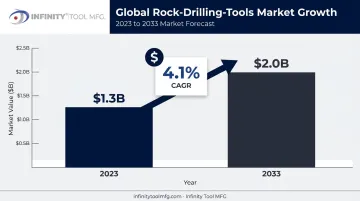
Demand for hard rock capability keeps climbing. The global rock-drilling-tools market was valued at $1.3 billion in 2023 and is projected to hit $2.0 billion by 2033, growing at a 4.1% CAGR, according to a 2023 market report from Allied Market Research.
Geothermal expansion is part of that push. The IEA estimates geothermal could supply up to 15% of global electricity-demand growth through 2050, which means more wells drilled through increasingly hard formations.
Below, we break down the bit types best suited for that kind of rock.
Best Types of Drill Bits for Hard Rock
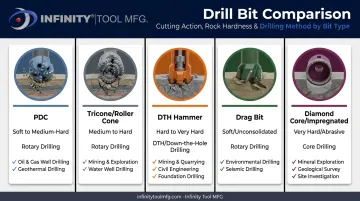
Selection here comes down to three things: penetration rate, durability against abrasive wear, and compatibility with your drilling method, whether that's rotary, percussive, or hammer-based.
PDC (Polycrystalline Diamond Compact) Bits
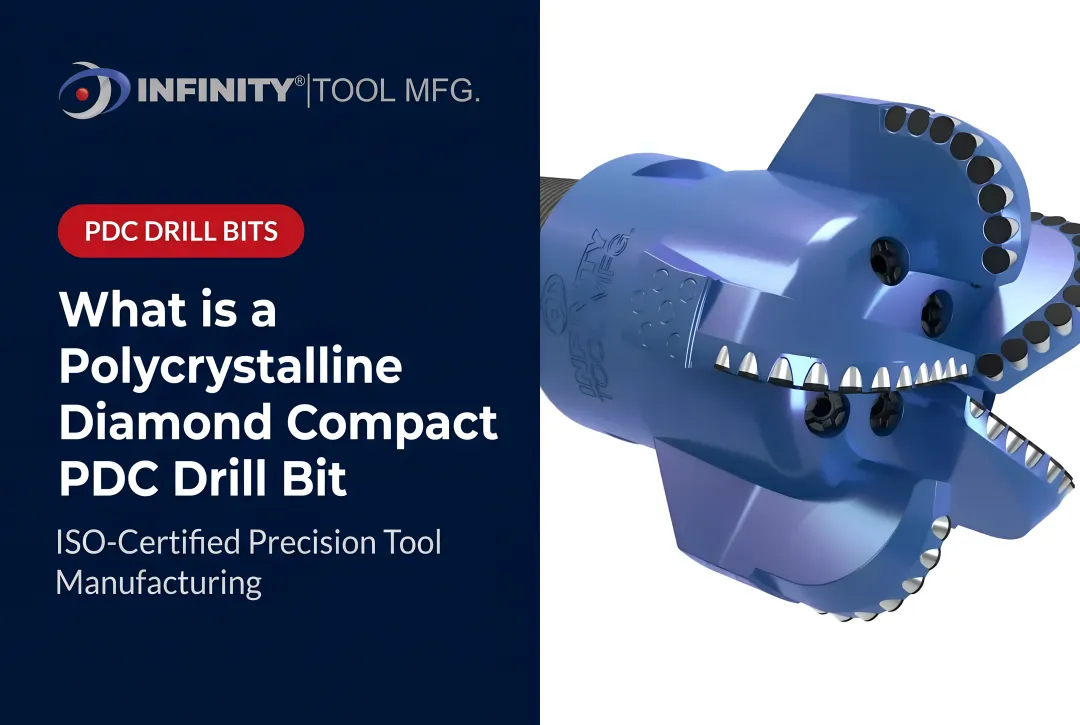
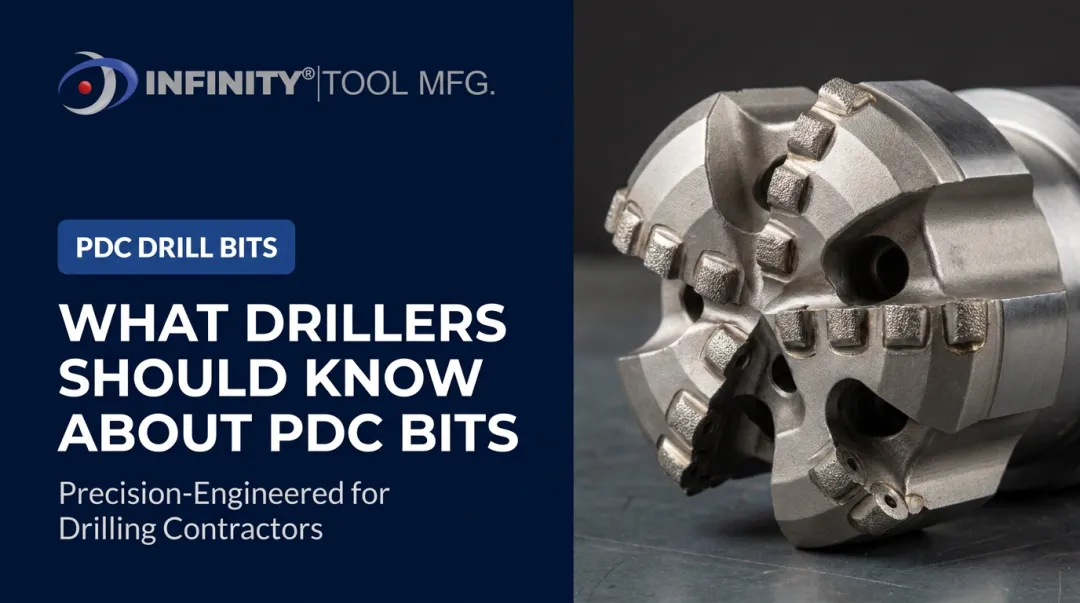
PDC bits use synthetic diamond cutters arranged to shear rock as the bit rotates. They're a staple in oil & gas and HDD work, particularly for medium-hard to hard formations.
What makes them stand out: high penetration rates and long service life, backed by a design with no moving parts to wear out or fail. Infinity Tool MFG engineers proprietary designs like the Rock Boss Extreme specifically for challenging drilling conditions where standard PDC geometry falls short.
| Attribute | Description |
|---|---|
| Best For | Medium-hard to hard, less abrasive formations |
| Drilling Method Compatibility | Rotary drilling (oil & gas rigs, HDD rigs) |
| Typical Applications/Cost Range | Directional drilling, geothermal wells, HDD bores; pricing varies by diameter and configuration |
PDC cutters can ring out or wear rapidly in extremely hard, highly abrasive rock. Tricone and percussive designs pick up where PDC leaves off.
Tricone / Roller Cone Bits
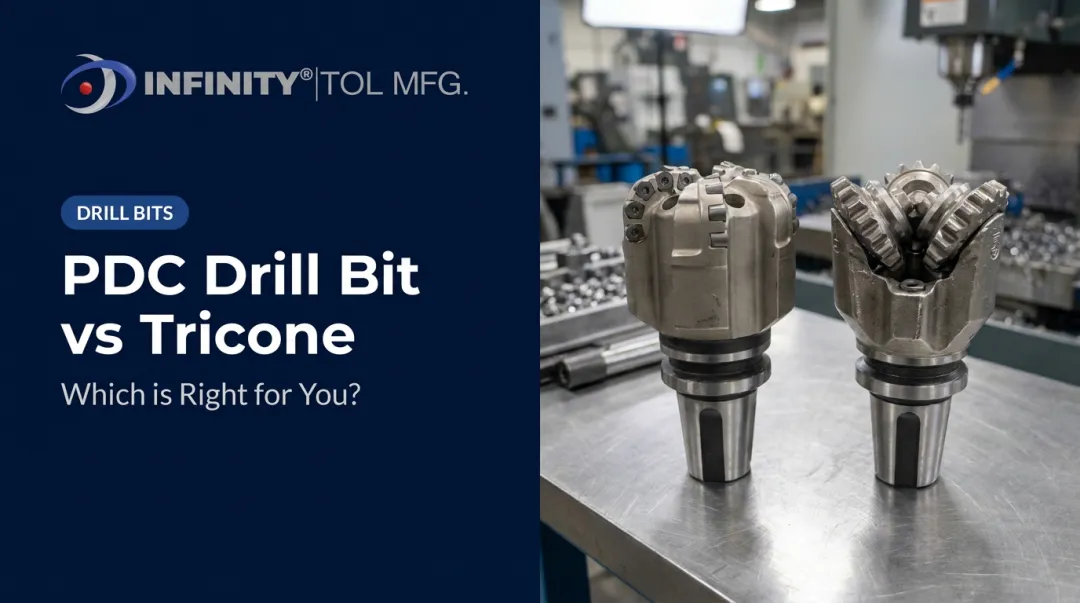
Tricone bits use three rotating cones fitted with tungsten carbide inserts or milled steel teeth. As the bit turns, the cones crush and gouge rock rather than shear it.
Versatility is the biggest draw. Tricone bits handle mixed hard and soft strata reliably, which makes them a common choice across oil & gas exploration where formation type shifts with depth.
| Attribute | Description |
|---|---|
| Best For | Broad range, from soft rock to hard formations (TCI variants rated up to roughly 38,000-60,000 psi UCS) |
| Drilling Method Compatibility | Rotary drilling rigs |
| Typical Applications/Cost Range | Oil & gas wells, mixed-formation exploration; cost depends on tooth type (milled vs. carbide insert) and diameter |
Bearing wear is the main limitation. RPM and weight-on-bit have to match the formation, or you'll shorten bit life fast.
DTH (Down-the-Hole) Hammer Bits
DTH bits pair a pneumatic hammer with the bit itself, delivering rapid percussive blows directly at the bottom of the hole. That's ideal for very hard, abrasive rock like granite.
Because the hammer sits right behind the bit, energy loss is minimal. Center Rock notes this design supports straighter holes and stronger penetration in granite, basalt, and quartzite compared to rotary alternatives.
Infinity Tool MFG has spent over a decade refining DTH bit designs. The MACH 20 series uses a convex face geometry built to concentrate drilling force in dense, cobble-laden formations.
| Attribute | Description |
|---|---|
| Best For | Very hard, abrasive rock (granite, basalt, hard limestone above roughly 30,000 psi) |
| Drilling Method Compatibility | Pneumatic hammer rigs, percussive drilling systems |
| Typical Applications/Cost Range | Mining blast holes, geothermal wells, water well drilling in hard formations; available from 2" to 18" diameters |
Drag Bits (Tungsten Carbide Insert)
Drag bits use fixed carbide inserts to shear soft-to-medium rock. You'll typically find them on water well rigs and shallow construction jobs where formations aren't particularly tough.
Simplicity and cost drive their appeal: no moving parts, straightforward design, low price point. But once you hit medium-hard rock, effectiveness drops off fast.
| Attribute | Description |
|---|---|
| Best For | Soft-to-medium formations (clay, sand, unconsolidated material) |
| Drilling Method Compatibility | Rotary rigs, shallow water well setups |
| Typical Applications/Cost Range | Shallow-to-medium-depth water wells, construction drilling; generally the lowest-cost bit category |
Diamond Core Bits / Impregnated Bits
These bits embed small synthetic diamonds throughout a metal matrix. As the matrix wears down during drilling, fresh diamond is continuously exposed, keeping the cutting edge active.
The standout benefit is precision. Impregnated bits deliver strong core recovery even in the hardest, most abrasive rock, making them the default choice for geotechnical sampling.
| Attribute | Description |
|---|---|
| Best For | Very hard to extremely hard, abrasive formations |
| Drilling Method Compatibility | Core drilling rigs, exploration and geotechnical setups |
| Typical Applications/Cost Range | Mineral exploration, geotechnical core sampling; cost scales with matrix hardness and diamond quality |
How We Chose the Best Drill Bit Types for Hard Rock
The most common mistake in bit selection is chasing the lowest upfront price instead of looking at cost-per-foot across the whole job. A cheaper bit that wears out in half the footage isn't actually cheaper.
We weighted four things to keep these recommendations tied to real operational outcomes:
- Measures penetration rate under realistic hard rock conditions
- Assesses bit lifespan against abrasive wear
- Ensures compatibility with existing rig or hammer setups
- Evaluates manufacturer engineering expertise in application-specific design
Key Factors to Consider When Selecting a Hard Rock Drill Bit
Rock Formation Hardness
Unconfined Compressive Strength (UCS) tells you how much load intact rock can bear before failing. Mohs hardness measures scratch resistance instead, which is a different property entirely. Extremely strong rock (above 250 MPa on the ISRM scale) generally pushes you toward DTH or diamond-impregnated bits. Medium-strong formations often work fine with PDC.
Hole Diameter and Depth Requirements
Larger diameters and deeper holes shift the math:
- Drag bits max out at shallow, soft-formation wells
- DTH hammers scale from 3 to 12 inches on standard shanks, with some designs reaching 40 inches for large-diameter work
- Tricone bits cover roughly 2.375 to 16 inches depending on the product line
Rig and Drilling Method Compatibility
A hammer bit won't perform on a rotary-only rig, and vice versa. A DTH hammer needs an air compressor and percussive drive train, while a PDC or tricone bit relies on rotary torque and weight-on-bit alone. Matching bit type to your existing rig setup, whether rotary, percussive, or hybrid, avoids both inefficiency and equipment damage.
Cost-Per-Foot Economics
Cost-per-foot starts high due to initial bit price, drops as footage accumulates, then climbs again once the bit dulls and ROP declines. Factor in total holes drilled, replacement frequency, and downtime for a real comparison, not just the number on the invoice.
Conclusion
There's no single "best" hard rock drill bit. The right choice depends on matching bit type to rock hardness, hole specs, and your rig setup, not following a generic recommendation pulled from a catalog.
Bit type is only half the equation. Evaluate performance at scale before committing to a supplier long-term:
- Wear rates under actual formation conditions
- Penetration consistency across the run
- Total cost-per-foot, not just per-bit price
Infinity Tool MFG's in-house engineering team builds these metrics into every custom PDC, DTH, and drag bit for oil & gas, mining, geothermal, and HDD projects. If you're unsure which bit fits your formation, their technical team can help.
Frequently Asked Questions
What drill bit to use for rocks?
PDC or DTH hammer bits generally work best for hard rock, while tricone or drag bits suit softer-to-medium formations. The right pick depends on hardness and hole specs.
What is the best drill bit for granite?
DTH hammer bits or diamond-impregnated bits typically perform best in granite because of its high compressive strength and abrasiveness. DTH suits production holes; impregnated bits suit core sampling.
What is the difference between a PDC bit and a DTH bit?
PDC bits shear rock using fixed diamond cutters during rotary drilling. DTH bits use a pneumatic hammer to deliver percussive blows, which works better in harder, more abrasive formations.
How long do hard rock drill bits typically last?
Lifespan varies by bit type, rock abrasiveness, and maintenance practices. Check manufacturer data or field case studies for expected footage per bit in your specific formation.
What RPM and pressure should be used when drilling hard rock?
Hard rock generally calls for lower RPM with higher weight-on-bit compared to softer formations. Exact settings vary by bit type and rig, so consult manufacturer guidance for your setup.
Can PDC bits be used in all hard rock conditions?
PDC bits perform well in medium-to-hard, less abrasive formations but wear faster in extremely hard, highly abrasive rock. DTH bits are usually the better fit in those extreme conditions.