Picking the wrong one isn't a minor inconvenience. It inflates your cost-per-foot, triggers premature bit failure, and in the worst cases, sends you into a fishing operation that eats days of rig time. PDC bits now drill more than 90% of worldwide footage, up from less than 2% in 1980 — but that dominance doesn't mean PDC is always the right call.
This guide breaks down how each bit works, where each one wins, and how to decide for your specific ground conditions.
Key Takeaways
- PDC bits shear rock with diamond cutters, delivering high ROP in soft-to-medium formations
- Tricone bits crush rock with three rotating cones, offering impact resistance in fractured ground
- PDC costs more upfront but often wins on cost-per-foot; tricone wears faster in abrasive rock
- The right choice depends on formation hardness, abrasiveness, and project economics
- In-house engineering support matches bit design to your ground conditions, not a generic catalog pick
PDC vs Tricone: Quick Comparison
Before covering the mechanics, here's how the two bit types stack up across the factors that matter most on a jobsite.
| Factor | PDC Bit | Tricone Bit |
|---|---|---|
| Upfront cost | Higher, due to synthetic diamond cutter technology | Lower, easier on tighter budgets |
| Moving parts | None — fixed cutters, solid body | Three independently rotating cones on sealed bearings |
| Lifespan limiter | Cutter chipping in fractured or hard rock | Bearing and seal wear, especially in abrasive ground |
| Rate of penetration | Generally higher in ideal formations | Slower but steadier through hard, fractured rock |
| Best formations | Soft-to-medium, homogeneous (shale, sandstone, limestone) | Soft-to-hard, fractured, interbedded (granite, basalt, chert) |
The short version: PDC wins on speed and longevity in predictable ground. Tricone wins on versatility and impact resistance when the geology gets messy.
One data point illustrates this durability tradeoff. Roller-cone studies have found that seal encroachment is a leading cause of bearing failure, with one benchmark citing 1 million bit revolutions as the point where metal-bearing seals typically start showing wear.
PDC bits skip that failure mode entirely since they have no bearings. Instead, they introduce a different vulnerability in fractured rock, where cutter chipping becomes the limiting factor.
What Is a PDC Drill Bit?
PDC stands for Polycrystalline Diamond Compact. It's a fixed-cutter bit design where a synthetic diamond layer is sintered onto a tungsten carbide substrate, then mounted permanently on the bit's blades. There are no bearings, no moving parts, and no cones to wear out.
That matters more than it sounds like it should. Eliminating moving parts removes an entire category of mechanical failure: the seal and bearing breakdowns that plague roller-cone designs in long, abrasive runs. For directional oil & gas wells, HDD crossings, and geothermal boreholes, that reliability translates directly into:
- Higher ROP: continuous shearing action cuts faster than crushing/chipping in suitable rock
- Lower maintenance risk: no bearings means no seal failures mid-run
- Smoother torque delivery: better steerability for directional drilling applications
PDC Design Variations
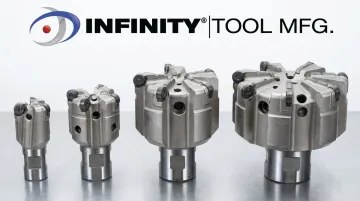
Not all PDC bits look the same. Blade count, cutter size, and cutter shape all get tuned to the job. Infinity Tool MFG's PDC lineup, for example, spans diameters from roughly 1" up to 17.5", with blade configurations in its Big Flush series ranging from 3-blade to 6-blade setups depending on hole size.
Higher blade counts add cutting surface for aggressive penetration, while lower counts favor a cleaner, more streamlined cutting action in specific formations. Some designs also incorporate a no-back-out cutter mounting, which keeps cutters seated under heavy torque loads.
Use Cases of PDC Bits
PDC bits are the go-to choice for:
- HDD pilot holes requiring a fast, clean, consistent-diameter bore
- Directional oil & gas wells in shale and sandstone formations
- Geothermal and water well boreholes where formation is largely homogeneous
PDC performs best in rock rated up to roughly 25,000 PSI compressive strength: think shale, mudstone, sandstone, and limestone. Field data backs up the ROP advantage in the right ground.
In the Tecominoacan Field case discussed below, switching to a PDC design doubled penetration rates over the previous roller-cone runs. If you're drilling homogeneous, non-abrasive formations, PDC is usually the faster and cheaper-per-foot option over the life of the project.
What Is a Tricone Drill Bit?
The tricone bit traces back to a 1909 patent from Howard Hughes Sr. and Walter Sharp, whose original design used two rotating cones. Hughes Tool Company later commercialized the three-cone version in 1933, nearly a decade after Hughes Sr.'s death, developed by company engineers rather than by Hughes himself.
Over a century later, the design principle hasn't changed much: three independently rotating cones, each studded with teeth or inserts, crush and chip rock as they turn.
That crushing-and-chipping action is what gives tricone bits their core strength: versatility. A single bit can grind through soft clay, hit a boulder, and keep working through fractured limestone without catastrophic failure. That reduces the need for multiple bit trips on jobs where the geology isn't fully known upfront, and the lower upfront cost makes budgeting simpler for shorter runs.
Milled Tooth vs. TCI Construction
Tricone bits come in two main tooth configurations:
- Milled tooth (steel tooth) bits: teeth are machined or forged directly into the cone, suited to softer formations
- Tungsten carbide insert (TCI) bits: carbide inserts are pressed into the cone body, built for harder, more abrasive ground
Infinity Tool MFG manufactures both tricone bits and tricone hole openers across a range of sizes, giving drillers a choice depending on whether they're fighting soft clay or hard, abrasive rock.
Use Cases of Tricone Bits
Tricone bits show up most often in:
- Water well drilling through variable, unpredictable strata
- Construction piling through cobble and boulder zones
- Mining exploration boreholes in hard, fractured rock
The versatility argument holds up in the field. In hard, abrasive interbedded formations near Estevan, Saskatchewan, where the Lodgepole interval contained up to 65% chert, an improved TCI tricone design drilled 317 meters in a single run.
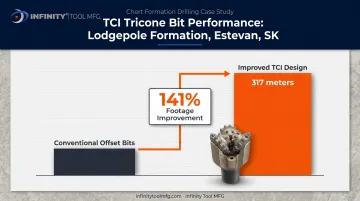
That was a 141% footage improvement over conventional offset bits, enough to eliminate two full trips. That's the kind of impact resistance that makes tricone bits the safer bet when you're not sure what's coming next downhole.
PDC vs Tricone: Which Is Better for Your Project?
There's no universal winner here. The right bit depends on a handful of concrete factors:
- Formation hardness and homogeneity: is the rock consistent, or does it change every few feet?
- Abrasiveness: how quickly will the formation wear down cutters or bearings?
- Desired ROP: is speed the priority, or is reliability through unknown ground more important?
- Directional control needs: does the job require precise steerability?
- Total cost of ownership: factor in bit price, trip costs, and footage per bit, not just the sticker price
- Junk or fractured zones: is there a risk of impact damage from debris or broken rock?
Choose PDC when you're drilling soft-to-medium, homogeneous, non-abrasive formations and prioritize speed, steerability, and lower cost per foot over the life of the run.
Choose tricone when formations are hard, fractured, interbedded, or abrasive, or when upfront budget and impact resistance matter more than raw ROP.
The Hybrid Approach
Many operators don't pick just one. A common strategy starts with a tricone bit through overburden or mixed surface layers, then switches to PDC once the formation turns consistent, or runs the reverse sequence if conditions get rougher with depth.
This hedges against each design's biggest weakness: tricone's slower ROP in homogeneous rock, and PDC's vulnerability to chipping in fractured zones.
For projects that don't fit a standard catalog bit, manufacturers offering in-house engineering support can analyze ground reports and recommend, or custom-design, a bit built for the specific formation rather than a generic off-the-shelf option.
Infinity Tool MFG takes this approach with products like its Rock Boss Extreme and Cobble Boss Extreme lines, built for drilling conditions that fall outside standard PDC or tricone performance ranges.
Real-World Example & Final Takeaway
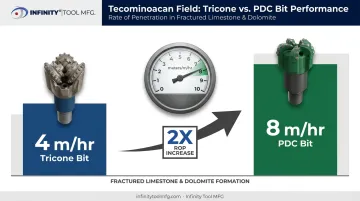
Formation-driven bit switches aren't theoretical. In southeastern Mexico's Tecominoacan Field, drillers working deep Cretaceous and Jurassic fractured limestone and dolomite were running IADC 517-537 insert tricone bits, historically averaging around 4 meters per hour. The fractured, hard carbonate ground was chewing through cones and slowing progress section after section.
The decision to switch came down to a straightforward cost and ROP review: tricone performance had plateaued, and the fractured formation wasn't improving. Engineers introduced a new PDC bit design for the 8-1/2-inch and 5-7/8-inch sections. The result: average ROP doubled to roughly 8 meters per hour, cutting section time significantly and reducing the trip count tied to the earlier roller-cone runs.
That's the pattern worth remembering: bit selection should follow the formation, not habit. Formation data, cost review, and ROP trends should drive the decision, not whichever bit happens to be on the shelf.
If your project is straddling formation types, or you're seeing repeated bit failures that don't match the textbook expectations for PDC or tricone, it's worth a conversation before the next run. Infinity Tool MFG's engineering team works directly with drillers to select or custom-design PDC and tricone bits suited to specific ground conditions. Reach out through their resources page to talk through your formation data.
Frequently Asked Questions
What is the main difference between PDC and tricone drill bits?
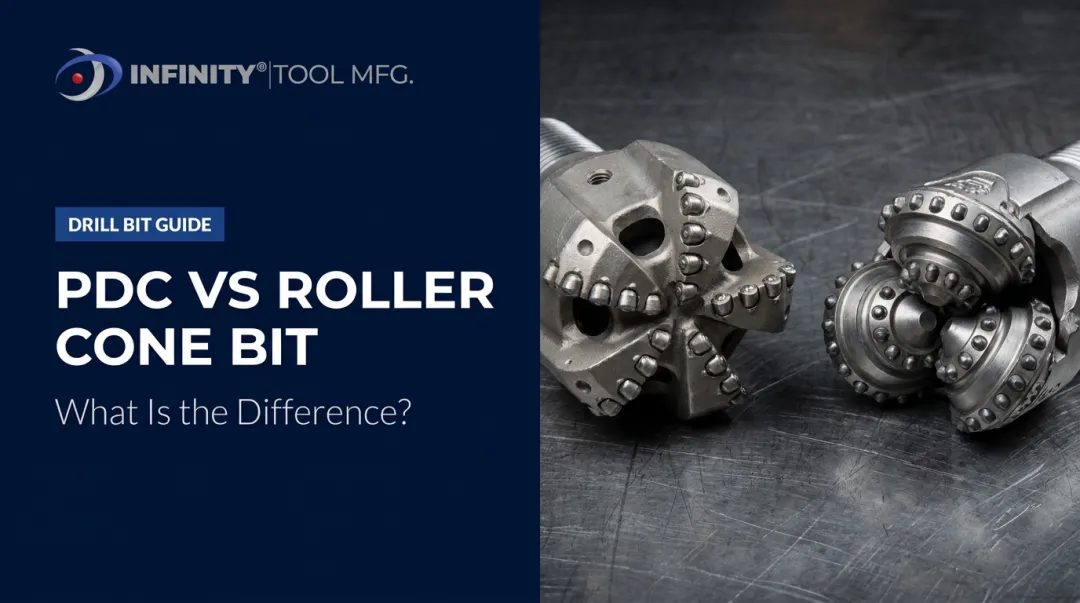
PDC bits use fixed diamond cutters that shear through rock in a continuous motion. Tricone bits use three rotating cones with teeth or inserts that crush and chip rock as they turn.
Which drill bit lasts longer, PDC or tricone?
PDC bits typically last longer in suitable formations since they have no bearings to fail. Bearing and seal wear usually limit tricone lifespan, especially in abrasive ground.
Can PDC bits be used in hard rock formations?
PDC bits can struggle in very hard, fractured, or abrasive rock, where cutter chipping and delamination become risks. Tricone or DTH hammer bits generally perform better in those conditions.
Are PDC bits more expensive than tricone bits?
Yes, PDC bits cost more upfront due to their diamond cutter technology. However, they often deliver a lower total cost per foot thanks to longer life and faster penetration rates.
What factors should I consider when choosing between PDC and tricone bits for HDD?
Formation type, abrasiveness, required steerability, and project budget are the key factors. Homogeneous soil generally favors PDC, while mixed or rocky ground favors tricone.
Can I switch from a tricone bit to a PDC bit mid-project?
Yes, switching mid-project is common when formation conditions change or ROP data shows a bit isn't performing. Consulting a manufacturer's engineering team can help make the transition smoother.