Introduction
Every borehole project starts with the same fork in the road: down-the-hole (DTH) hammer or rotary rig? Oil & gas operators, water well drillers, geothermal contractors, and mining crews all face this decision before mobilizing equipment.
Get it wrong, and the costs show up fast. Bit wear accelerates, penetration rates drop, and compressed air or fuel consumption climbs.
A 2015 economic study of surface mining operations found that rotary drilling carried higher start-up costs but often produced lower total cost per drilled volume. The cheaper rig on paper isn't always the cheaper choice on site.
This guide breaks down how DTH and rotary drilling actually work, where each method wins, and how to pair the right bit design with your formation.
TL;DR
- DTH drilling delivers percussive hammer blows for hard, abrasive rock
- Rotary drilling uses surface torque, best suited to softer ground and larger diameters
- Rock hardness, target depth, and hole diameter drive most method choices
- Large projects often combine both drilling methods
- Bit and reamer design matter as much as rig selection
DTH vs Rotary Drilling: Quick Comparison
Contractors typically weigh five factors before committing a rig to a project. Here's the snapshot:
| Factor | DTH Drilling | Rotary Drilling |
|---|---|---|
| Upfront cost | Lower rig investment | Higher rig investment |
| Rock range | 80-350 MPa UCS (hard, competent rock) | 10-500 MPa UCS (soft to hard) |
| Speed advantage | Faster in hard/ultra-hard rock | Steadier at extreme depth |
| Diameter range | Small to medium (roughly 2"-20") | Wide, including large-diameter bores |
| Site disturbance | Generally lower vibration footprint | Can generate more depending on setup |
Cost
DTH systems typically demand a smaller upfront rig investment, making them attractive for hard-rock jobs at small-to-medium depths. Rotary equipment costs more to mobilize, but the same 2015 mining study found rotary produced a lower total cost per bank cubic meter across the mines surveyed.
The real lesson: don't compare bit price alone. Factor in:
- Bit or hammer life expectancy
- Achievable penetration rate
- Hole diameter and required drilled meters
- Total project timeline
Rock and Geological Suitability
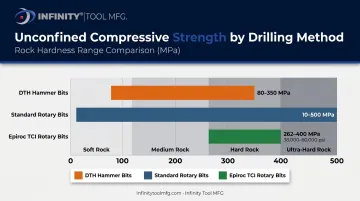
Rock hardness is the single biggest driver of method choice. DTH commonly handles 80-350 MPa unconfined compressive strength (UCS), while rotary spans a much broader 10-500 MPa range. That overlap matters: rotary isn't limited to soft ground.
Epiroc's tungsten-carbide-insert rotary bits, for example, are rated for 38,000-60,000 psi (roughly 262-400 MPa), proving rotary can compete in genuinely hard formations when paired with the right bit design. UCS alone doesn't decide the outcome, either. Rock structure, fracturing, and elasticity all factor into drillability.
Drilling Speed and Depth
In hard and ultra-hard rock, DTH has the edge. A field test using a large-diameter pneumatic DTH hammer achieved 1.7 times the penetration rate of conventional mud rotary drilling in comparable formations.
That advantage can shrink with depth. DTH hammers sit at the bottom of the string, so impact energy doesn't have to travel through the full drill pipe. Rising borehole back pressure at depth, however, still suppresses performance.
Rotary drilling delivers power from the surface consistently. That's why it remains the default choice for very deep oil & gas and water wells.
Hole Diameter Range
DTH tools generally target smaller to medium diameters. Infinity Tool MFG's own DTH hammer bit lineup, for instance, spans 2 to 18 inches, with hole openers extending to 20 inches for enlarging pilot holes.
Rotary equipment covers a wider spread. Industry catalogs list rotary bits from roughly 2.5 to 16 inches, and rotary raisebore systems have reamed shafts several meters wide (more on that below).
Environmental Impact (Noise and Vibration)
There's no universally agreed ranking here, and available data don't compare cleanly. NIOSH found some air-rotary drill operators exposed to noise levels above 85 dB inside the cab, while separate underwater DTH pile studies measured very different acoustic metrics entirely.
If you're working an urban or environmentally sensitive site, commission a project-specific noise and vibration assessment rather than assuming one method is quieter.
What is DTH Drilling?
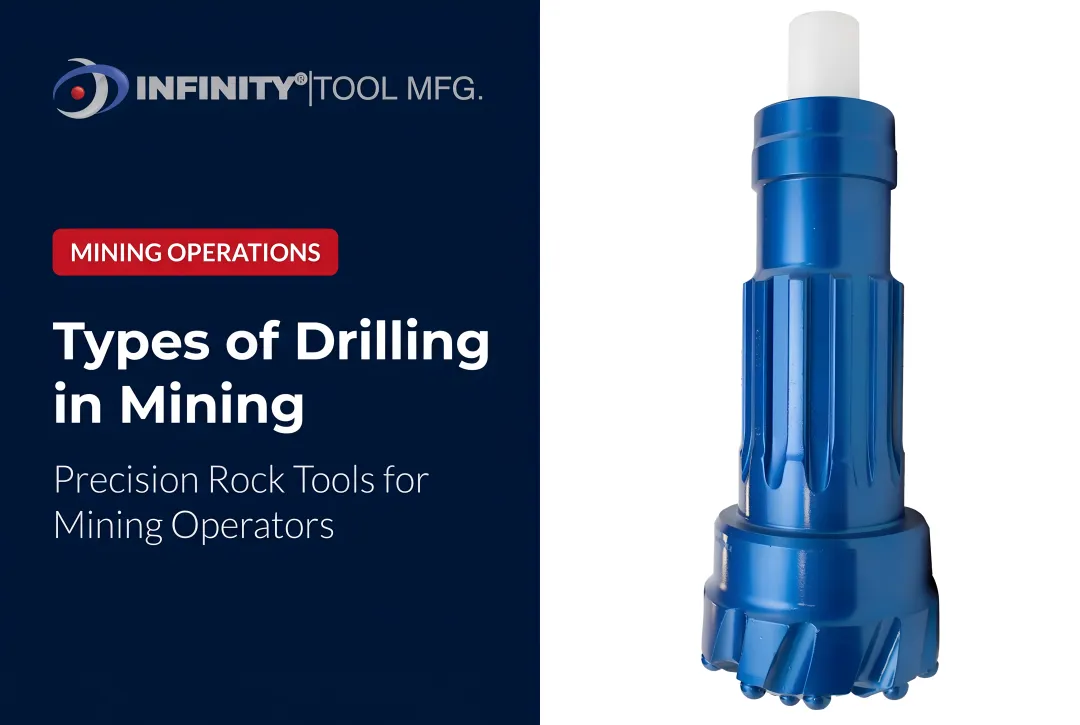
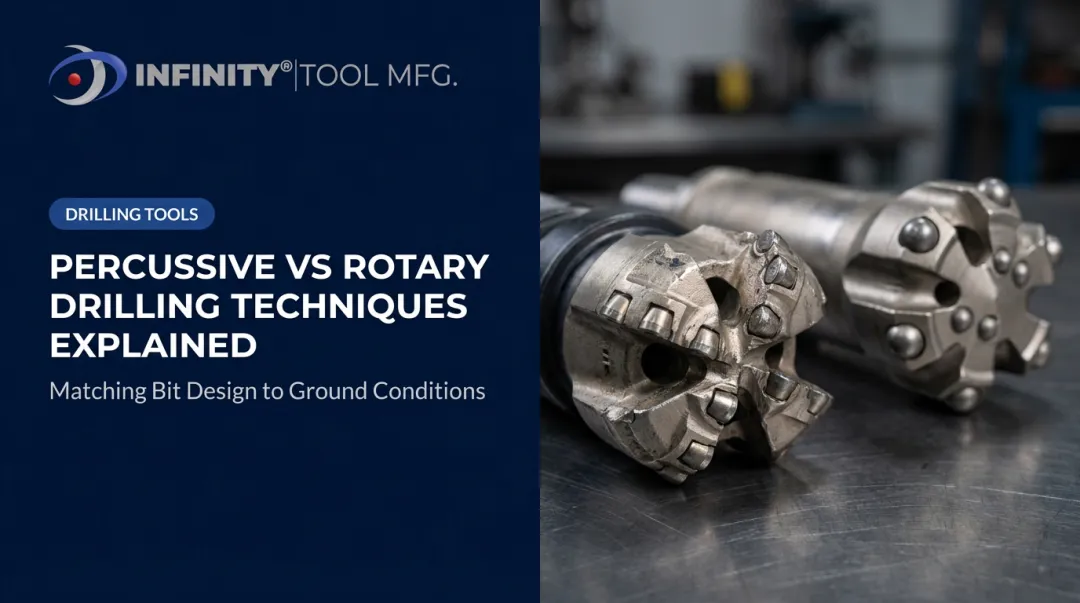
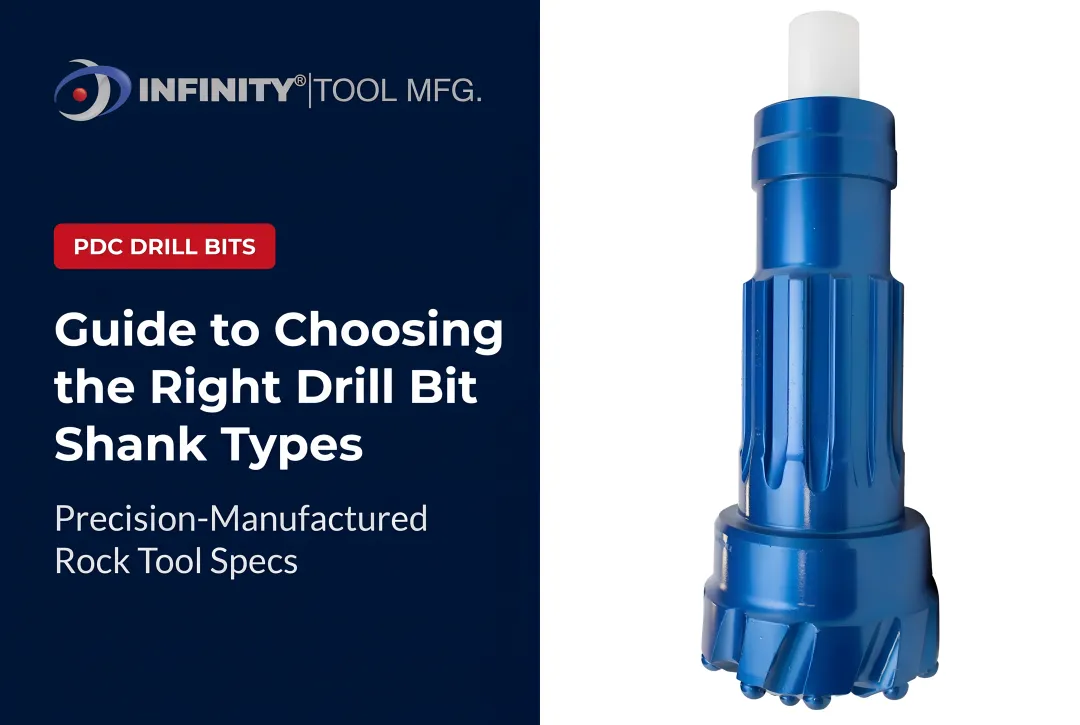
DTH drilling places a pneumatic hammer directly above the bit, delivering rapid percussive blows while compressed air flushes cuttings up and out of the hole. Because the hammer travels with the bit instead of transmitting force through the entire drill string, energy loss stays minimal. That efficiency is why DTH dominates hard-rock work.
Operational payoffs include:
- Higher penetration rates in hard, abrasive formations
- Straighter boreholes with less deviation
- Reduced downhole equipment wear compared to grinding methods
- Lower energy loss versus surface-driven torque systems
Purpose-Built DTH Bit Designs
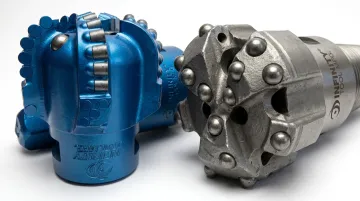
Standard DTH bits work well in consistent hard rock, but fractured ground and cobble fields need something tougher. Infinity Tool MFG builds its Rock Boss Extreme and Cobble Boss Extreme bits specifically for these conditions, where standard bits are prone to premature wear or stalling against loose cobble.
These purpose-built bits use reinforced carbide inserts and modified face designs to keep drilling forward when standard bits would stall or crack. That added durability translates into fewer bit changes and lower cost per foot in mixed or fractured formations.
Use Cases of DTH Drilling
Beyond choosing the right bit, DTH shows up wherever hard rock and precision matter most:
- Pilot hole pre-drilling ahead of larger-diameter work
- Water well and geothermal drilling in competent bedrock
- Mining shaft development and exploration
- Hard-rock foundation and piling work
Infinity Tool MFG's DTH hammer bits and hole openers serve mining, oil & gas, geothermal and water well, construction, HDD, and geotechnical customers, reflecting how broadly hard-rock percussion drilling applies.
Field tests in GQ-400 rock recorded a 1.7x penetration rate advantage over rotary methods in hard and ultra-hard formations, a compelling reason for contractors stuck on slow rotary progress to trial a DTH hammer.
What is Rotary Drilling?
Rotary drilling uses surface-applied torque and downward weight-on-bit to shear or grind through formations, typically aided by circulating drilling fluid that clears cuttings and stabilizes the hole. It's the workhorse method for versatile, large-scale operations because it doesn't depend on a single rock hardness range to perform.
Core advantages:
- Adapts across soil types and rock hardness, from unconsolidated sand to hard formations
- Delivers consistent power at greater depths without losing torque
- Produces large-diameter bores efficiently in a single operation
PDC Bits and Reamers
Getting the most out of these advantages depends on bit selection as much as machine setup. Standard rotary (tricone) bits still have their place, but PDC (polycrystalline diamond compact) bits and reamers have taken over most modern rotary applications. Infinity Tool MFG manufactures PDC reamers with a taper-and-spiral design intended to protect the diamond cutters from chipping while allowing pilot-to-finish reaming in a single pass — cutting out an entire reaming stage on many jobs.
Use Cases of Rotary Drilling
Rotary is the default choice for:
- Deep oil & gas exploration and production wells
- Large-diameter foundation and bored piles
- Horizontal directional drilling (HDD) bores
- General construction and civil drilling
The diameter ceiling is high. Epiroc's rotary bit catalog runs up to 16 inches (406 mm), and as the case below shows, purpose-built rotary reaming systems go far beyond that.
Real-World Example: Choosing the Right Method in Practice
The Trident Mine ventilation shaft project illustrates what happens when diameter, not rock hardness, drives the method decision.
The challenge: the mine needed a ventilation shaft cutting through mixed weathered and fresh rock, at a final diameter of 4.1 meters, well beyond what any DTH hammer or standard rotary bit could achieve directly.
The approach: engineers used a rotary pilot hole followed by rotary raiseboring to enlarge it to full diameter. This is a rotary pilot-and-ream sequence, not a DTH-to-rotary switch, but it demonstrates the same underlying principle: match the method to what the hole actually requires.
The numbers:
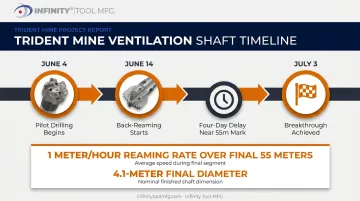
- Pilot drilling began June 4, 2007
- Back-reaming started June 14
- Breakthrough occurred July 3, after a four-day pause near the 55-meter mark
- The final 55 meters reamed at approximately 1 meter per hour
The takeaway: once target diameter moves into meter-scale territory, rotary pilot-and-ream systems are the proven path. DTH still wins for smaller-diameter, hard-rock precision holes, but nobody drills a 4-meter shaft with a hammer bit.
If your project sits somewhere between these extremes (hard rock, moderate diameter, tight timeline), it's worth a conversation with Infinity Tool MFG's engineering team. Talk through the specifics before you commit a rig to the wrong bit design.
Conclusion
Neither DTH nor rotary drilling is universally "better." DTH earns its keep in hard, abrasive rock and depth-limited precision jobs. Rotary takes over for softer formations, larger diameters, or consistent power at extreme depth.
The real payoff shows up in fewer bit replacements, less downtime, and faster completion — but only if the bit or reamer design matches the formation as closely as the rig itself does. Infinity Tool MFG manufactures both bit types, along with reamers and hole openers, matched to your specific formation and rig setup.
Frequently Asked Questions
What is DTH rotary drilling?
It refers to using a down-the-hole pneumatic hammer bit within a rotary drill string, combining percussive impact with rotation for efficient hard-rock penetration.
Can DTH and rotary drilling be combined on the same project?
Yes. Sequencing a smaller pilot hole with a larger reaming pass, whether DTH or rotary, is a common technique on hard-rock foundation and shaft projects where diameter and rock hardness both matter.
Which method is more cost-effective for water well drilling?
It depends on rock hardness and depth. DTH is often more economical in hard rock at moderate depths, while rotary tends to win out for deeper or larger-diameter wells.
How do I choose between a DTH bit and a PDC bit for my formation?
DTH bits suit hard, abrasive rock; PDC bits and reamers suit softer-to-medium formations needing smooth, symmetrical bores. Infinity Tool MFG's in-house engineering team can confirm the right call for your specific formation.
Does hole diameter affect whether I should use DTH or rotary drilling?
Yes. DTH generally covers smaller-to-medium diameters (roughly 2 to 18 inches), while rotary systems handle a much wider range, including large-diameter bores measured in feet or meters.
Is rotary drilling faster than DTH drilling in soft formations?
Yes. Rotary's continuous shearing action outperforms DTH in soft, unconsolidated ground, while DTH's advantage shows up specifically once formations get hard.