That shift creates a real learning curve. Drillers who've spent years reading the feel of a roller-cone bit now have to learn a different language: balling instead of bearing failure, chatter instead of cone wear, cutter chipping instead of broken teeth.
This guide breaks down how PDC bits actually work, how to pick the right type for your ground conditions, and how to solve the field problems that trip up even experienced crews.
Key Takeaways
- PDC bits shear and scrape rock instead of crushing it, boosting ROP in matched formations
- Body style and cutter layout need to match your formation, not the other way around
- Most field failures trace back to three fixable problems: balling, cutter damage, and chatter
- Custom-engineered bits solve ground conditions that catalog designs can't touch
What Is a PDC Bit? Understanding the Technology and Design
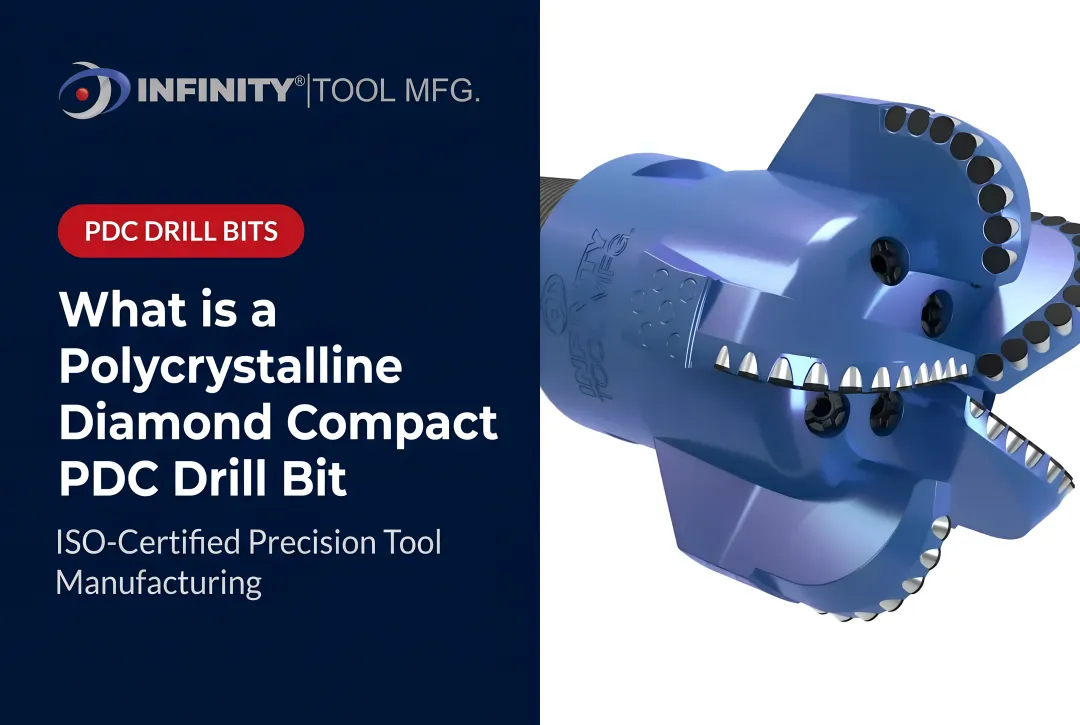
A PDC bit is a fixed-cutter drilling tool with no moving parts. Each cutter is built by sintering fine synthetic-diamond grit onto a tungsten carbide substrate under extreme heat and pressure. The result is a diamond table hard enough to shear rock and a carbide base tough enough to be brazed onto a steel or matrix blade.
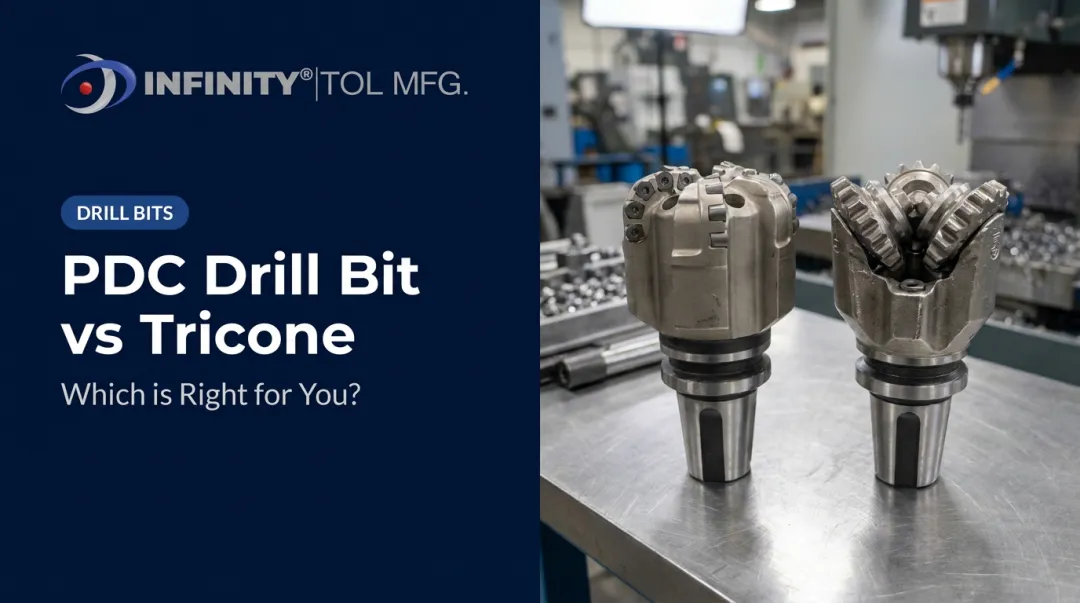
That's the core difference from a tri-cone. A roller-cone bit has three independently rotating cones riding on bearings and seals (components that wear out and eventually fail). A PDC bit has none of that. The cutters stay fixed on the blades while the bit's rotation drags their diamond faces across the formation.
This shift from moving parts to a fixed diamond face didn't happen overnight. PDC technology started in the oilfield in the early 1970s, when General Electric developed the first carbide-supported diamond cutter. It was expensive and niche for decades. As manufacturing scaled up, PDC bits became affordable enough for water well, HDD, and construction rigs to adopt as standard equipment rather than a specialty upgrade.
What Does a PDC Bit Look Like?
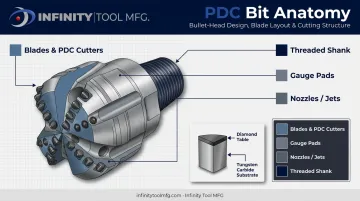
Most PDC bits you'll see in the field use a bullet head body style: a rounded, bullet-shaped profile that tends to run smoother and hold up better in rough or interbedded ground. The less common wing bit design uses flatter, wing-like blades; it can be effective in specific formations but generally shows more sensitivity to vibration.
Regardless of style, you'll recognize the same basic components:
- Blades or wings carrying the diamond cutters across the face
- Gauge pads that maintain consistent hole diameter as the bit wears
- Nozzles or jets directing drilling fluid across the cutting face
- A threaded shank connecting the bit to the drill string
How PDC Bits Work: The Shearing Principle
Here's the mechanical difference that matters most in the field. A tri-cone crushes and gouges rock as its cones roll across the formation. A PDC bit shears it: the cutter's diamond face moves transversely through the rock in a continuous scraping motion, closer to how a wood chisel works than a hammer.
This shearing action is why PDC bits perform best in soft-to-medium, non-abrasive formations like shale, sandstone, and limestone, generally in the 2,000-30,000 psi unconfined compressive strength range. Softer rock calls for fewer, more aggressive blades; harder rock needs more blades and better-protected cutters.
The jets on a PDC bit aren't just for cooling. They create a pressure drop at the bit face that shear-thins the mud, which helps prevent cuttings from sticking to the cutting structure and keeps the face clean as the bit advances.
Getting this match right pays off in measurable speed. Diamond Drilling Industries reported to Trenchless Technology that its HDD PDC design achieved up to three times the rate of penetration of a tri-cone in suitable rock.
PDC Bits vs. Tricone and Drag Bits: Which Should You Choose?
The choice comes down to formation, not personal preference.
| Factor | PDC Bit | Tri-Cone Bit | Drag Bit |
|---|---|---|---|
| Working principle | Shears/scrapes rock | Crushes/gouges rock | Scrapes rock with fixed blades |
| Ideal formation | Soft-to-medium, non-abrasive (shale, sandstone, limestone) | Hard, abrasive, interbedded | Soft, unconsolidated (clay, loose sand) |
| Moving parts | None (no bearings to fail) | Bearings and seals that wear | None (fixed blades) |
| Vulnerability | Cutter damage in chatter/impact conditions | Bearing failure, cone wear | Rapid wear in hard or abrasive ground |
The no-moving-parts advantage is real. There's no bearing seal to blow out mid-run, which is often the failure point that ends a tri-cone's life. The tradeoff: PDC cutters face more impact damage risk in rough, chattering conditions — something a tri-cone's crushing action tolerates better.
Longevity numbers from the field make the case for water well drillers. In a Water Well Journal interview, driller Jake Foord of Wm L. Foord Water Well reported 15,000 to 30,000 feet of drilling before needing a PDC rebuild.
His drag bits had lasted just 1,500 to 2,000 feet by comparison — roughly a full year of service from a single PDC bit in his operation.
Match the bit to the formation using this quick guide:
- Soft, unconsolidated ground (clay, loose sand): drag bits handle pilot holes but wear fast in continuous rock
- Soft-to-medium, non-abrasive rock (shale, sandstone, limestone): PDC delivers the longest run life, with no bearings to fail
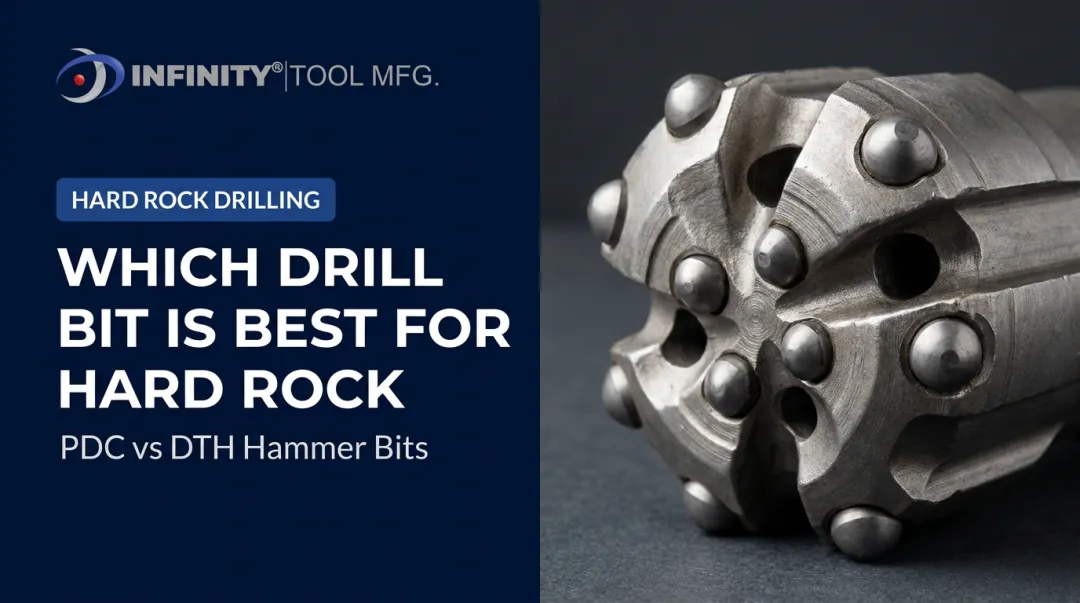
- Hard, abrasive, or highly variable ground (gravel, broken rock, interbedded formations): a tri-cone's bearing stability still wins
Types of PDC Bits and How to Choose the Right One for the Job
Not every PDC bit is built the same way. Body construction changes how the bit handles heat, abrasion, and impact.
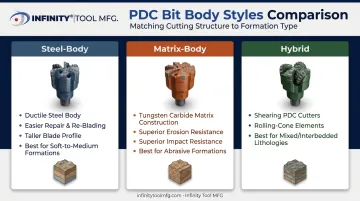
Common PDC Bit Body Styles
- Steel-body bits: Easier to repair and more ductile, with room for taller blades and larger junk slots. Good fit for soft-to-medium formations, though exposed steel wears faster in abrasive ground and often needs hardfacing.
- Matrix-body bits: Tungsten carbide powder bonded into a matrix around a steel core, giving superior erosion and impact resistance for highly abrasive formations. The trade-off is a more brittle body overall.
- Hybrid PDC bits: Combine shearing cutters with rolling-cone elements for mixed or interbedded lithologies. These are application-specific tools, not a universal fix whenever a conventional PDC starts chattering.
Key Factors When Selecting a PDC Bit
Formation hardness dictates cutter density and blade configuration. Softer ground needs more aggressive cutter exposure to maintain ROP; harder ground needs more durable, protected cutters to survive the run.
Weight-on-bit and RPM also have to match the bit's design intent:
- Set WOB according to formation: too much weight on a bit designed for softer rock accelerates cutter wear
- Match RPM to blade geometry: excessive speed on the wrong design increases vibration risk
- Adjust as conditions change: interbedded ground may require operators to modify parameters mid-run
Here's where off-the-shelf designs often fall short. Standard catalog bits are engineered for average conditions, but ground rarely cooperates with averages.
Manufacturers offering in-house engineering can build around your specific problem. Infinity Tool MFG's Rock Boss Extreme, for instance, uses a concave head design, back-out cutters, and a one-piece high-grade alloy steel body to reduce side pressure and protect diamond cutters.
This construction is built specifically for challenging drilling conditions where a stock bit would chip out early. The Cobble Boss Extreme fills a similar role for tougher, mixed-formation ground.
Field Challenges Every Driller Faces with PDC Bits (and How to Solve Them)
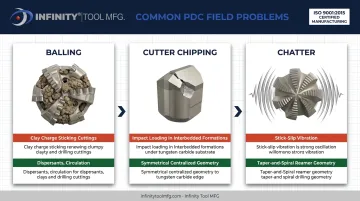
Most PDC problems in the field come down to three issues. All three are fixable once you know what's causing them.
Bit Balling in Sticky Clay
You'll spot it fast: torque drops, standpipe pressure climbs, and the bit stops making hole. Clay particles carry an electrical charge that causes cuttings to reassemble and stick to the bit face instead of washing away.
Fixes that work in the field:
- Add dispersants or tetraphosphate products to strip the charge off cuttings and keep them from reflocculating
- Maintain adequate circulation and pressure drop at the bit — this matters as much as chemistry
- If the bit balls up anyway, pick up off bottom, rotate fast, and stroke the pipe (without hitting bottom) to break the ball loose
Cutter Chipping and Breaking
High-impact or interbedded formations are hard on diamond cutters. Impact loading chips or breaks the diamond table, and once that happens, ROP drops fast. Drilling through shale-to-sandstone transitions, for instance, can shock-load a cutter in a fraction of a second.
Reamer and bit designs engineered with symmetrical, centralized geometry reduce this risk by keeping cutting forces balanced instead of concentrated on one blade.
Chatter and Fluctuating Torque
Chatter is a stability problem. An analysis of 56 PDC field runs identified stick-slip vibration as a primary cause of cutter damage, distinguishing between friction-induced and cutting-action-induced mechanisms that each need different fixes. Body style and blade symmetry directly affect how smoothly a bit cuts.
Design details matter here, more than most drillers realize. Infinity Tool MFG's PDC reamers use a taper-and-spiral geometry: the taper centralizes the tool in the pilot hole, and the spiral staggers cutting engagement to reduce chatter and even out torque swings.
That combination lets a single reamer pass go from pilot to finish bore in most holes, instead of tripping in and out to correct an off-center cut. The company reports this design completes bores up to 50% faster than traditional reaming methods.
Fewer trips isn't just a convenience. Every trip out of the hole to swap a chattered-out bit or damaged reamer costs rig time that a more durable, well-balanced design avoids entirely.
Maintenance and Best Practices to Maximize PDC Bit ROI
Getting the most out of a PDC bit isn't complicated, but it does take discipline most crews skip when they're busy.
Before and after every run:
- Inspect cutters for chips, breaks, or excessive wear
- Check gauge pads for undergauge conditions that could damage the next bit run
- Clear and inspect nozzles for erosion or blockage
Storage matters more than people think. Keep bits clean and dry between jobs, and handle them carefully during transport — a dropped or knocked-around bit can chip cutters before it ever touches rock.
Beyond storage and handling, rebuilding worn bits is a well-established industry practice worth understanding. Water Well Journal has documented contractors rebuilding PDC bits rather than replacing them outright, extending usable life well beyond the original run. That said, incorrect rebuild work can let cutters come loose during drilling, so it's not a shortcut to take lightly.
A manufacturer's role matters most upfront: building bits and reamers precise enough, and engineered specifically enough for your ground, that they need fewer emergency fixes in the first place. Infinity Tool MFG manufactures its PDC bits, reamers, and custom rock drilling tools at its ISO 9001:2015-certified Benton, Illinois facility, with in-house engineering available when a standard catalog design won't hold up to your formation.
Frequently Asked Questions
What is a PDC drill bit?
A PDC bit is a fixed-cutter bit using synthetic diamond cutters bonded to a tungsten carbide substrate to shear rock. Unlike roller-cone bits, it has no moving parts or bearings to fail.
What does a PDC drill bit look like?
Most feature a rounded "bullet head" body with blades carrying embedded diamond cutters, gauge pads to maintain hole size, and fluid nozzles across the face. Wing-style bodies exist but are less common.
How long do PDC bits typically last?
Lifespan depends heavily on formation and bit design. Some water well drillers report 15,000 to 30,000 feet from a single bit before needing a rebuild in favorable ground conditions.
Can PDC bits be rebuilt or repaired?
Yes, specialized rebuild shops can restore many PDC bits, extending usable life and lowering overall cost per foot. Correct rebuilding keeps cutters from loosening during a later run.
What causes PDC bit balling and how do you fix it?
Balling happens when clay's electrical charge causes cuttings to stick to the bit face, dropping torque and raising standpipe pressure. Dispersants, adequate circulation, and stroking the pipe off bottom typically clear it.
Are PDC bits better than tricone bits for water well drilling?
PDC bits generally outperform tricones in softer, non-abrasive formations like shale and sandstone, delivering higher ROP and longer runs. Tricones may still hold the edge in harder, more abrasive, or highly variable ground.