It means slow penetration rates, cutters that wear out before the job is half finished, and a rig sitting idle while crews pull pipe to swap equipment. Every hour of that downtime carries a real cost.
This guide breaks down what downhole drilling tools actually are, the main categories you'll encounter, which industries depend on them, and how to match the right tool to your formation. We'll also cover maintenance basics that keep tools running longer between replacements.
Key Takeaways
- Downhole drilling tools cut, ream, or stabilize a borehole below the surface
- Tool selection depends on rock formation, hole diameter, and drilling method
- PDC bits, DTH hammers, drag bits, and reamers each solve different drilling problems
- Oil & gas, geothermal, HDD, water well, and mining all rely on these tools daily
- Regular inspection and formation-matched tool selection cut non-productive time
What Is a Downhole Drilling Tool?
"Downhole" refers to anything operating inside the borehole, below the wellhead or surface equipment. The term applies across drilling, completion, and production stages, but in a drilling context, it specifically means the tools mounted at or near the bottom of the drill string that actually make contact with rock.
This is sometimes called "down the hole" drilling: advancing a borehole using a bit or hammer positioned directly behind the cutting face, rather than relying purely on surface-driven rotation. These tools function as an extension of the drill string, transmitting rotational torque or percussive impact down to where the rock actually breaks.
The environment these tools survive is unforgiving:
- High ambient and frictional heat, especially in deep or geothermal wells
- Extreme hydrostatic and formation pressure
- Abrasive rock that grinds away cutting structures
- Corrosive fluids and gases in certain formations
These extremes also dictate a tool's dimensions: bit and hammer diameters must match each project's depth and rock type. Epiroc's deep-hole drilling documentation describes air-DTH surface-hole phases drilled to 250–1,000 feet, depending on the well design, before deeper sections switch to other methods.
Infinity Tool MFG's product range covers most of these needs:
| Tool Type | Diameter Range |
|---|---|
| PDC bits | 1 inch to 17.5 inches |
| DTH hammer bits | 2 inches to 18 inches |
That spread fits most water well, HDD, and mid-scale drilling projects.
Types of Downhole Drilling Tools
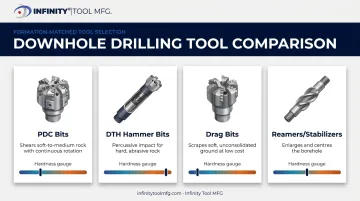
Downhole drilling tools generally split into three groups based on how they break rock: fixed-cutter bits that shear or scrape, percussive bits that hammer, and hole-conditioning tools that enlarge or stabilize.
PDC (Polycrystalline Diamond Compact) Bits
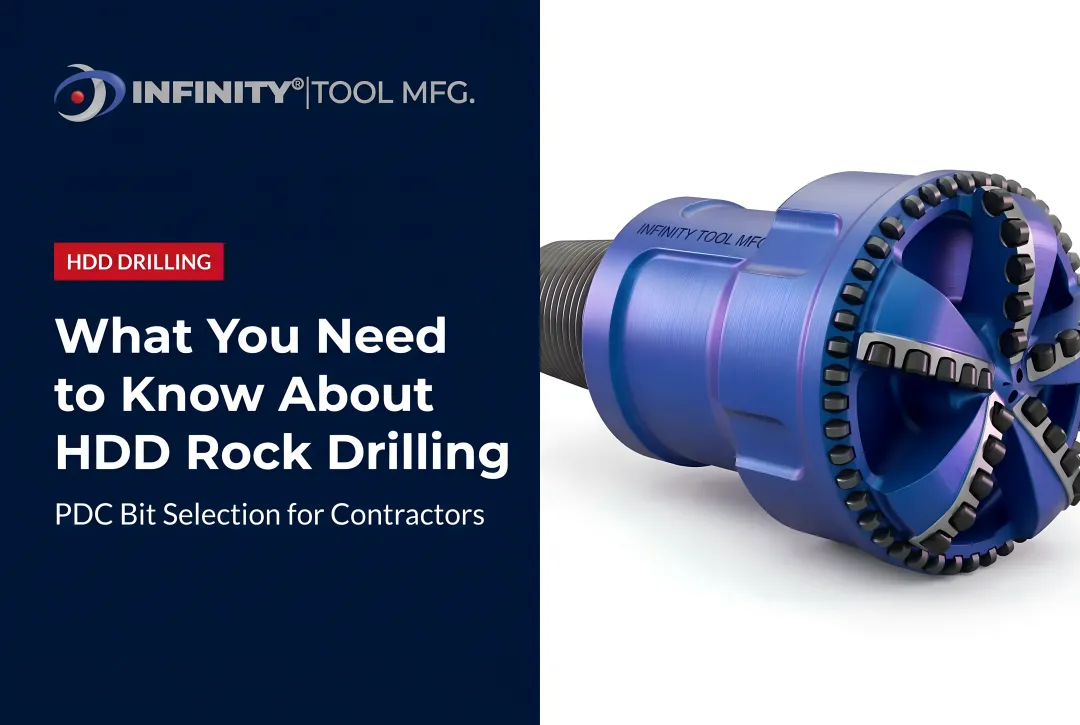
PDC bits use fixed synthetic-diamond cutters mounted on blades that rotate with the drill string, shearing rock away in a continuous motion rather than crushing it. This makes them well suited to soft-to-medium formations like shale, sandstone, and limestone.
Cutter geometry drives performance more than people expect. Research from the Society of Petroleum Engineers on PDC bit design shows that lower back rake increases aggressiveness and rate of penetration, while higher back rake reduces ROP but extends cutter life and lowers vibration. There's no single best setting, just a tradeoff every operator weighs against formation and priorities.
DTH (Down-The-Hole) Hammer Bits
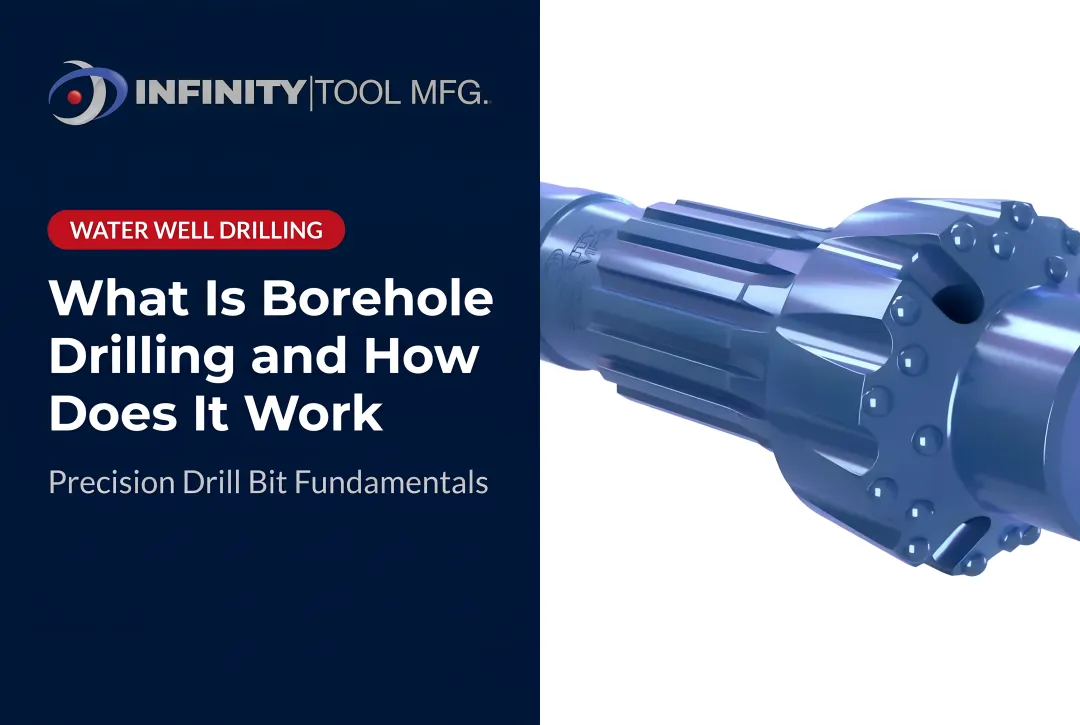
DTH bits work through direct percussion. A piston inside the hammer strikes the bit repeatedly, powered by compressed air that travels down through the drill pipe. The same air exhausts through the bit face to flush cuttings out of the hole.
This percussive action makes DTH tools the go-to choice for hard, fractured, or highly abrasive rock where a shearing PDC cutter would wear out fast. Diameter and depth capabilities vary by manufacturer and hammer class.
Infinity Tool MFG's DTH hammer bits run from 2 to 18 inches, a range that covers most water well, geothermal, and mining blast-hole applications.
Drag Bits
Drag bits are simple, fixed-blade tools without diamond cutters or moving parts. They scrape and cut rather than shear or hammer, which limits them to soft, unconsolidated ground.
Best suited for:
- Clay and shale formations
- Soft, unconsolidated sand
- Shallow water well projects
- Cost-sensitive HDD pilot bores
Their simple design keeps costs down, making them the practical choice when a PDC or DTH tool would be overkill.
Reamers and Stabilizers
Reamers enlarge or maintain a consistent hole diameter as the bore advances. Stabilizers keep the bottomhole assembly centered, preventing the wobble that leads to an out-of-round or crooked hole.
Infinity Tool MFG's PDC reamers use a taper-and-spiral geometry paired with a centralized build. That design reduces chatter and fluctuating torque during reaming, two problems that chip diamonds and shorten tool life fast.
The centralized build also helps the reamer cut a symmetrical hole rather than drifting off-center. Most jobs can ream from pilot bore through to finish size without a tool change mid-run.
Industries That Rely on Downhole Drilling Tools
Downhole tools aren't exclusive to oil rigs. Several industries depend on the same core categories, just tuned to different formations and hole geometries.
- Oil & gas – PDC and DTH tools reach production zones through everything from soft shale to hard carbonate. In the North Sea's Shearwater field, new PDC technology saved operators over $1 million per well across two 16-inch and 12.25-inch HPHT wells, according to an IADC/SPE technical paper.
- Geothermal drilling – Formations here run hotter and harder than typical oil & gas targets, pushing PDC cutter design toward greater heat and abrasion resistance.
- Water well drilling – DTH hammers and drag bits handle everything from soft overburden to hard bedrock, often on the same job.
- Construction and HDD – Reamers and stabilizers keep bore paths accurate for utility installation, where a few degrees of drift can miss the target entirely.
- Mining – DTH hammers dominate blast-hole and exploration drilling, where rock hardness swings from soft ore to dense hard rock within a single hole.
How to Choose the Right Downhole Drilling Tool
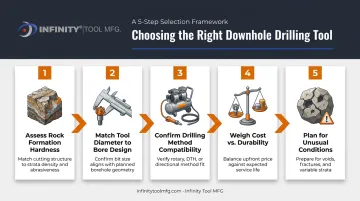
Picking the right tool comes down to a handful of decisions, in roughly this order.
- Start with rock formation hardness and composition. Soft, unconsolidated ground favors PDC bits or drag bits. Hard, abrasive, or fractured rock calls for DTH hammers. Mixed formations often need a hybrid approach.
- Match tool diameter to your bore design. A tool sized wrong for the hole, whether too small or too large for the rig's capabilities, creates problems no cutting structure can fix.
- Confirm drilling method compatibility. DTH hammers need a reliable compressed air supply; rotary PDC systems don't. Check your rig setup before committing to a tool type.
- Weigh cost against durability. A premium PDC cutter or carbide-grade DTH bit costs more upfront but often reduces trips and non-productive time over the life of the hole. That tradeoff usually favors quality when depth or formation difficulty increases.
- Plan for unusual conditions early. Cobble, boulders, and mixed formations chew through standard tools fast.
When standard tools aren't enough:
This is where in-house engineering matters. Infinity Tool MFG's engineering and drafting team designs tools like the Rock Boss Extreme and Cobble Boss Extreme specifically for challenging drilling conditions that off-the-shelf bits struggle to handle.
If your project runs through cobble, boulders, or unpredictable mixed ground, a custom-engineered solution often costs less over the project than repeatedly replacing standard tools that weren't built for it.
Maintenance Tips for Downhole Drilling Tools
Even the best-matched tool wears out faster than it should without basic maintenance discipline.
- Inspect between every run. Check for chipped diamonds, uneven cutter wear, and bit body damage before sending a tool back down the hole.
- Manage fluid or air pressure carefully. Insufficient flushing lets cuttings build up, generating heat and wear on both PDC drilling fluid and DTH compressed air systems.
- Store and handle tools properly. Rough handling during transport or downtime can damage precision cutting structures and threaded connections; clean, dry storage protects your investment.
A quick pre-run inspection takes minutes. Replacing a bit that failed early in the hole costs hours, sometimes days.
Frequently Asked Questions
What is a downhole?
"Downhole" refers to anything located or operating within the borehole, below the surface or wellhead. It's used across drilling, completion, and production contexts to describe equipment or conditions inside the hole itself.
What is down hole drilling?
Down-the-hole drilling is a method that mounts a percussive hammer or bit directly behind the cutting face, rather than relying only on surface-driven rotation. Compressed air powers the hammer and flushes cuttings out through the bit.
What is the difference between crosshole and downhole?
Downhole describes tool operation or measurement within a single borehole. Crosshole refers to methods, often seismic testing, that measure between two separate, adjacent boreholes.
What are the main types of downhole drilling tools?
The primary categories are PDC bits, DTH hammer bits, drag bits, and reamers/stabilizers. Infinity Tool MFG manufactures all four in-house, each suited to different rock formations, from soft clay to hard, fractured rock.
How do I know which drilling tool is right for my project?
Start with your rock formation type, then confirm hole diameter and depth requirements, and check that your rig supports the drilling method (rotary vs. percussive). These three factors narrow the choice quickly.
How long do downhole drilling tools typically last?
Lifespan depends heavily on formation hardness, abrasivity, and tool quality. Proper maintenance and choosing a tool matched to the formation, rather than a generic option, extends service life.