That choice affects rate of penetration, tool wear, unplanned downtime, and the total cost of a project. Get it wrong, and you're looking at snapped bits, blown budgets, and delays that ripple through the entire job schedule.
The stakes are real at scale, too. The global mining drill-bit market alone is valued at $1.98 billion in 2025, with projections reaching $3.03 billion by 2034, according to Fortune Business Insights. That growth reflects how much operators are investing in getting bit selection right.
Key Takeaways
- Percussive drilling excels in hard, abrasive rock and confined mining sites
- Rotary drilling suits softer formations, deep wells, and large-diameter boreholes
- Formation type drives cost, speed, precision, and water usage differences
- Transitional ground often needs hybrid or specialized drill bits
- Early manufacturer consultation avoids costly on-site trial-and-error
Percussive vs Rotary Drilling: Quick Comparison
| Factor | Percussive Drilling | Rotary Drilling |
|---|---|---|
| Cost | Lower equipment cost, simpler maintenance | Higher upfront investment, costlier fluid/mud systems |
| Mechanism | Hammering/impact action fractures rock | Continuous rotation shears or grinds material |
| Speed & Depth | Slower; best for shallow-to-medium hard rock | Faster; reaches greater depths efficiently |
| Precision | More vibration, rougher borehole walls | Smoother walls, cleaner core samples |
| Water/Fluid Use | Minimal; often air-driven | Requires significant drilling fluid or mud volume |
Neither method wins across the board. The right pick depends on what's underground, target depth, and which bit (DTH hammer for percussive, PDC for rotary) matches the job.
What Is Percussive Drilling?
Percussive drilling breaks rock by repeatedly hammering the bit against the formation rather than cutting it away. Each impact chips and crushes the material, while the bit indexes slightly with rotation to strike a new surface on the next blow.
This makes it a go-to method for hard rock mining, quarrying, and geothermal exploration where dense, abrasive formations would chew through a rotary bit's cutting edges in short order.
The operational payoff is straightforward:
- Faster penetration in abrasive hard rock compared to grinding through it
- Lower water consumption, since many percussive rigs run on compressed air
- Reduced fluid-handling costs, cutting out the mud systems rotary rigs often need
Percussive Drilling Subtypes
Three configurations dominate the percussive category:
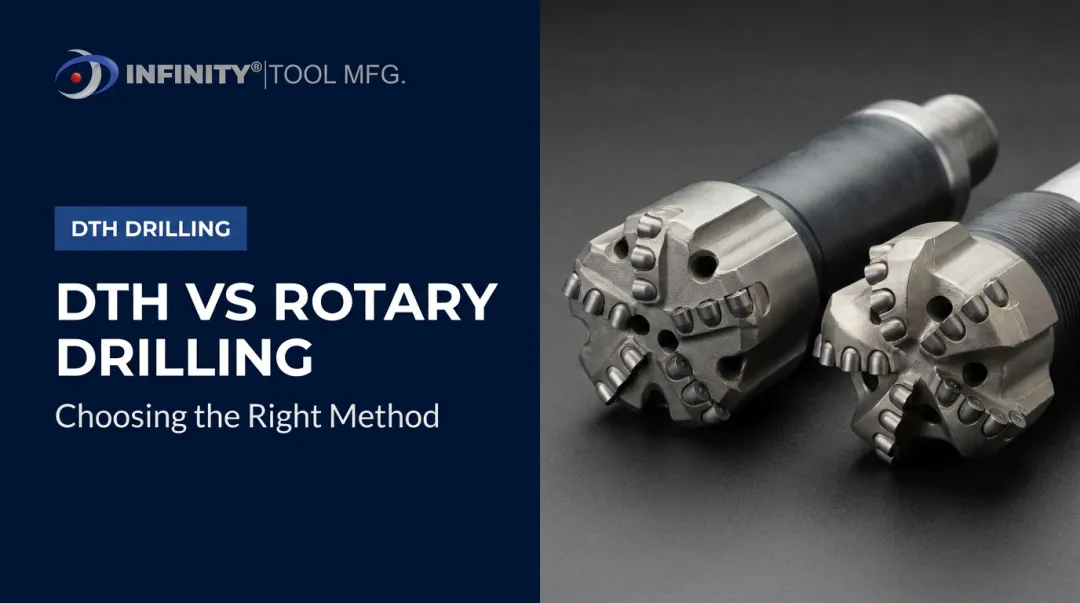
- Down-the-hole (DTH) hammers – the piston sits at the bit itself, striking directly at the bottom of the hole for strong energy transfer even at depth
- Top-hammer drilling – percussion is generated above ground and travels down the drill string as a stress wave, suited to shallower holes
- Reverse circulation (RC) drilling – cuttings return through a dual-wall pipe; RC frequently pairs with a DTH hammer in mineral exploration, though it can also run on rotary cutting
Infinity Tool MFG's DTH bit line is built for exactly these high-impact conditions, engineered to hold up through repeated stress cycles in hard, abrasive rock without premature button failure.
Where Percussive Drilling Fits
Percussive methods show up wherever dense rock and tight sites collide:
- Mineral exploration and blasting hole preparation in hard-rock mining
- Geothermal well development in competent, high-temperature rock
- Confined urban construction sites where a compact rig footprint matters
The hard-rock advantage isn't theoretical. A Sandia National Laboratories and Atlas Copco Secoroc test in Sierra White granite, rated at 24 ksi (roughly the strength of dense hard rock), recorded a DTH hammer exceeding 100 ft/hr. That compares to a 10-20 ft/hr benchmark for conventional roller-cone bits under similar conditions, according to Sandia's geothermal drilling research.
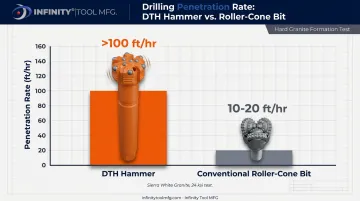
That was a controlled laboratory test rather than a field job, but it illustrates just how much impact energy can outpace grinding in truly hard rock.
What Is Rotary Drilling?
Rotary drilling cuts through formations with a continuously spinning bit, driven by a surface rig or downhole motor. Instead of hammering, the bit shears, grinds, or crushes material as it rotates, making it the standard approach across oil and gas, water well construction, and HDD work.
The core benefits line up differently than percussive methods:
- Faster penetration in soft-to-medium formations like shale, sandstone, and clay
- Larger diameter capability, useful for production wells and utility bores
- Smoother borehole walls, which reduce casing wear and improve hole stability
Rotary Drilling Subtypes
Rotary tooling splits into a few distinct families, each suited to a different rock profile:
- Auger drilling – best for loose soil and unconsolidated ground
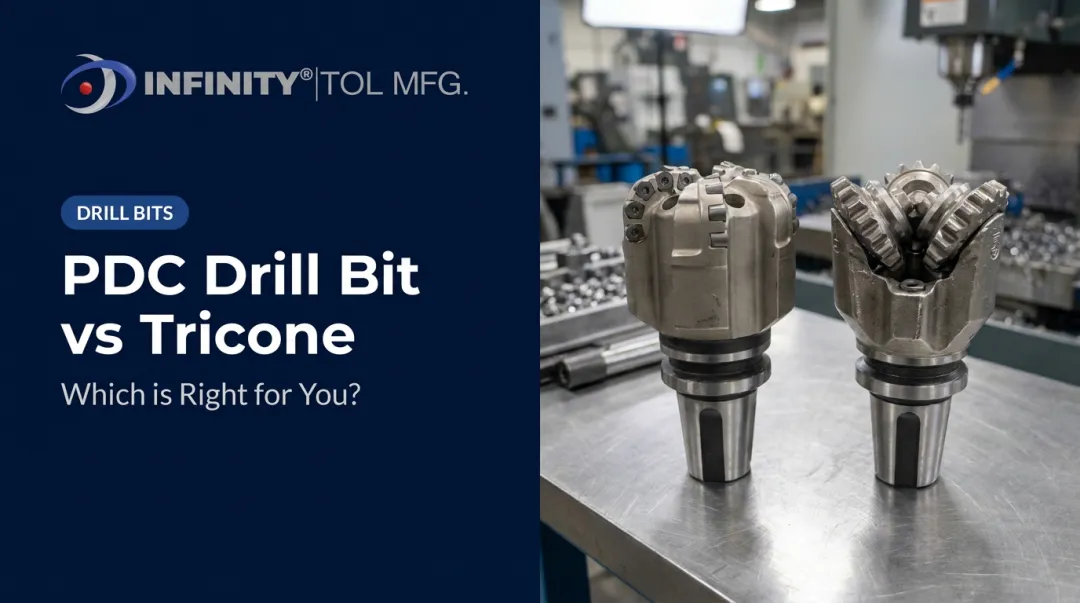
- Tricone/rock roller bits – rolling cones crush and grind, tolerating a wide hardness range
- Calyx drilling – used for larger-diameter shafts in moderately hard rock
- PDC/diamond drag bits – shear through softer-to-medium rock with a fixed cutting face, no moving parts to wear out
Infinity Tool MFG's PDC bits and PDC reamers, built with a spiral and taper design, are engineered to ream from pilot bore straight through to finish diameter in most holes. That design reduces chatter and fluctuating torque, and the company's testing has shown bores completed roughly 50% faster than with traditional reaming methods.
Where Rotary Drilling Fits
Rotary methods carry the load in these settings:
- Petroleum drilling and deep well construction
- HDD utility installation under roads, rivers, and rail lines
- Foundation piling and geological core sampling
The efficiency gap can be dramatic in the right formation. At Italy's Monterotondo geothermal field, a PDC bit reached up to 20 m/h in mica schist and granite, compared to a 3-4 m/h baseline from conventional roller-cone bits, per the World Geothermal Congress case study.
Later runs in tougher sections dropped back to around 3 m/h with vibration issues, a reminder that PDC performance still depends heavily on lithology and cutter survival.
Percussive vs Rotary: Which Technique Is Better?
There's no universal winner here. The right call depends on five factors working together:
- Formation hardness – hard, abrasive rock favors percussive impact; softer rock favors rotary cutting
- Target depth – deep wells generally favor rotary systems for sustained ROP
- Water availability – air-driven percussive rigs work well where water is scarce
- Budget – percussive equipment tends to cost less upfront; rotary fluid systems add expense
- Borehole precision – rotary methods deliver smoother walls and cleaner samples
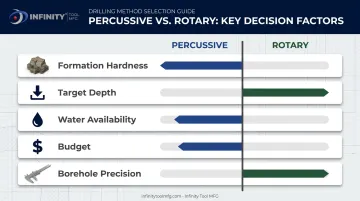
Choose percussive for hard, abrasive rock or confined-space sites. Choose rotary for softer formations, deep wells, or large-diameter bores where speed matters most.
When the Ground Doesn't Cooperate
Real job sites rarely offer a clean, single-formation profile. Cobble beds, boulder-laden ground, and interbedded transitions can defeat a bit optimized for just one breakage mode. A hammer built for hard rock can wear out its carbides within a matter of feet in cobble. A PDC bit designed to shear soft rock can chip apart against buried boulders.
This is exactly the gap Infinity Tool MFG built the Rock Boss Extreme and Cobble Boss Extreme to close. Both are purpose-engineered for mixed and transitional ground where standard percussive or rotary bits underperform, combining features from both breakage approaches into a single tool.
If your project spans formations that shift with depth, don't guess. Talk to Infinity Tool MFG's engineering team about a bit configuration matched to your actual ground conditions, not just the textbook average.
Conclusion
Neither percussive nor rotary drilling is inherently better. The right choice hinges on formation type, target depth, and what the project prioritizes most, whether that's raw speed, precision, or keeping costs down. Hard, abrasive rock rewards impact energy; softer or deeper formations reward continuous cutting.
For manufacturers and operators, success means matching the technique, and the bit, to the ground in front of them. Infinity Tool MFG builds PDC bits for rotary drilling and DTH hammer bits for percussive work, each engineered for its target formation. That alignment cuts downtime, lowers cost-per-foot, and stretches tool life beyond what a mismatched setup could deliver.
Frequently Asked Questions
What does percussion drilling in mining mean?
Percussion drilling uses repeated hammering or impact force to fracture hard rock, rather than cutting or grinding it away. It's the standard method for breaking through dense, abrasive rock in mining operations.
How does percussion drilling differ from reverse circulation (RC) and diamond drilling?
RC describes how cuttings return to the surface (through dual-wall pipe) and often pairs with a DTH percussive hammer in mineral exploration. Diamond drilling is a rotary method using diamond-embedded bits for precise core recovery.
Which is more cost-effective, percussive or rotary drilling?
Percussive equipment generally carries lower upfront and maintenance costs. Rotary drilling can be more cost-efficient per foot in soft formations, since faster penetration offsets the higher fluid system expense.
Can percussive and rotary drilling be combined on the same project?
Yes. Many rigs switch methods or bit types as formation hardness changes with depth, and hybrid bits combining shearing and crushing action are increasingly common in interbedded ground.
What is the difference between DTH and top-hammer percussive drilling?
DTH places the hammer directly at the bit, delivering strong energy transfer even in deep holes. Top-hammer drilling generates impact above ground and sends it down the drill string, better suited to shallower work.
How do I choose the right drill bit for my formation type?
Start by evaluating rock hardness, abrasiveness, and target hole depth. From there, work with a manufacturer like Infinity Tool MFG, whose in-house engineering team can design a bit matched to your exact conditions.